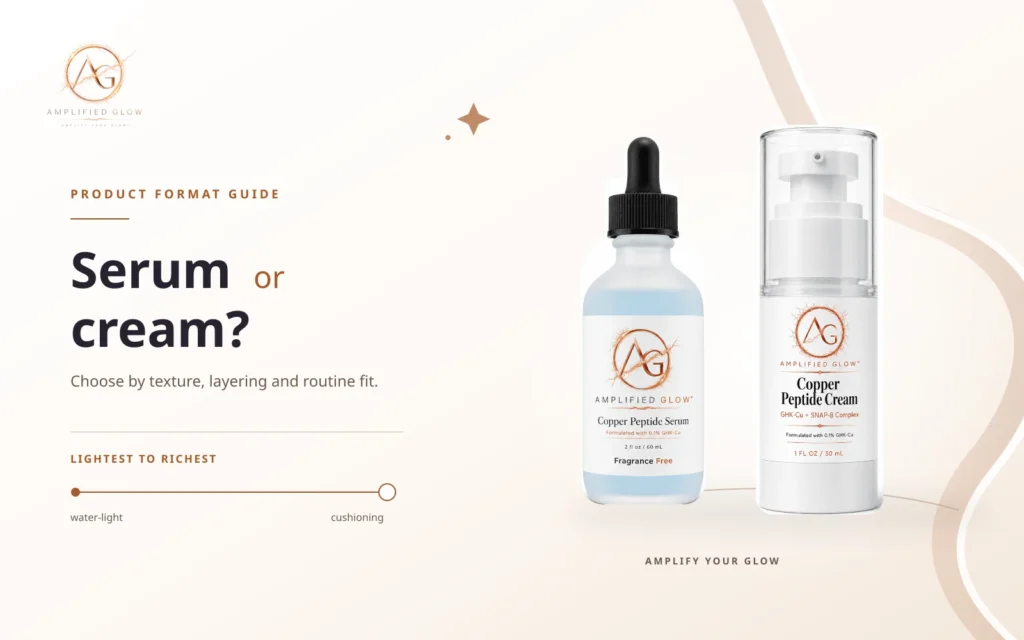
Choosing between a peptide serum and a peptide cream isn't a question of which one is stronger, even though that's how the decision often gets framed online. A peptide serum is usually the lighter, leave-on step applied before moisturizer. A peptide cream is usually an emulsion that combines peptide ingredients with moisturizing ingredients, used later in the routine. Neither format is automatically more effective — "serum" and "cream" describe how a product is built and where it sits in your routine, not a guaranteed strength level. Choose based on the full ingredient list, directions, your skin type, and whether you want a lightweight layering step or more moisture in one product. For the underlying ingredient science, see the complete guide to copper peptides in skincare.
Peptide serum vs peptide cream at a glance
| Decision factor | Peptide serum | Peptide cream |
|---|---|---|
| Typical texture | Lightweight fluid or gel | Lotion-to-rich emulsion |
| Routine position | After cleansing, before cream | Moisturizer step, or after serum |
| Main format advantage | Easy layering | Added emollience and moisture support |
| Better fit when | You want a light, targeted step | You want peptide ingredients built into your moisturizer |
| Does format prove concentration? | No | No |
| Can both be used? | Potentially | Potentially — check for redundancy and tolerance |
There's no universal winner in this table. A thin, fast-absorbing texture doesn't mean a serum has more active ingredient than a cream, and a rich texture doesn't mean a cream is doing less work — it means the two are built for different jobs in a routine.
What actually changes between a serum and a cream?
Vehicle and texture
A serum is typically a lightweight, water- or gel-based "vehicle" — the base that carries the active ingredients. A cream is typically an emulsion, meaning it blends a water phase with an oil phase into a thicker, more cushioned texture. This difference is real and meaningful for how a product feels and layers: a serum tends to absorb quickly and leave little residue, while a cream tends to sit on the skin longer and provide a more noticeable moisture barrier. Both are legitimate ways to deliver the same underlying ingredient — the texture difference is about sensory experience and layering, not a potency ranking.
Supporting ingredients
Serums often lean on humectants (ingredients that attract water, like sodium hyaluronate) and lighter solvents to keep the texture thin. Creams often combine water with oils, fatty alcohols, or richer emollients such as shea butter or jojoba oil to create a more cushioned feel. Note the word "often" here — these are common patterns, not fixed rules, and individual formulas vary. Some serums include oils for a slightly richer feel, and some creams are formulated to be surprisingly lightweight, so the category name is a starting expectation rather than a guarantee.
What format cannot tell you
The word on the front label — "serum" or "cream" — cannot confirm which peptide is used, at what percentage, how stable the formula is, how well it's delivered into skin, or how the finished product actually performs. Two products both labeled "serum" can use entirely different peptides at entirely different concentrations, with entirely different supporting ingredients. The complete INCI ingredient list and the product's own directions matter far more than the format name for understanding what you're actually buying.
When a peptide serum may fit better
A serum can be the more natural choice if:
- You want a lightweight daytime step, or you're building a layered routine with several products.
- Your skin is oily or combination and prefers lighter textures.
- You already have a moisturizer you like and just want to add a targeted peptide step before it.
- You want to apply a product to clean skin before your regular moisturizer, rather than replacing it.
One qualification: skin type alone doesn't determine tolerance. A "lightweight" serum can still contain fragrance, botanical extracts, or other ingredients some people react to, so the complete formula matters as much as the general texture.
When a peptide cream may fit better
A cream can be the more natural choice if:
- Your skin feels dry, or you generally prefer more noticeable moisturization.
- You want a simplified routine where the peptide ingredient is already built into your moisturizing step, rather than adding an extra layer.
- You're building a night routine, or you're in a colder or drier environment where a richer texture feels more comfortable.
The same qualification applies in reverse here: a cream is not automatically more effective, and it isn't automatically the safer or better choice for sensitive skin. Richer formulas can include their own set of fragrances, oils, or botanicals that some people don't tolerate well.
Can you use peptide serum and peptide cream together?
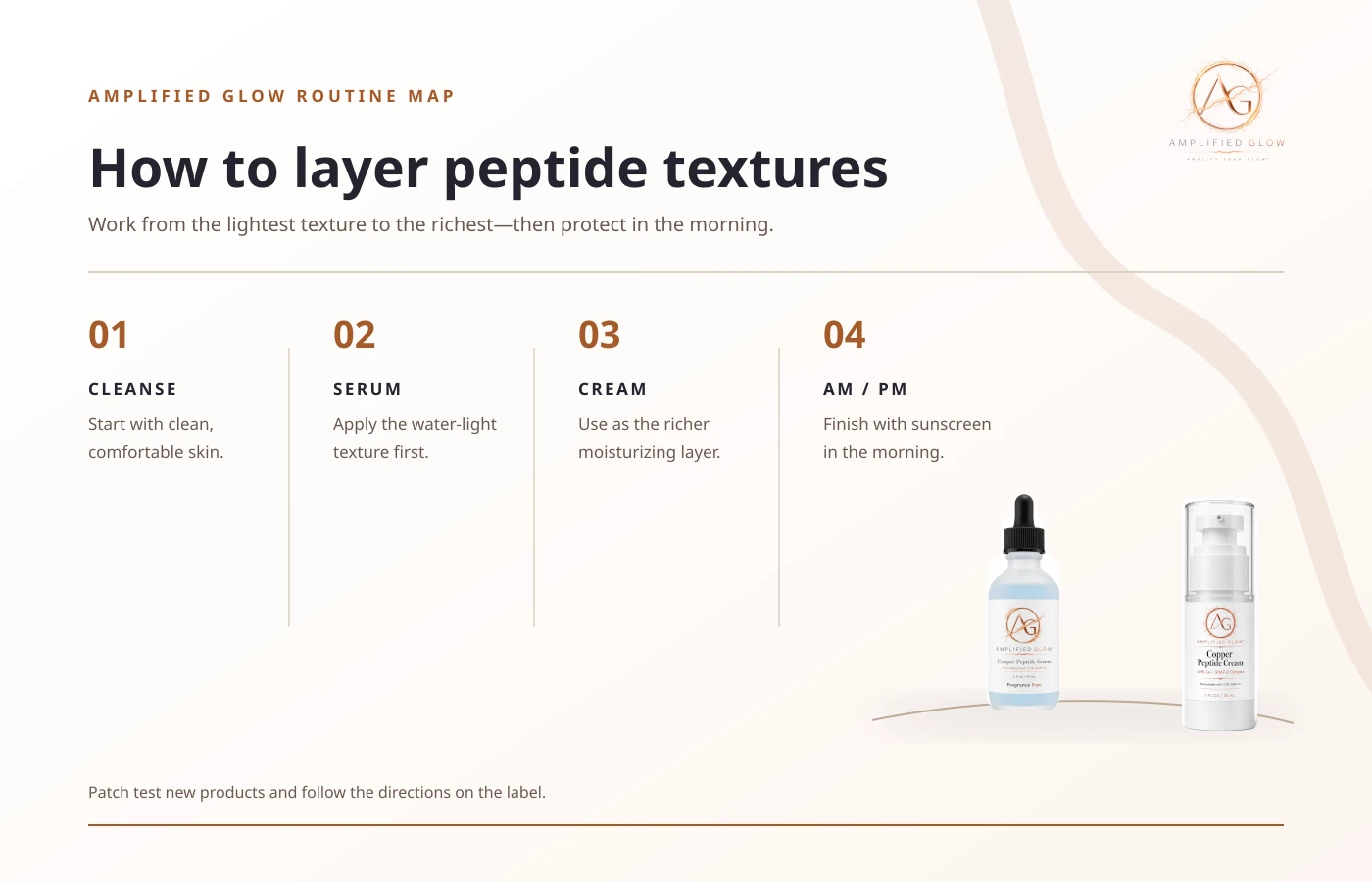
Yes, if both products' directions allow it and the combination feels comfortable on your skin — but using two peptide products isn't automatically necessary, and it can be redundant if they're built around the same ingredient.
A simple sequence for combining them:
- Gentle cleanser.
- Peptide serum, applied to clean skin according to its label.
- Peptide cream or your regular moisturizer.
- Broad-spectrum sunscreen as the final daytime step.
Follow the directions for both products rather than imposing a fixed waiting time between serum and cream. If both products contain overlapping peptide systems, it's reasonable to introduce them one at a time so you can evaluate comfort and avoid paying for two products doing a very similar job without a clear reason. If you already own a moisturizer you're happy with, layering a peptide serum underneath it can be a simpler way to add a peptide step than switching to a dedicated peptide cream as well.
Which format fits your skin and routine?
- Want the lightest routine: a peptide serum plus an existing lightweight moisturizer.
- Want fewer steps: a peptide cream used as the moisturizer step on its own.
- Dry or comfort-seeking skin: a cream may be the more natural starting format.
- Oily or combination skin: a lightweight serum, or a gel-cream, may feel easier — but check the full formula rather than assuming based on category.
- Sensitive or reactive skin: choose the simplest formula you tolerate, patch-test first, and introduce one new product at a time.
- Already using several active ingredients: don't add both a peptide serum and a peptide cream just because both mention peptides — pick the one that fills an actual gap in your routine.
How to compare peptide products without falling for format claims
- The exact peptide or INCI name is disclosed on the label or product page.
- A full ingredient list and clear directions are available.
- Claims stay cosmetic and appearance-focused, not medical.
- The texture fits comfortably into the rest of your routine.
- Fragrance and any known sensitivities are accounted for.
- Packaging and storage directions are clear.
- Product-specific testing is distinguished from general ingredient research.
- No claim that a serum "reaches the dermis" or works deeper simply because it feels thin — texture alone doesn't establish depth of delivery.
Amplified Glow peptide serum and cream compared
The Copper Peptide Renewal Serum is a fragrance-free 2 fl oz / 60 mL serum listing 0.1% GHK-Cu, dual hyaluronic acid (sodium hyaluronate and hydrolyzed hyaluronic acid), Palmitoyl Tripeptide-1, jojoba oil, and green tea extract. Its directions call for a small amount on clean face and neck twice daily, followed by moisturizer if desired.
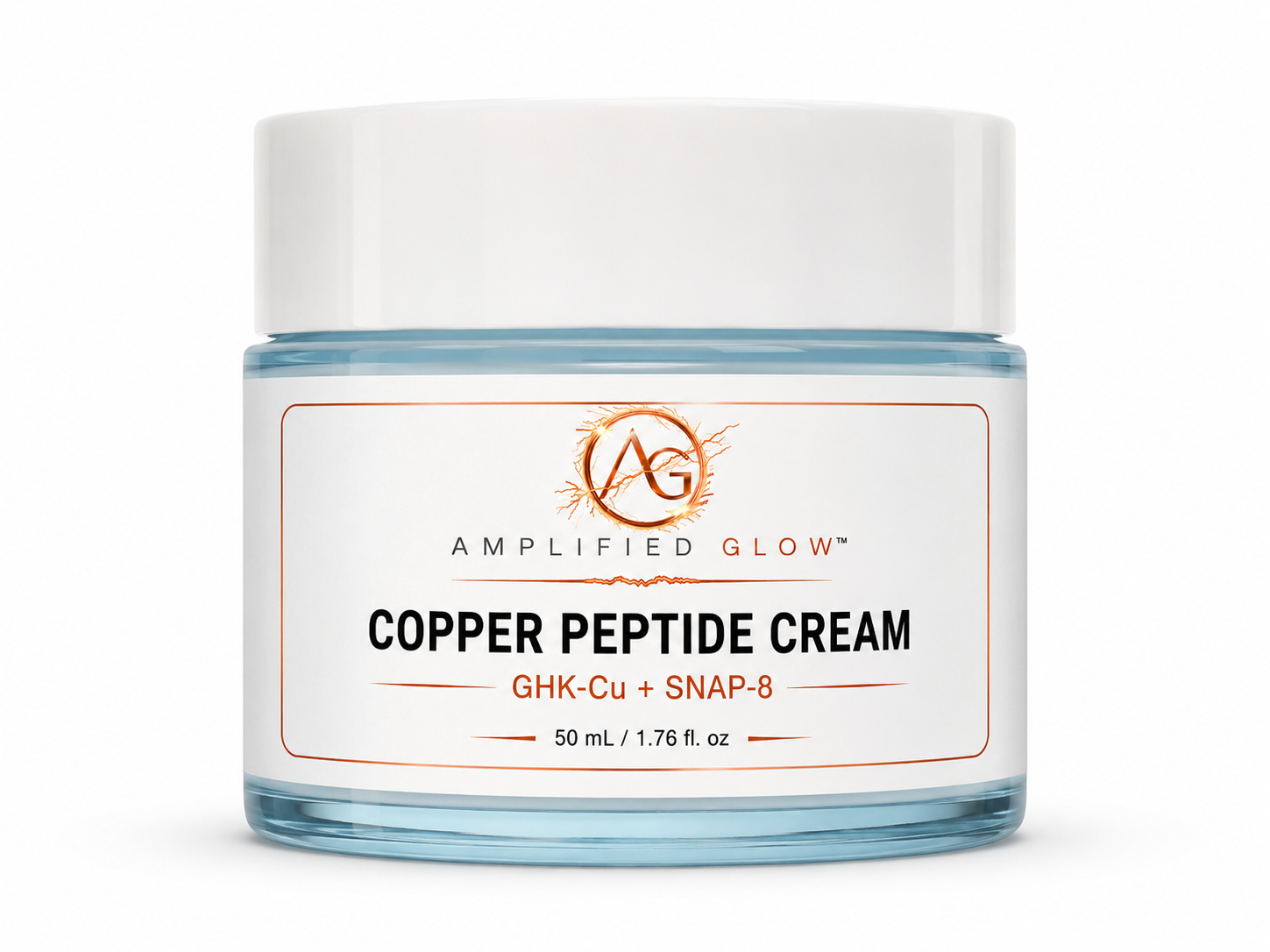
The Copper Peptide Renewal Cream is a 1 fl oz / 30 mL cream formulated with 0.1% GHK-Cu, SNAP-8, hyaluronic acid, shea butter, jojoba oil, pomegranate seed oil, panthenol, and aloe vera, with directions that allow use on its own or layered after the serum.
Neither product is presented here as the "better" option — the useful choice is based on texture and routine role, not a strength claim. Current pricing, stock status, ingredient lists and directions are available on the linked product pages.
To see the full range side by side, compare face serum formulas or copper peptide face creams directly.
Common myths
Myth: Serum always penetrates deeper.
Correction: Delivery depends on the specific molecule and the complete formulation, not on texture alone. A thin feel is not proof of deeper penetration.
Myth: Cream dilutes the peptide.
Correction: A cream can be the intended, finished vehicle for that ingredient — performance is formulation-specific, not a simple function of thickness.
Myth: More peptide products are always better.
Correction: Redundant layers add cost and can make it harder to tell which product is responsible for a result, or for any irritation.
Myth: Peptide cream automatically replaces sunscreen.
Correction: It does not, unless the product is a regulated sunscreen with a labeled SPF. Amplified Glow's peptide creams are not presented as sunscreen.
Frequently asked questions
Is peptide serum better than peptide cream?
Neither is universally better. A serum suits a lightweight, layered routine; a cream suits someone who wants moisture and peptides in one step. The right choice depends on your skin, routine, and the specific product's full formula.
Which goes first, peptide serum or cream?
Serum typically goes on clean skin first, as a common layering order, followed by a cream or moisturizer. Always defer to the specific product's own directions if they differ.
Can peptide cream replace moisturizer?
Often, yes — many peptide creams are formulated to function as the moisturizing step. Check the product's directions to confirm it's intended that way.
Can I use peptide serum and cream together every day?
Potentially, if both products' directions support daily use and your skin tolerates the combination well. Introduce new products gradually and watch for irritation.
Which format is better for dry skin?
A cream's typically richer texture is often the more comfortable starting point for dry skin, though the complete ingredient list matters more than the category alone.
Which format is better for oily skin?
A lighter serum, or a gel-based cream, is often preferred for oily or combination skin, but individual tolerance and the full formula still matter more than the label.
Is a serum more concentrated than a cream?
Not necessarily. The word "serum" doesn't disclose a percentage or guarantee a higher concentration of any ingredient — only the label's stated concentration (when disclosed) or the manufacturer can confirm that.
How should a beginner introduce peptides?
Start with one product, patch-test it, and use it consistently for a few weeks before adding a second peptide product. This makes it easier to judge how your skin responds to each step.
Conclusion
Format helps determine how a peptide product fits your routine — not how potent it is. A serum suits a lightweight, layerable step; a cream suits a richer, simplified moisturizing step; and using both only makes sense if they're each filling a distinct need. Start with one well-chosen product, and add a second only if it addresses something the first doesn't.
Compare the fragrance-free Copper Peptide Renewal Serum with the richer Copper Peptide Renewal Cream directly on their product pages, or read the GHK-Cu vs SNAP-8 guide next to understand the individual peptides used across both formats.
References
This comparison is a format and routine guide rather than an ingredient-evidence review; for the underlying research on GHK-Cu, see the References section of the complete guide to copper peptides in skincare.