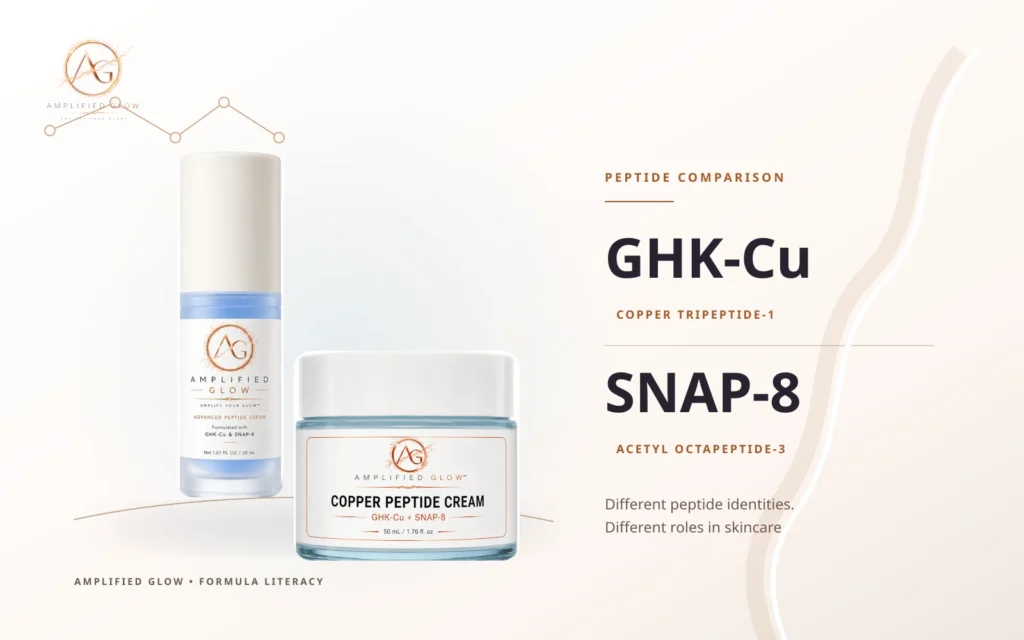
GHK-Cu and SNAP-8 are different cosmetic peptides. GHK-Cu is a copper-bound tripeptide studied mainly in skin-repair and matrix-related research, while SNAP-8 is a synthetic octapeptide marketed for the appearance of expression lines. Neither is topical Botox, and the evidence behind ordinary retail formulas containing either one is limited and formula-specific. A finished product may reasonably contain both — but online comparisons often blur their names and evidence levels together, so this guide covers each one separately, on topical cosmetic products only.
GHK-Cu vs SNAP-8 at a glance
| Attribute | GHK-Cu | SNAP-8 |
|---|---|---|
| Peptide identity | Copper-bound tripeptide | Synthetic octapeptide |
| Common cosmetic label name | Copper Tripeptide-1 | Acetyl Octapeptide-3 |
| Common formula story | Hydration, smoother-looking texture, radiance | Appearance of expression lines, smoother-looking skin |
| Evidence picture | Substantial mechanistic interest; limited finished-formula clinical evidence | Mostly supplier or multi-ingredient evidence; limited independent peptide-specific trials |
| Equivalent to an injection? | No | No |
| Can the two appear together in one product? | Yes, in a formulated cosmetic | Yes, in a formulated cosmetic |
The two peptides do not perform one interchangeable "anti-aging" job. They target different cosmetic goals and rest on different (and both fairly limited) bodies of evidence.
What is GHK-Cu?
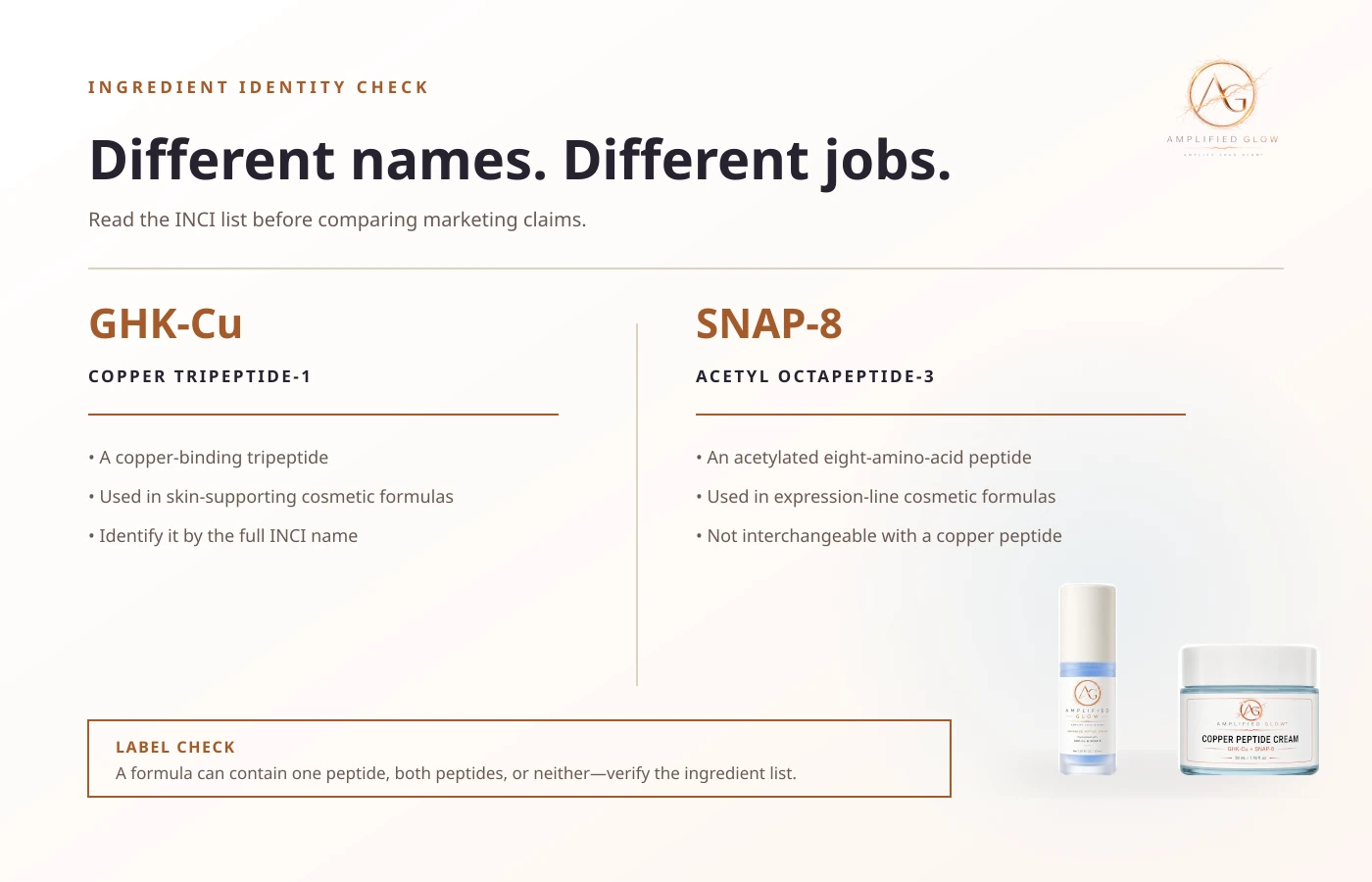
GHK-Cu (glycyl-L-histidyl-L-lysine bound to a copper ion) is commonly listed on ingredient labels under its INCI name, Copper Tripeptide-1. It's one of the more extensively discussed peptides in cosmetic science, with a long history of mechanistic and cell-based research into skin repair and matrix-related processes.
That research interest, however, hasn't translated into a large body of finished-product clinical testing. A 2024/2025 review of topically applied GHK noted that although GHK-Cu and its palmitoylated relative Pal-GHK are widely used in anti-wrinkle products, there is a "surprising absence" of clinical studies actually using them, and flagged skin permeability as an open formulation challenge.[1] The most directly relevant human topical study is a small randomized, double-blind trial of a GHK-Cu regimen used after CO2 laser resurfacing: 13 patients completed it, and while patient satisfaction was significantly higher with the GHK-Cu regimen, computer analysis and blinded evaluators found no statistically significant difference in erythema resolution, and no significant objective improvement in wrinkles or overall skin quality.[2]
That combination — real mechanistic interest, but limited and mixed clinical results — is the honest evidence picture for GHK-Cu. It's a genuinely different picture from an ingredient with no research behind it at all, but it's also a long way from "clinically proven" for any specific finished serum or cream. This guide does not recommend using a GHK-Cu product after a professional procedure; the cited study describes a specific post-laser research context, not a general skincare recommendation.
What is SNAP-8?
SNAP-8 is the trade name most commonly associated with the INCI ingredient Acetyl Octapeptide-3, a synthetic peptide designed around a fragment of research into expression-line signaling. It's marketed for helping soften the visible appearance of expression lines and support smoother-looking skin.
Here's where evidence-quality questions become important. Many of the specific wrinkle-reduction figures attached to SNAP-8 in marketing material trace back to supplier documentation and small formula studies, rather than large, independent trials of SNAP-8 as a standalone ingredient. Multi-ingredient serum studies — the kind that test a proprietary blend of "neuropeptides, proteins, amino acids, and marine extracts" together — are sometimes cited in SNAP-8 marketing, but this type of study cannot isolate what SNAP-8 itself contributed versus every other ingredient in the blend.[3] Similarly, microneedle-patch research that includes an octapeptide alongside several other active ingredients in a dissolving patch delivery system is a different evidence category altogether — it says nothing about how the same ingredient performs in a standard leave-on serum or cream, since the delivery method itself is the variable being studied.[4] Neither format of study should be read as proof for an ordinary topical SNAP-8 product.
SNAP-8 is not Argireline
These two names are frequently used interchangeably online, but they refer to different INCI ingredients:
- SNAP-8: Acetyl Octapeptide-3 — an eight-amino-acid peptide.
- Argireline: commonly Acetyl Hexapeptide-8, a six-amino-acid peptide; some older literature and marketing material uses the name Acetyl Hexapeptide-3 for this same peptide family, which adds to the confusion.
- SNAP-8 was developed as a related, extended version of the Argireline concept, but the two are related cosmetic peptide ideas, not the same INCI ingredient.
This page treats all three labels — SNAP-8, Argireline, and the ingredient names behind them — as distinct terms rather than synonyms, because collapsing them into "basically the same thing" is exactly the kind of mixing this guide is trying to correct.
How their proposed cosmetic roles differ
- GHK-Cu: commonly positioned around a hydrated feel, smoother-looking texture, radiance, and a softer appearance of fine lines.
- SNAP-8: commonly positioned specifically around the visible appearance of expression lines (the lines that form from repeated facial movement, like forehead lines or crow's feet).
- Shared ground: both peptides are often included in hydrating leave-on formulas alongside ingredients like sodium hyaluronate and emollients, so some of the softness or smoothness a user notices can come from the surrounding formula rather than either peptide specifically.
- Limit: a "hero" ingredient on a product label cannot be separated from the rest of the formula without testing that finished product directly — the peptide name alone doesn't tell you how much of any visible effect it's responsible for.
In practice, this means a product built around GHK-Cu and one built around SNAP-8 are usually trying to solve different problems for the person using them, even if both end up described as "anti-aging" in marketing copy. Someone mainly bothered by dry, dull-looking skin and someone mainly bothered by forehead lines from repeated expressions are, in principle, better served by different formula stories — even though many finished products blend several peptides together rather than isolating one per product.
Which peptide has better evidence?
| Evidence question | GHK-Cu | SNAP-8 |
|---|---|---|
| Mechanistic/cell-based literature | Substantial research interest | Plausible design concept, built on related peptide literature |
| Independent human evidence for ordinary cosmetic use | Limited | Limited |
| Finished Amplified Glow product testing | None available in this brief's source pack | None available in this brief's source pack |
| Fair conclusion | Evidence-aware cosmetic positioning only | Evidence-aware cosmetic positioning only |
The honest answer is that the evidence available is insufficient to compare the two peptides head-to-head in a meaningful way — not that one clearly "wins." Treat any claim that ranks them with a specific score or percentage as unsubstantiated unless it names the exact study and finished product being compared.
Can GHK-Cu and SNAP-8 be used together?
Yes — a professionally formulated cosmetic serum or cream may reasonably contain both peptides. That co-presence is a formulation decision, not proof of synergy between the two ingredients; no study in this guide's source pack tested GHK-Cu and SNAP-8 together as a specific combination.
This guide does not advise mixing raw peptide powders, research-grade vials, or separate products together in the palm of your hand. Layering a finished serum under a finished moisturizer is a routine decision, made by following each product's own directions — it is not the same thing as combining raw ingredients yourself. As with any new product, introduce it gradually and watch how your skin responds.
How to read a peptide product label
- Find the exact INCI name, not just the trade name printed on the front of the package.
- Separate trade names (like SNAP-8 or Argireline) from the actual INCI ingredient name they refer to.
- Confirm whether the product is a serum, cream, or another delivery system (like a patch), since the format changes what evidence is even relevant.
- Look for complete directions, warnings, and the supporting hydrators used alongside the peptide.
- Reject language like "Botox alternative," guaranteed wrinkle removal, or claims that a cosmetic changes muscle function.
- Remember that ingredient list order alone doesn't reveal an exact percentage once an ingredient falls below the regulatory disclosure threshold, unless the brand voluntarily states the concentration.
How Amplified Glow combines these peptide concepts
The GHK-Cu + SNAP-8 Peptide Renewal Serum is a fragrance-free 1 fl oz / 30 mL formula. Its product page states 0.15% GHK-Cu alongside SNAP-8, sodium hyaluronate, and a botanical extract blend, with directions calling for 2–3 drops on clean skin, morning or evening, followed by moisturizer and daytime sunscreen.
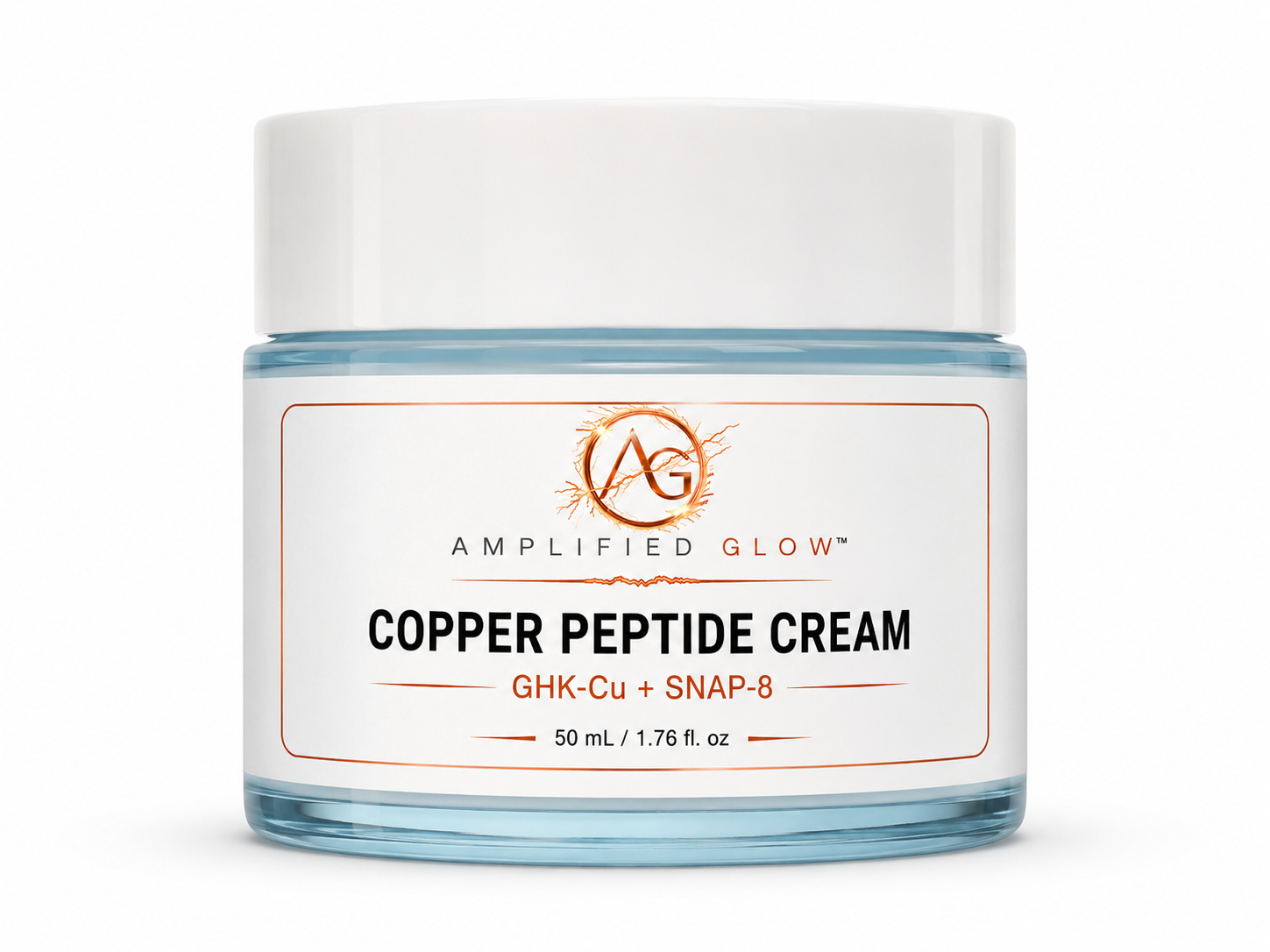
A second option is the GHK-Cu + SNAP-8 Copper Peptide Cream. Compare its complete ingredient list and current directions with the serum before choosing your product format.
For a wider comparison of finished formulas, explore the face serum collection and face cream collection.
The serum's current product page lists SNAP-8 and Acetyl Hexapeptide-3 separately. This comparison therefore treats SNAP-8 by its standard INCI identity, Acetyl Octapeptide-3, without assuming that the separately listed hexapeptide is the same ingredient.
Common myths
Myth: GHK-Cu and SNAP-8 are the same peptide.
Correction: They differ in amino acid sequence, copper binding, and cosmetic positioning. One is a copper-bound tripeptide; the other is a synthetic octapeptide unrelated to copper.
Myth: SNAP-8 is topical Botox.
Correction: It's a cosmetic peptide ingredient, not equivalent to an injected prescription neuromodulator. Treat "Botox in a bottle" language as marketing, not a chemical or clinical fact.
Myth: A combined formula proves synergy.
Correction: Including both peptides in one product is a formulation choice. It doesn't, by itself, demonstrate that the two work better together than either does alone.
Myth: All copper-peptide research proves retail anti-wrinkle results.
Correction: Evidence type and the specific finished formula tested both matter. A cell-based or small post-procedure study is not the same claim as a retail product guarantee.
Frequently asked questions
Is SNAP-8 a copper peptide?
No. SNAP-8 (Acetyl Octapeptide-3) doesn't contain or rely on copper binding — that's a defining feature of GHK-Cu, not SNAP-8.
Is SNAP-8 the same as Argireline?
No. SNAP-8 is a related, extended version of the Argireline concept, but they are different INCI ingredients (Acetyl Octapeptide-3 versus commonly Acetyl Hexapeptide-8).
Is Copper Tripeptide-1 the same as GHK-Cu?
Yes. Copper Tripeptide-1 is the INCI (ingredient label) name most commonly used for GHK-Cu.
Can GHK-Cu and SNAP-8 be used together?
Yes, in a professionally formulated finished product. Co-formulation is a normal cosmetic practice — just don't read it as proof the two ingredients work synergistically.
Which peptide is better for expression-line appearance?
SNAP-8 is more specifically positioned around expression lines in its formula story, while GHK-Cu's formula story leans toward hydration and texture. Neither has strong independent evidence proving superiority for this specific goal.
Does either peptide replace retinoids or sunscreen?
No. Both are used as complementary steps in a routine. Sunscreen remains a separate, necessary daytime step regardless of which peptide serum or cream you use.
Can beginners use a formula containing both?
Yes, with the same caution as introducing any new active: patch-test first and watch for irritation over the first couple of weeks of use.
How long should users wait before judging a cosmetic product?
There's no universal week count that applies to every product. Results depend on the specific formula, your skin's baseline, how consistently you use it, and which outcome you're evaluating — expect this to vary from person to person.
Conclusion
GHK-Cu and SNAP-8 are related in that both are cosmetic peptides sometimes discussed together, but they differ in identity, formula story, and the specific (limited) evidence behind each. Reading past the trade name to the actual INCI ingredient — and staying skeptical of "Botox in a bottle" language wherever you encounter it — is the most useful habit for evaluating any peptide product, on this site or elsewhere.
For the broader ingredient background, see the complete guide to copper peptides in skincare, and for a format-focused comparison, see peptide serum vs peptide cream.
References
- Mortazavi SM, Mohammadi Vadoud SA, Moghimi HR. Topically Applied GHK as an Anti-Wrinkle Peptide: Advantages, Problems and Prospective. BioImpacts. 2025;15:30071. PubMed
- Miller TR, Wagner JD, Baack BR, Eisbach KJ. Effects of Topical Copper Tripeptide Complex on CO2 Laser–Resurfaced Skin. Archives of Facial Plastic Surgery. 2006;8(4):252–259. PubMed
- Moy M, Diaz I, Lesniak E, Giancola G. Peptide-Pro Complex Serum: Investigating Effects on Aged Skin. Journal of Cosmetic Dermatology. 2023;22(1):267–274. PubMed
- Clinical Safety and Efficacy Evaluation of a Dissolving Microneedle Patch. PubMed — a delivery-patch study containing Acetyl Octapeptide-3 with other actives; not evidence for a conventional serum or cream.