Skip to content
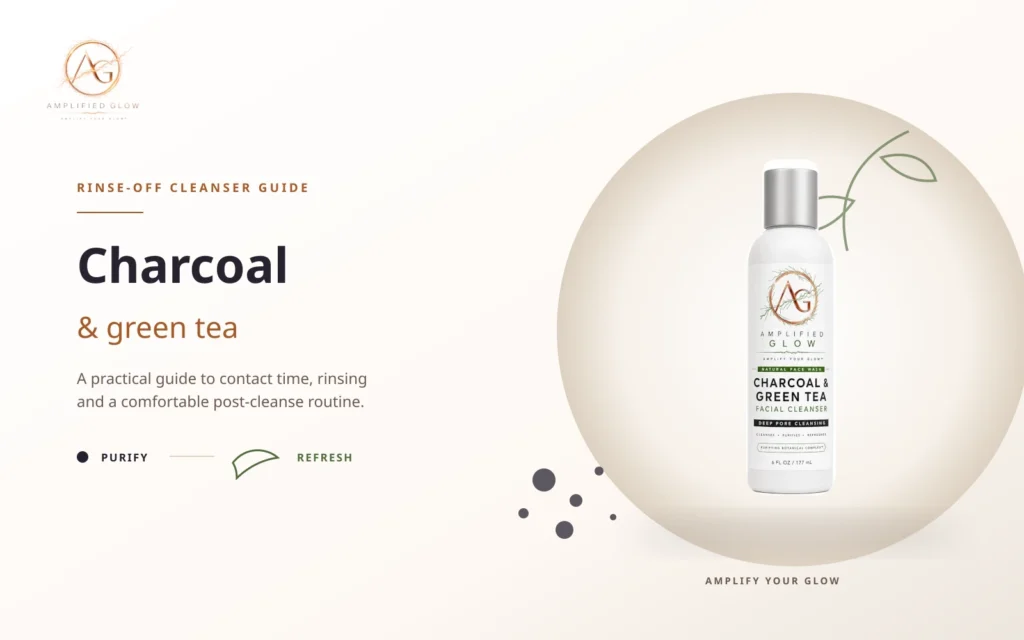
A charcoal and green tea facial cleanser is, at its core, a rinse-off cleansing product. It may help remove daily buildup and excess surface oil, while green tea and supporting hydrators contribute to the formula's feel and story. Activated charcoal should not be described as detoxing skin or treating acne, and research on leave-on green tea preparations does not prove the same results from a wash-off cleanser. This guide separates realistic cleanser performance from ingredient hype — it is not an acne-treatment guide.
What is a charcoal and green tea cleanser?
A facial cleanser's core job is cleansing: removing surface oil, sunscreen, makeup, dirt, and the buildup that accumulates over a day, using surfactants (the cleansing ingredients that lift away oil and debris so it can rinse off with water).
Activated charcoal is carbon that's been processed (often from sources like bamboo, coconut shell, or wood) to become highly porous, giving it a large surface area with adsorbent properties — meaning things can stick to its surface. That adsorbent quality is the whole basis for charcoal's inclusion in cleansers; it's the same general property that makes charcoal useful in some medical and water-filtration contexts, though a cosmetic cleanser is a very different application from either of those. Green tea extract comes from the Camellia sinensis plant and contributes antioxidant compounds to a formula, alongside whatever scent and sensory qualities the brand builds around it.
The important point for a rinse-off product: the complete formula — the surfactant system, supporting hydrators, and how the whole thing is balanced — controls how a cleanser actually cleanses, feels, and is tolerated, not the two headline ingredients alone. Charcoal and green tea contribute to the story and experience of the product, but they don't override how the base cleansing system behaves on your skin. Two cleansers can both list "activated charcoal" and still feel completely different to use, because the surfactant blend underneath it is doing most of the actual work.
What activated charcoal can and cannot do
| Reasonable cosmetic statement | Unsupported or misleading statement |
|---|---|
| Included in a cleanser intended to help remove surface oil and buildup | Pulls toxins from the skin |
| May contribute to the product's purifying feel and experience | Treats or cures acne |
| Commonly used in cleansers and soaps | Permanently shrinks pores |
| Generally used safely in cosmetics | Clinically proven to exfoliate skin or reverse aging |
A 2020 dermatology review of activated charcoal's cosmetic uses concluded that although there are no reported negative skin effects from charcoal, there are equally few reports supporting its exfoliative or anti-aging abilities — despite the wide range of products marketed with those claims.[1] In plain terms: charcoal is generally considered safe to use on skin, but the clinical evidence doesn't back up the more dramatic claims attached to it in marketing.
What green tea adds to the formula story
Green tea (Camellia sinensis) contains catechins, including EGCG (epigallocatechin gallate), which are antioxidant compounds studied for various roles in skin. A systematic review and meta-analysis of randomized trials found that topical green tea extract significantly reduced inflammatory acne lesion counts compared with control, while oral green tea intake showed only a minimal effect.[2]
Here's the important qualifier for this specific cleanser: that research (and similar small studies looking at green tea's effect on skin sebum) generally tested leave-on lotions, emulsions, or other therapeutic preparations applied and left on the skin — not a rinse-off facial cleanser washed away within a minute of contact.[3] A leave-on treatment and a rinse-off cleanser have very different contact time with the skin, so this research should be treated as useful background on green tea as an ingredient family, not as proof that Amplified Glow's rinse-off cleanser will reduce acne or control sebum the way a leave-on product might.
Who may prefer this kind of cleanser?
- Normal, combination, oily, or buildup-prone skin may enjoy the cleansing profile and feel of a charcoal-based formula, particularly if you like a cleanser that feels thorough without being harsh.
- Dry or sensitive skin should pay close attention to how the skin feels after washing and adjust frequency if it feels tight or stripped — a charcoal cleanser isn't automatically off-limits, but comfort should guide how often you use it.
- Fragrance- or essential-oil-sensitive users should review the complete ingredient list before choosing any cleanser, not just this one, since botanical extracts and fragrance components vary by formula.
- Acne-prone readers should look for a gentle, non-abrasive cleanser and seek medical advice if acne persists — this cleanser is not positioned or intended as an acne treatment, and expecting it to function as one is likely to lead to disappointment or, with over-washing, irritation that can make acne look worse rather than better.
None of these are strict rules. Skin type is a starting point for expectations, not a guarantee of how any individual will respond to a specific formula — patch-testing and paying attention to how your own skin reacts remain the most reliable guide.
How to use a charcoal and green tea cleanser
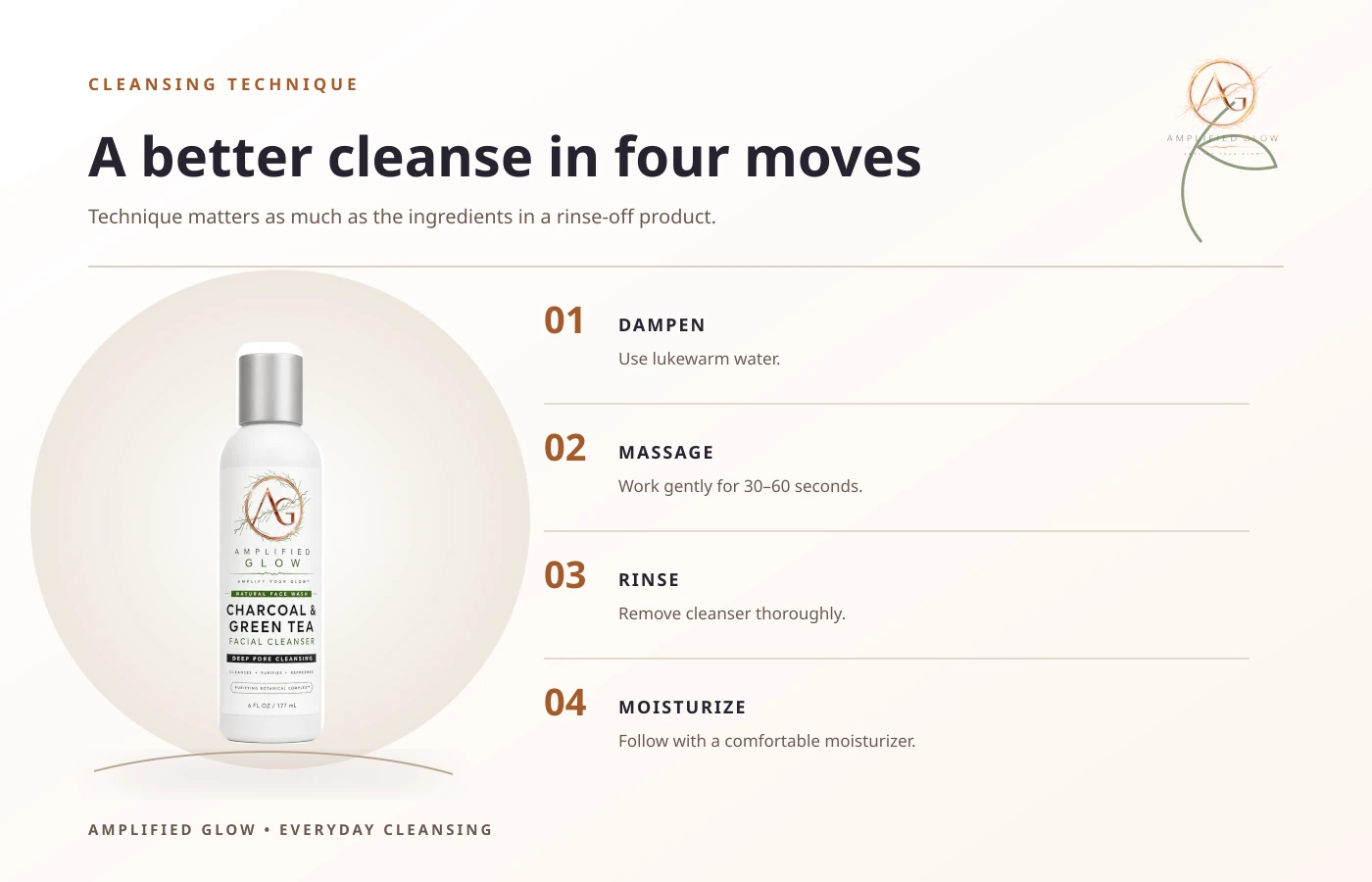
- Wet your hands, face, and neck with lukewarm water.
- Apply a small, label-directed amount to wet hands.
- Massage gently with fingertips in circular motions — don't scrub with abrasive tools or pads.
- Rinse thoroughly with lukewarm water.
- Pat dry with a soft towel.
- Follow with moisturizer as needed, and broad-spectrum sunscreen during the day.
The American Academy of Dermatology advises limiting face washing to twice daily and after sweating, using lukewarm (not hot) water.[4] If a cleanser leaves your skin feeling tight, irritated, or stripped, that's a signal to reduce frequency or switch products, not a sign that it's "working."
Morning, evening, and double-cleansing use
Amplified Glow's product page suggests morning and night use, but individual tolerance still matters more than a general recommendation — if your skin feels dry or reactive with twice-daily use, once a day may be the better fit for you.
A second cleansing step (sometimes called double cleansing) is genuinely useful when you need to remove makeup, water-resistant sunscreen, or heavy buildup — it isn't something everyone needs as a universal rule. People with minimal makeup and no heavy sunscreen use often do fine with a single, thorough cleanse in the evening. Chasing a "squeaky clean" feeling by washing more often than necessary tends to work against comfortable, healthy-feeling skin rather than for it, since it can strip more oil than the skin barrier is comfortable losing. Sunscreen remains the final daytime step after cleansing, moisturizing, and any other routine steps.
What to look for in the complete formula
- A gentle surfactant system with clear, complete directions.
- Supporting hydrators or conditioning ingredients, such as sodium hyaluronate or panthenol.
- Fragrance and botanical oils, assessed against your own known sensitivities.
- No detox, pore-shrinking, or acne-treatment promises on the label.
- A frequency recommendation that matches how your specific skin responds.
- A complete INCI ingredient list and any relevant warnings.
- Realistic, appearance-focused language rather than medical claims — a cleanser can reasonably say it helps skin look and feel clean and refreshed, but it shouldn't claim to treat a diagnosed skin condition.
Weigh these factors together rather than picking a cleanser off one headline ingredient. A product built around excellent supporting ingredients but a harsh surfactant system can still leave skin feeling stripped, while a simple, well-balanced formula without trendy ingredients can outperform it in daily comfort.
To see how the cleansing step connects with leave-on products, explore the Amplified Glow skincare collection and compare the role of each formula.
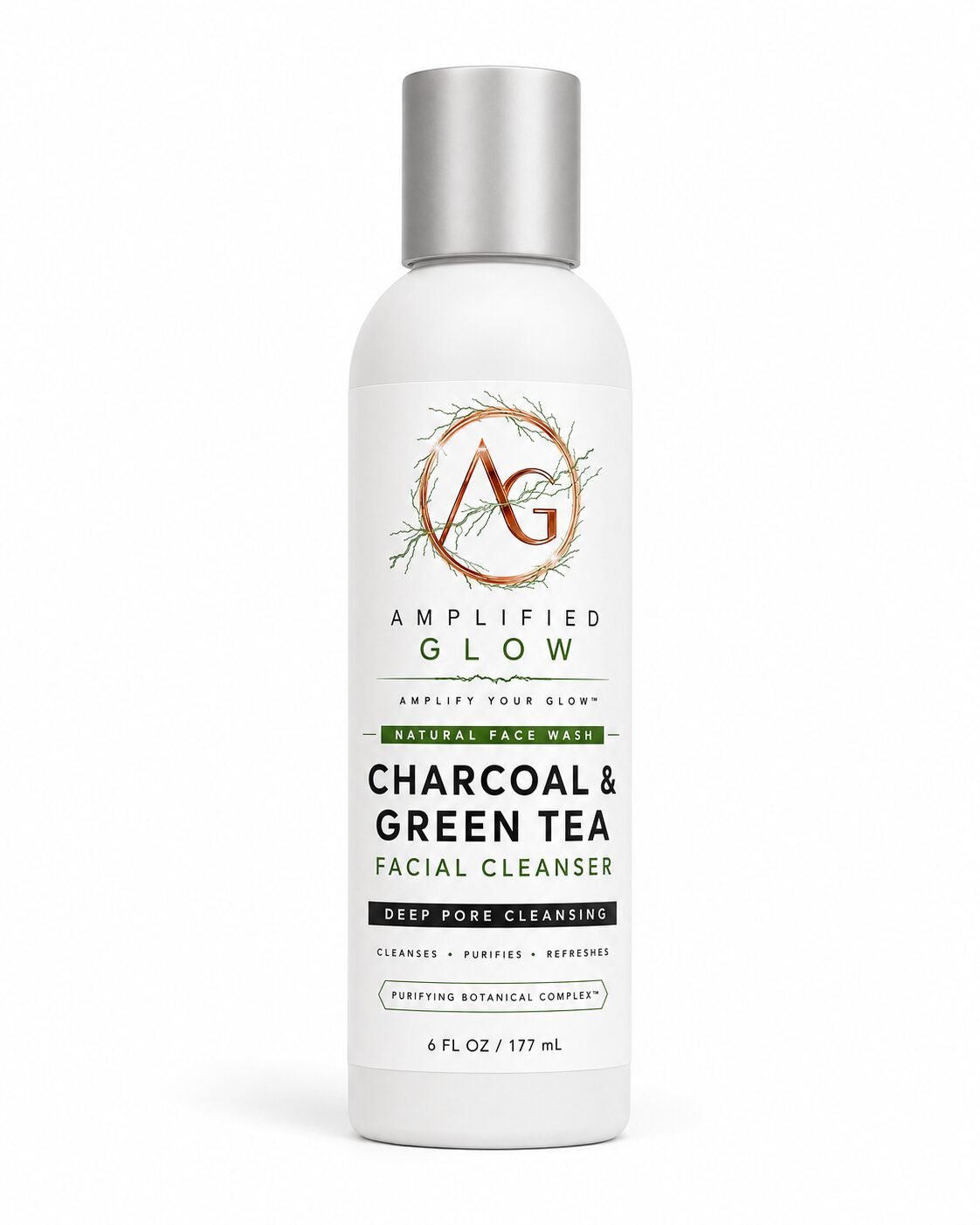
Amplified Glow Charcoal and Green Tea Facial Cleanser
The Charcoal and Green Tea Facial Cleanser is a 6 fl oz / 177 mL formula. Its product page lists activated charcoal, green and white tea extracts, aloe vera, sodium hyaluronate, panthenol, MSM, vitamin C, and botanical oils, with directions calling for wet hands and skin, gentle circular massage, a thorough warm-water rinse, and morning or night use. The page positions it for normal, combination, oily, or buildup-prone skin, and describes it as cleansing away buildup, excess oil, and impurities.
Where the product page uses language like "deep pore cleansing," this guide reframes that as thorough surface cleansing rather than evidence that the product reaches into or empties pores themselves — that distinction matters, since "deep pore cleansing" can otherwise be read as implying more than a rinse-off product can substantiate. Current stock, price, ingredients, and directions are available on the linked product page.
Common myths
Myth: Charcoal detoxes skin.
Correction: "Detox" isn't a supported clinical outcome for a cosmetic cleanser — there's no credible mechanism by which a rinse-off product removes "toxins" from skin.
Myth: Green tea in any product treats acne.
Correction: Leave-on study results can't be assumed to apply to a rinse-off cosmetic, and this cleanser is not a drug or acne treatment.
Myth: A tight feeling after washing means cleaner skin.
Correction: Tightness often signals that a routine is too drying or irritating for your skin, not that it cleaned more effectively.
Myth: More washing is better for oily skin.
Correction: Over-cleansing can irritate skin and potentially worsen oiliness. Gentle technique and a reasonable frequency matter more than washing frequently.
Myth: A cleanser replaces moisturizer or sunscreen.
Correction: Those steps have different jobs in a routine — cleansing removes buildup, while moisturizer and sunscreen protect and hydrate afterward.
Frequently asked questions
Can charcoal face wash be used every day?
Many people use it daily as part of a twice-daily washing routine, but this depends on your skin's response. Reduce frequency if it feels drying or irritating.
Is charcoal cleanser suitable for oily skin?
It's commonly chosen by people with oily or combination skin for its cleansing feel, though suitability still depends on the complete formula and your own skin's response, not the charcoal alone.
Can charcoal cleanser dry the skin?
Any cleanser can feel drying depending on the surfactant system, water temperature, and frequency of use. Charcoal itself isn't inherently more or less drying than other cleansing ingredients.
Does activated charcoal remove toxins from pores?
No credible clinical evidence supports a "toxin removal" claim for cosmetic charcoal. It's better described as contributing to a cleanser's surface-cleansing feel.
Does green tea cleanser treat acne?
The relevant research on green tea and acne generally used leave-on preparations, not rinse-off cleansers, so it can't be used to claim this cleanser treats acne. Persistent acne is better addressed with a dermatologist.
Can the cleanser remove makeup and sunscreen?
A gentle cleanser can help remove light makeup and daily sunscreen, though heavier or water-resistant products may benefit from a dedicated makeup remover or a double-cleansing step first.
Should moisturizer be used after cleansing?
Yes, for most people — cleansing removes oil and buildup, and moisturizer helps replace lost hydration afterward, particularly if your skin feels dry or tight.
Can it be used with peptide serum or vitamin C serum?
Yes. The cleanser is rinsed off first as the initial step in a routine; whatever leave-on serum you use afterward should follow its own label directions and your personal tolerance.
Conclusion
A charcoal and green tea cleanser's real value is straightforward: it's a cleansing step, built around a rinse-off surfactant system, with charcoal and green tea contributing to the formula's feel and story rather than functioning as a detox or acne treatment. Judge it by how clean and comfortable your skin feels afterward — not by how dramatic the ingredient claims sound — and use a gentle technique with a frequency your skin actually tolerates. If a cleanser ever leaves your skin feeling tighter or more irritated over time rather than simply clean, that's worth listening to, regardless of how appealing the ingredient list looks on paper.
Explore the Charcoal and Green Tea Facial Cleanser directly, or continue to peptide serum vs peptide cream to plan what comes after cleansing in your routine.
References
- Sanchez N, Fayne R, Burroway B. Charcoal: An Ancient Material with a New Face. Clinics in Dermatology. 2020;38(2):262–264. PubMed
- Kim S, Park TH, Kim WI, Park S, Kim JH, Cho MK. The Effects of Green Tea on Acne Vulgaris: A Systematic Review and Meta-Analysis of Randomized Clinical Trials. Phytotherapy Research. 2021;35(1):374–383. PubMed
- A Comparison of the Effects of Topical Green Tea and Lotus on Facial Sebum Control. PubMed — small split-face leave-on emulsion study, formula- and format-specific. Outcomes of 3% Green Tea Emulsion on Skin Sebum Production. PubMed — small leave-on emulsion study; neither tests a rinse-off cleanser.
- American Academy of Dermatology. Face Washing 101.
- U.S. Food and Drug Administration. Cosmetics Labeling Claims.