Retinol and peptides aren't two versions of the same ingredient, so neither one wins by default. Retinol is a vitamin A–derived ingredient in the retinoid family; "peptides" is a broad family of amino-acid chains with many different named ingredients. Neither word on a label guarantees how a complete formula performs. Which fits depends on your goal, how your skin handles a specific product, and that product's directions. Below: how they differ, what the evidence compares, and what to check before using both.
The 30-second version
- Retinol is one specific vitamin A–derived ingredient, and a type of retinoid.
- Peptides are a whole family. Each named peptide is its own ingredient, so evidence for one doesn't transfer to another.
- The evidence: both have real studies behind specific products, but the studies reviewed here don't compare the two head to head, so neither "wins."
- Using both: it depends on the two exact products. Read both labels, and don't override a restriction.
What is the difference between retinol and peptides?
Think of retinol as one specific tool and "peptides" as a whole toolbox. Retinol is one type of retinoid, a family of vitamin A–related compounds that also includes prescription medicines such as tretinoin. The American Academy of Dermatology (AAD) describes retinol as a type of retinoid routinely used for concerns like uneven tone, pigmentation and texture, so "retinol" and "retinoid" aren't interchangeable words.
Peptides are short chains of amino acids, and the word covers many different ingredients, each with its own name, structure and evidence. A palmitoyl pentapeptide studied in one moisturizer is a different ingredient from Copper Tripeptide-1 (GHK-Cu) or Palmitoyl Tripeptide-1, even though all of them get called "peptides." Copper peptides are a subset: peptides bound to copper. GHK-Cu is one example, and our guide to copper peptides in skincare covers it in more depth.
| Criterion | Retinol | Peptides |
|---|---|---|
| Identity | A particular vitamin A ingredient within the retinoid family | A broad family of amino-acid chains; each named peptide is its own ingredient |
| Why consider it? | Visible fine lines, texture or tone, depending on the product and how your skin tolerates it | A formula's stated cosmetic goal. Some specific peptide preparations have fine-line evidence, but that can't be assigned to the whole family |
| Which evidence matters? | The actual retinol preparation and the people it was tested on | The exact peptide and the finished product tested |
| What to check on the bottle | Ingredient identity, use instructions, precautions and the supporting formula | The named peptide, the complete formula, use instructions and any compatibility guidance |
Notice what the peptide column doesn't say: there's no single mechanism or result you can assume for every peptide.
Label decoder: what the words on the bottle tell you
Two serums can both say "peptide" or "retinol" on the front and still be very different products. Here's how to read the words that matter.
| If you see… | It tells you | It doesn't tell you |
|---|---|---|
| Retinol | A vitamin A–derived ingredient, one type of retinoid, sold over the counter | How much is in the bottle. The AAD notes that over-the-counter products have no standard requirement to list the retinol percentage |
| Retinoid | The umbrella term for vitamin A–based products, including over-the-counter and prescription options | Which retinoid it is, or whether it's over-the-counter or prescription |
| Tretinoin | A prescription retinoid | How it fits with other products. That's a conversation for your prescriber |
| "Peptide complex" | That some peptide is in there | Which peptide, how much of it, or what it's meant to do |
| Copper Tripeptide-1 | The label name for GHK-Cu, a copper-bound peptide | Amount, or how the finished formula performs |
| Palmitoyl Tripeptide-1 | A different, separately named peptide ingredient | Whether it's the main ingredient or a supporting one |
What does the evidence actually compare?
Both ingredient types have real studies behind them, but the studies answer different questions.
- Retinol. In a 24-week study of 36 older adults (average age 87), a retinol lotion applied to one arm improved fine-wrinkle scores compared with the same lotion base without retinol on the other arm. The trial was randomized, blinded and vehicle-controlled. It also wasn't all smooth: the original trial report records irritation on the retinol-treated arm, with most reactions rated as mild and three participants withdrawing because of irritation or itching. It tested one retinol preparation on arm skin in an elderly group, so it can't tell you how a retail facial retinol will perform.
- Peptides. A 12-week split-face trial in 93 women aged 35–55 compared a moisturizer containing a palmitoyl pentapeptide (pal-KTTKS) with the same moisturizer without it. The study reported improved fine-line and wrinkle measures, and described the peptide as well tolerated in that trial. That's one specific peptide in one formulation. It wasn't GHK-Cu, it wasn't Palmitoyl Tripeptide-1, and it wasn't an Amplified Glow product.
Two positive studies of two different products don't tell you which category wins. A laboratory finding about an ingredient, a percentage printed on a label and a trial of a finished product are different kinds of evidence, and each supports different claims.
Four questions to ask about any claim:
- Which exact ingredient was it?
- In which product, or just in a lab?
- Tested on whom?
- Measuring what?
Those questions keep retinol research from being borrowed for peptides, keep one peptide's results from being applied to another, and mean results for prescription retinoids shouldn't be assumed for an over-the-counter retinol.
Which approach fits your routine?
Start with what you want, not with the ingredient names. The AAD's basics apply whichever way you go: moisturize, and use broad-spectrum sunscreen with an SPF of at least 30 every day. Its guidance on reducing the signs of aging also recommends testing a new product on your inner forearm for 4 to 5 days before using it on your face, even if it's labeled hypoallergenic, and limiting how many products you use, because too many (especially more than one anti-aging product) tends to irritate skin.
Three safety basics worth knowing up front:
- Retinoids can irritate. The AAD says people with skin allergies or dryness are probably not good candidates, and a dermatologist quoted there advises people with a lot of redness or inflammation to ask about other options.
- Retinoids can make skin more sensitive to the sun, so daily sun protection matters.
- Retinoids shouldn't be used during pregnancy. Ask a clinician about alternatives, and don't assume a peptide product is pregnancy-safe just because it isn't a retinoid.
Tap the situation that sounds most like you:
I’m new to both
Change one thing at a time. If your current routine already includes a moisturizer and daily sunscreen, you have the AAD's basics covered, and anything you add is a bonus. Patch-test whatever you try first, and give each product a fair run before adding another, so you can tell what's helping and what's irritating. If you're curious about retinol, a board-certified dermatologist can tell you whether it suits your skin. If a peptide formula appeals, start with what a peptide serum is.
My routine already works for me
Then you don't have to add either one. Adding retinol or a peptide serum is optional, and "more products" isn't the same as a better routine. If you're just curious, treat it as a small trial of a single product, not a reason to overhaul what's working.
I want to try retinol
The AAD describes retinoids as a good option for mild fine lines and wrinkles, mild pigmentation irregularities and mild acne. A dermatologist quoted there advises choosing the least-intense formula you can find, building up slowly and using it at night, with sun protection during the day. For darker skin tones, a dermatologist quoted by the AAD notes that irritation can trigger dark marks, so starting slowly and moisturizing matters. The AAD also notes that over-the-counter products don't have to list the retinol percentage, and its bottom line is to talk to a dermatologist about whether retinol is right for you.
I’d rather try a peptide formula
Choose by the named peptide, the complete formula and a realistic cosmetic goal, not by the word "peptide" alone. Read the directions, and patch-test first. Our guides on how to choose a GHK-Cu serum and peptide serum vs peptide cream cover the label checks and format choice in more detail. A peptide product isn't a retinol replacement, and it isn't guaranteed to be gentler either.
Retinol irritates my skin
The AAD advises stopping products that sting or burn unless a dermatologist has prescribed them, because irritating your skin makes signs of aging more noticeable. Applying more than directed can also cause clogged pores or a blotchy complexion. Don't push through, and don't buy a different active as the fix. A board-certified dermatologist can work out what's going on and what, if anything, to try next.
I’m pregnant, planning a pregnancy or breastfeeding
The AAD says retinoids shouldn't be used during pregnancy. Peptide products aren't automatically safe either, so ask your clinician about any new product. There's more on this in the pregnancy question below.
I use a prescription retinoid
Follow your prescriber's directions first. The AAD notes that some prescribed products can sting or burn, and that this can be safe and effective under a dermatologist's care, which is exactly why a prescription routine is a conversation for your prescriber and not a product label. Ask before adding anything new, peptide or otherwise.
Can you use peptides with retinol, and what about copper peptides?
It depends on the two specific products, not on the word "peptide." Manufacturers give different instructions for their own formulas, which is a clue that there's no single rule:
| Brand and product | What the brand says | What that doesn't mean |
|---|---|---|
| The Ordinary, Multi-Peptide + Copper Peptides 1% Serum | Avoid using this serum with retinoids | That every copper peptide product conflicts with retinol |
| Medik8, peptides and retinoids | Recommends pairing some of its peptide products with its vitamin A products, with placement advice that depends on the formula | That every peptide goes with every retinol. Its copper example also uses Copper PCA, a different copper ingredient, so it isn't a GHK-Cu case either |
These are different finished formulas with different instructions. They don't show that one brand is wrong, that copper peptides always cancel retinol, or that every peptide is fine alongside it. For copper peptides specifically, the studies above don't compare them with retinol, so compatibility remains a question about the exact copper-peptide product you own.
A practical way to check:
Amplified Glow's product pages don't describe a tested pairing with any specific retinol product, so the same checks apply to the products below. If you use a prescription retinoid, your prescriber is the right person to ask about adding new products.
Myth or fact?
Tap a myth to see what the sources say.
Myth: “Peptides are just a gentler version of retinol.”
Fact: They're different kinds of ingredient, not a milder and stronger version of the same thing. Any new product can irritate, which is why the AAD recommends patch-testing even hypoallergenic products and limiting how many you use.
Myth: “You have to choose one.”
Fact: Nothing in the sources reviewed says you must. What the label says matters: one brand tells you to avoid pairing its copper-peptide serum with retinoids, while another recommends certain pairings within its own range. Check both products.
Myth: “A higher percentage or a higher price means a better product.”
Fact: A percentage describes one ingredient in one product, so it can't rank retinol against a peptide or one peptide against another. And the AAD notes that a more expensive product isn't always more effective, and that there are effective, affordable options in ordinary skin care aisles.
If you choose a peptide product, choose the format too
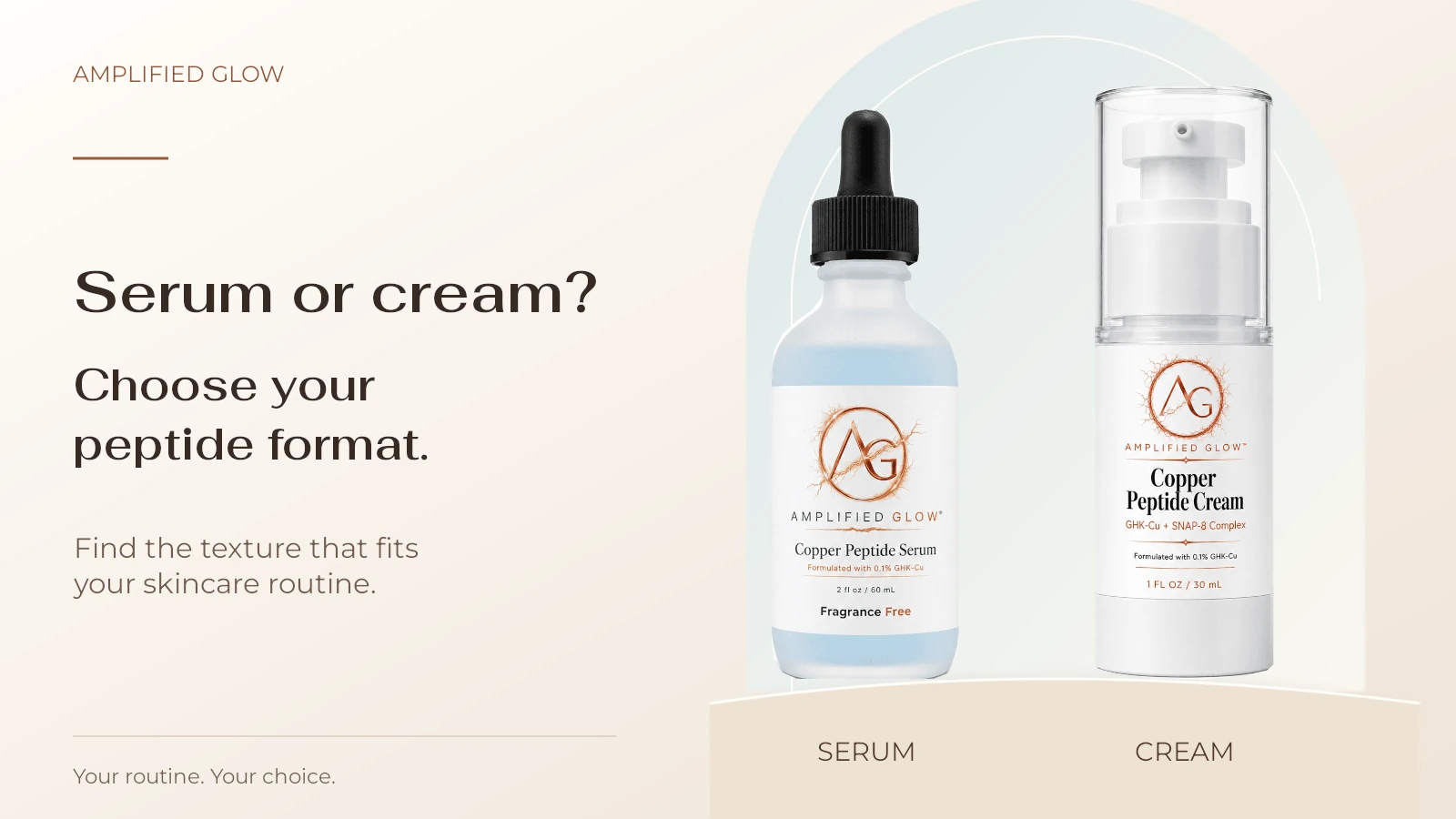
If you decide a peptide formula fits, serum versus cream is a format choice about texture and where the product sits in your routine. It says nothing about how strong either one is. Two Amplified Glow examples:
- Copper Peptide Renewal Serum is a facial serum. Its product page lists Copper Tripeptide-1 (GHK-Cu) and Palmitoyl Tripeptide-1 alongside sodium hyaluronate, a form of hyaluronic acid. The directions put it on clean face and neck, followed by moisturizer if desired.
- Copper Peptide Renewal Cream is the cream-format option. Its page directs use on face and neck, alone or after serum.
Those descriptions come from the product pages, not from independent testing. Neither is presented as a retinol replacement, and you don't need both.
Your questions about retinol and peptides
These are questions that come up around this topic, answered from the sources above. Tap a question to open it.
The basics
Are retinol and peptides the same thing?
No. Retinol is a single vitamin A–derived ingredient in the retinoid family. "Peptides" is a family of amino-acid chains with many different named ingredients. See the table at the top for the side-by-side.
Is retinol or peptides better for wrinkles and fine lines?
Neither is shown to win. One study found that a retinol lotion improved fine-wrinkle scores in older adults, and another found that one peptide moisturizer improved fine-line measures. They tested different products on different people, so they can't be ranked against each other. The AAD adds that moisturizing can help reduce the appearance of some fine lines.
Which is better for under-eye lines or dark circles?
This guide didn't review evidence on under-eye skin, so it can't say which works better there. Use products only where their directions say they can be used, and if dark circles or puffiness are a persistent concern, a dermatologist can look at the cause.
How do I pick a retinol strength?
This guide doesn't recommend a strength. The AAD notes that over-the-counter products don't have to disclose the retinol percentage, and a dermatologist quoted there advises using the lowest formulation you can find. The strength of the lotion in the study above isn't a starting dose. A dermatologist can advise you on what's right for your skin.
Are collagen peptides the same as skincare peptides?
This guide is about peptides in topical skincare. Collagen supplements are a different category, and we haven't reviewed evidence on them here.
Using them together
Can you use peptides and retinol together?
It depends on the two products. Manufacturers give different instructions for their own formulas, so read both labels, don't override an explicit restriction, and ask the brand or a clinician if you're unsure. The full checklist is in the pairing section above.
Which goes first, retinol or peptides, and can I split them between morning and night?
No single order or schedule is established in the sources we reviewed. A dermatologist quoted by the AAD advises using retinoids at night with sun protection during the day, and one brand says peptide placement depends on the formula. Beyond that, follow each product's own directions. If a brand says to avoid using its product with retinoids, take that at face value rather than assuming spacing them apart gets around it, and ask the brand if you're unsure.
Can I use copper peptides with retinol or tretinoin?
It depends on the exact copper-peptide product. One brand says to avoid using its copper-peptide serum with retinoids; another brand's different copper ingredient comes with different advice. Tretinoin is a prescription retinoid, so check with your prescriber before adding a copper-peptide product to a tretinoin routine.
Can I use the Copper Peptide Renewal Serum with my retinol?
The product page describes Copper Tripeptide-1 (GHK-Cu), Palmitoyl Tripeptide-1 and sodium hyaluronate, a salt form of hyaluronic acid, with directions for clean face and neck followed by moisturizer if desired. It doesn't describe a tested pairing with any retinol product, so we can't tell you that it's compatible or that it isn't. Read both labels, add one product at a time, and ask a dermatologist if you use a prescription retinoid. It isn't presented as a retinol replacement.
Results and routine
How long until I see results?
No one can promise a timeline for a specific product. As general guidance, the AAD notes that a moisturizer can plump up fine lines right away, while most anti-aging products take at least six weeks to work and sometimes three months. If you've followed the basics and still don't see what you expected, it suggests seeing a board-certified dermatologist.
Do I still need sunscreen and moisturizer?
Yes, whichever you choose. The AAD recommends daily broad-spectrum sunscreen with an SPF of at least 30, and moisturizing. If you have sensitive skin, it suggests a physical sunscreen containing titanium dioxide and/or zinc oxide. Neither retinol nor peptides replaces them.
Safety
What if my skin gets irritated or breaks out?
The AAD advises stopping products that sting or burn unless a dermatologist prescribed them, and notes that using more than directed or too many products can cause clogged pores, a blotchy complexion or irritation. If it doesn't settle, see a board-certified dermatologist. No one can say in advance whether a specific peptide product will or won't cause a breakout for you, which is why patch-testing helps.
Do peptides make skin sun-sensitive the way retinoids can?
The AAD says retinoids can make skin more sensitive to sun. None of the peptide sources we reviewed makes that claim about peptides, but daily SPF 30+ broad-spectrum sunscreen is a basic whichever products you use. If a specific product's label includes a sun warning, follow it.
Are retinol or peptides safe during pregnancy?
The AAD says retinoids, including retinol, shouldn't be used during pregnancy. We can't say that peptide products are pregnancy-safe, because the sources reviewed don't establish it. If you're pregnant, planning a pregnancy or breastfeeding, ask your clinician to review any product's ingredient list before you use it.
Choosing a product
Are all peptide serums copper-peptide serums?
No. "Peptide serum" describes a format that can contain many different peptides. Check the ingredient list: Copper Tripeptide-1 points to a copper peptide, while Palmitoyl Tripeptide-1 is a different ingredient. If the term is new to you, start with what a peptide serum is.
Does a higher percentage tell me which is better?
Not across different ingredients or formulas. A percentage describes one ingredient in one product. It can't rank retinol against a peptide or one peptide against another.
Should I get a peptide serum or a peptide cream?
That's a texture and routine question, not a strength one. A serum is typically a lighter step; a cream is typically richer. Peptide serum vs peptide cream compares them.
Before you buy: five quick questions
Answer these in your head, or jot them down. They usually make the decision for you.
- What do I actually want to change? Texture, tone, fine lines, hydration, or nothing at all?
- What am I already using, including any prescription retinoid?
- Is there a reason to ask a clinician first? Pregnancy, very dry or reactive skin, or a skin condition.
- What exactly is in the product, and what do its directions say?
- Can I add just one new thing, so I can tell what's working?
If your current routine is working, you don't have to add anything. If a peptide formula sounds right for what you want, Compare Amplified Glow face serums and read each product's ingredient list and directions before you choose.
Sources
- American Academy of Dermatology. Retinoid or retinol?
- American Academy of Dermatology. Wrinkle remedies
- Kafi R, et al. Improvement of naturally aged skin with vitamin A (retinol). Archives of Dermatology. 2007;143(5):606–612. PubMed
- Kafi R, et al. Full trial report and adverse reactions. JAMA Dermatology archive.
- Robinson LR, et al. Topical palmitoyl pentapeptide provides improvement in photoaged human facial skin. International Journal of Cosmetic Science. 2005;27(3):155–160. PubMed
- The Ordinary. Multi-Peptide + Copper Peptides 1% Serum (manufacturer compatibility guidance for that product).
- Medik8. Retinoids vs peptides—or retinoids and peptides? (manufacturer guidance for its own products).