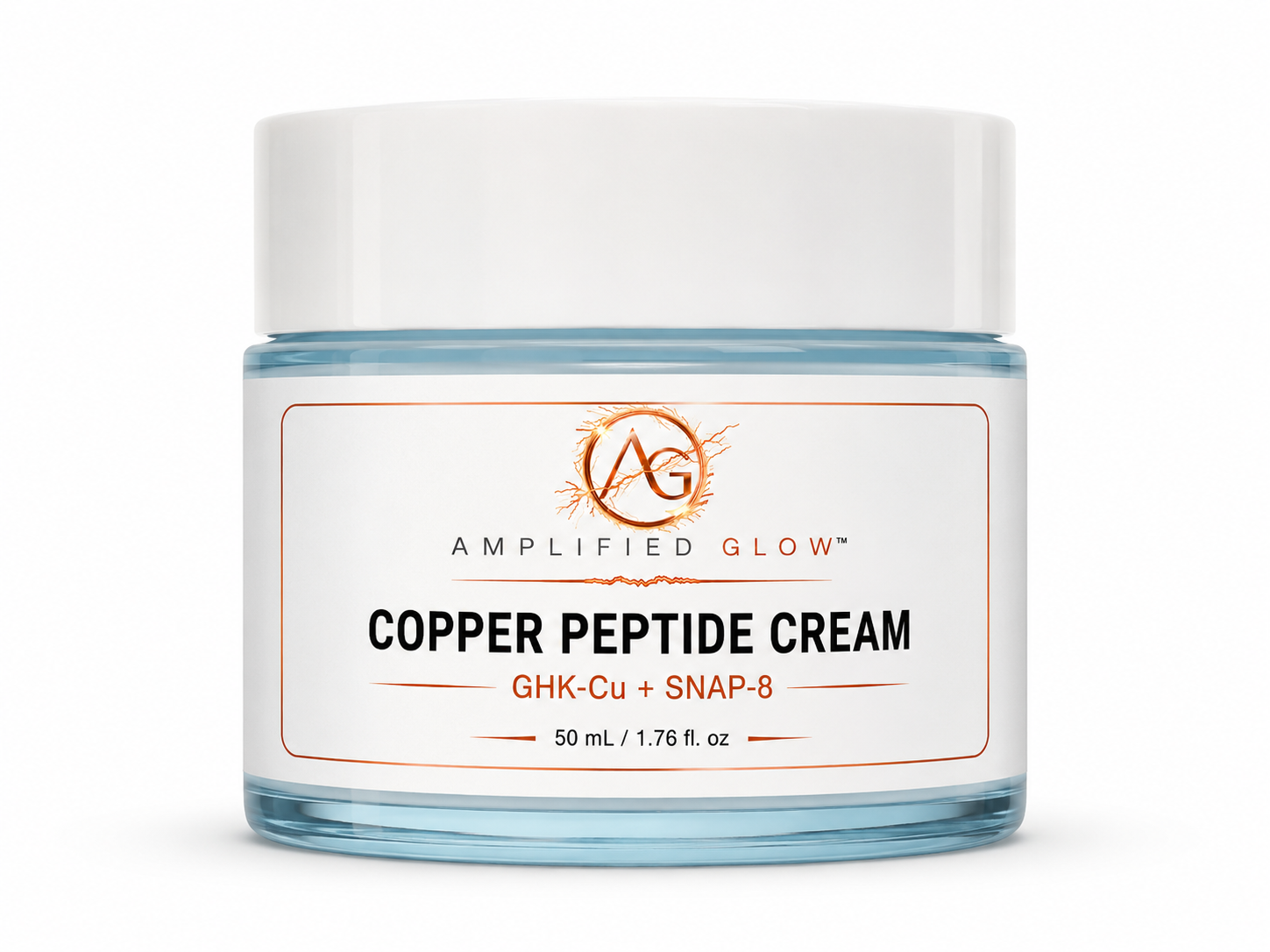
Peptides and hyaluronic acid (HA) aren't interchangeable names for the same job. HA is used for hydration, while "peptides" names a varied family of ingredients where the specific peptide matters. Because one product can contain both, the choice isn't always either/or, and it doesn't always mean buying two separate products. The more useful question is what a complete formula adds to the routine you already have.
The 30-second version
- Hyaluronic acid is a humectant, an ingredient that helps skin hold onto water.
- Peptides are a varied family. The specific peptide matters, and one peptide's evidence doesn't transfer to another.
- One bottle can hold both. Some finished products list peptides and HA forms together, so you don't always need two products.
- The real question isn't which ingredient wins. It's what a complete formula adds to the routine you already have.
What does each ingredient name tell you?
One name describes a job; the other describes a category. Hyaluronic acid is a humectant, which helps skin hold onto water, and that's why it's used as a topical moisturizing ingredient.
Peptides are short chains of amino acids, and the word covers many different ingredients. One example is a palmitoyl pentapeptide called pal-KTTKS, which was tested in a 12-week split-face study. It's a different ingredient from Copper Tripeptide-1 (GHK-Cu) or Palmitoyl Tripeptide-1, even though all of them get called peptides, which is why the specific molecule matters. If you'd like the beginner version of this topic first, read what a peptide serum is.
| Criterion | Hyaluronic acid | Peptides |
|---|---|---|
| Main distinction | A humectant used for hydration | A varied ingredient family; the specific molecule matters |
| The practical question | Does this formula meet the hydration need I'm trying to address? | Which named peptide is in here, and what supports this formula's stated cosmetic purpose? |
| Product format | Can be part of a serum or another complete skincare formula | Can sit in the same formula as HA, so it isn't automatically a separate step |
| What else to inspect | Complete ingredients, texture and directions | The same checks, plus the exact peptide's identity rather than a generic "complex" name |
An ingredient list alone doesn't reveal every ingredient's exact concentration. Nor does it establish how well the finished product performs, how deeply its ingredients penetrate or whether it will suit your skin. It tells you what's in the formula, and that's a starting point rather than a verdict.
What can the research tell us about visible results?
Two studies show how narrowly each result applies:
- Hyaluronic acid. A 2021 study tested one HA serum on 40 women over six weeks, used alongside sunscreen. Hydration was measured with instruments and compared with each woman's starting point. It had no separate control group, and several of the authors are affiliated with Colgate-Palmolive. It tells us about that serum's hydration measurements, not about HA versus peptides.
- Peptides. The pal-KTTKS study reported improved fine-line measures for one named peptide in one moisturizer, compared with the same moisturizer without it. That doesn't show that every peptide formula outperforms HA, or that HA is unnecessary.
If your skin feels softer or looks more hydrated after using a serum, you can't tell from the ingredient list which single ingredient is responsible. Humectants, the base formula and other ingredients can all affect how a serum feels, and the list alone can't divide up the credit. Nothing in these studies shows the two ingredient types work better together than apart.
Can you use peptides and hyaluronic acid together?
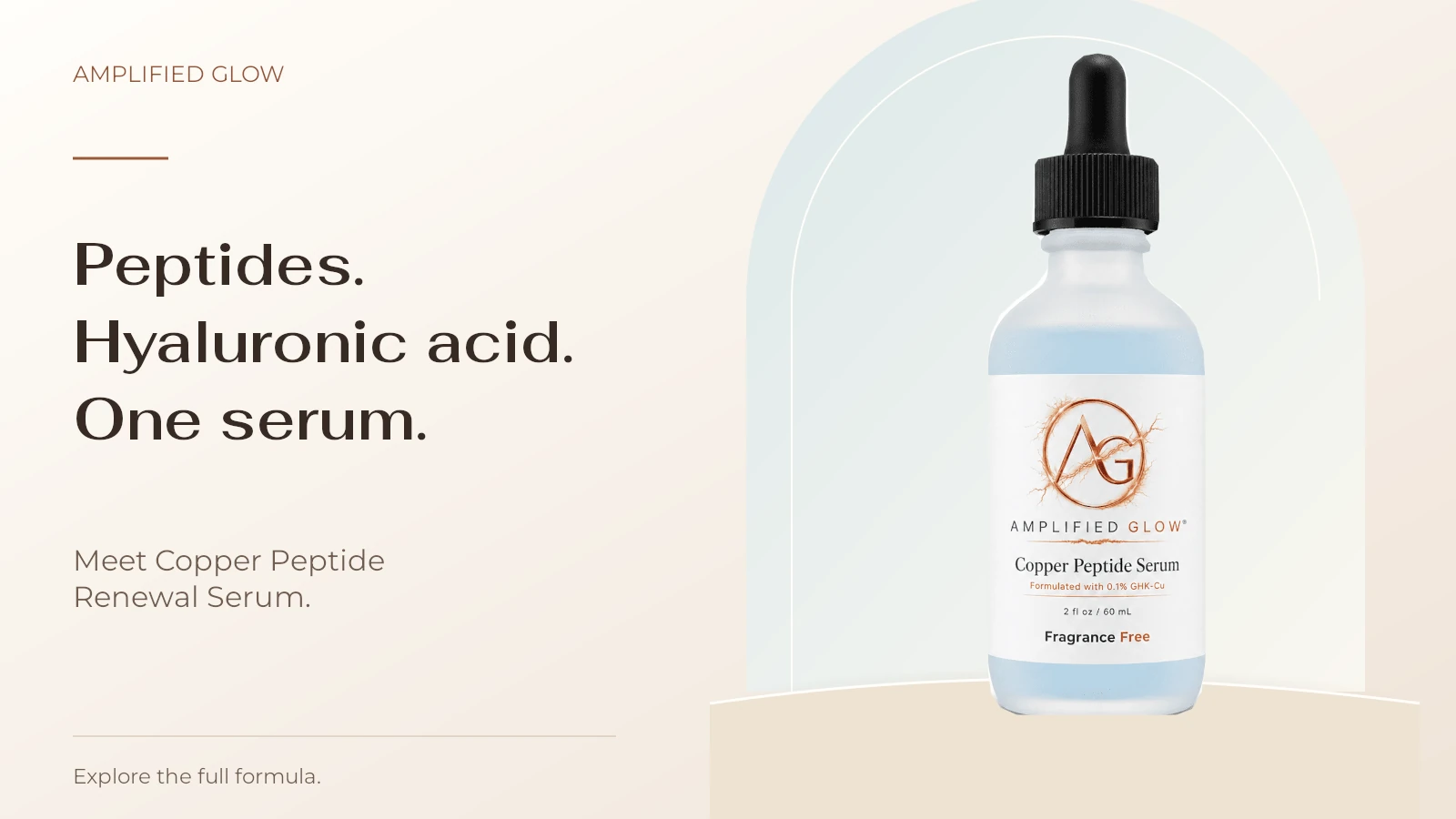
Yes, in the sense that some finished products are formulated with both, so you don't have to layer two bottles to get both. Amplified Glow's Copper Peptide Renewal Serum is one example. Its product page lists Copper Tripeptide-1 (GHK-Cu) and Palmitoyl Tripeptide-1 alongside sodium hyaluronate, a salt form of hyaluronic acid.
Scan one real ingredient list
It's a useful formula to practice label-reading on. Here's what each name on that product page does, and doesn't, tell you:
| Listed on the product page | What the name tells you | What it doesn't tell you |
|---|---|---|
| Copper Tripeptide-1 (GHK-Cu) | A named peptide bound to copper | How much is in the bottle, or how the finished serum performs |
| Palmitoyl Tripeptide-1 | A second, separately named peptide | Whether it's a main or supporting ingredient |
| Sodium hyaluronate | A salt form of HA | How much is in the bottle, or how deep it goes |
Sodium hyaluronate is a salt form of hyaluronic acid, which is one reason HA can show up on labels under more than one name. The name alone doesn't tell you how the ingredient performs in a finished formula or how deep it goes. The product page is the brand's own account of its formula, not an independent laboratory check.
Your 60-second label scan, for any serum:
- Find the full ingredient list, not just the front-of-bottle claims.
- Look for named peptides, such as Copper Tripeptide-1 or Palmitoyl Tripeptide-1.
- Look for HA forms, such as sodium hyaluronate, hydrolyzed hyaluronic acid or hyaluronic acid.
- Note what the label can't tell you: amounts, depth and performance.
- Read the directions for how and when to use it.
A combined formula also doesn't mean any two separate bottles will work well together. If you're thinking about layering a separate HA product or peptide product, read all the ingredients and directions on both, particularly if either contains other active ingredients.
One serum, two serums, or neither?
This is the practical decision behind the comparison. Tap your starting point:
My current serum already lists peptides and HA
Don't add another HA serum just to get an ingredient you already have. Check your label first (use the scan above), then ask whether a need remains that your routine doesn't meet. If it does, look for something that addresses that need rather than repeating what's already in the bottle.
My routine feels comfortable and meets my goals
Keeping it unchanged is a valid choice. The American Academy of Dermatology (AAD) includes moisturizing and daily broad-spectrum sunscreen with an SPF of at least 30 in its guidance on reducing the signs of aging. If you have those covered and you're happy with your results, you don't need another step.
I want fewer steps and a combined product
Compare complete combination formulas, including their texture and directions. Our guide on how to choose a GHK-Cu serum walks through the label checks. You can also browse our face serum collection to compare complete formulas side by side; ingredients vary from serum to serum, so read each list. Whether a combined product costs less than two separate ones depends on current prices and sizes, so check those rather than assuming.
I like using separate products
That's fine. Check both labels and how your skin tolerates the combination. Two products aren't inherently more effective than one, and the AAD notes that using too many products, especially more than one anti-aging product, tends to irritate skin.
A product is irritating me or feels uncomfortable
More layers aren't the fix. The AAD advises stopping products that sting or burn unless a dermatologist has prescribed them. Reassess the product, and if symptoms persist, see a board-certified dermatologist.
I also use a retinoid or another strong active
Other actives come with their own directions and cautions, and this guide doesn't cover pairing them. Read each label, add one new product at a time, and ask a dermatologist, especially if your retinoid is a prescription.
These are decision aids, not a tested regimen.
How do they fit into a routine?
Follow each product's own directions rather than a fixed rule like "HA first" or a set waiting time. For the Copper Peptide Renewal Serum, the product page places the serum on clean face and neck and allows moisturizer afterward. Treat that as that product's instruction, not a template for every serum.
The AAD's basics apply whichever serum you choose: moisturize, use broad-spectrum sunscreen with an SPF of at least 30, test new products before using them on your face and use them as directed.
Myth or fact?
Tap a myth to see what the sources say.
Myth: “HA works on the surface, while peptides repair deep skin.”
Fact: Some descriptions split the two this way, but the research reviewed here doesn't establish how deep any specific serum's ingredients go. An ingredient being on the list isn't a depth test.
Myth: “More layers means better results.”
Fact: Two products aren't inherently more effective than one, and the AAD notes that using too many products tends to irritate skin.
Myth: “‘Dual HA’ means a better serum.”
Fact: It means two forms of HA are listed. The names alone don't tell you which form performs better, how deep it goes or whether two beat one.
Myth: “You need a peptide serum and a separate HA serum.”
Fact: Some formulas contain both. Check what your current serum already lists before buying a second product.
Your questions about peptides and hyaluronic acid
These are questions that come up around this topic, answered from the sources above. Tap a question to open it.
The basics
Which is better, peptides or hyaluronic acid?
Neither is better across the board, because they aren't the same kind of ingredient. HA is used for hydration, and "peptides" is a family where the specific molecule matters. One study measured hydration for one HA serum, and another found improved fine-line measures for one peptide moisturizer. Neither tested HA against peptides.
Is hyaluronic acid a peptide? What about collagen and supplements?
No. HA is described as a humectant, an ingredient that helps skin hold onto water, while peptides are short chains of amino acids. Supplements such as collagen peptides are a separate category that this guide doesn't cover.
Using them together
Can you use peptides and hyaluronic acid together?
Yes, in the sense that some finished products contain both. If you're layering separate products, read both labels and directions rather than assuming any two bottles will work well together.
Which goes first, hyaluronic acid or peptides?
No fixed order is established in the sources we reviewed, and ingredient names alone don't decide placement. Texture and the product's directions do. If both are in one bottle, the question goes away. For separate bottles, follow each label.
Do I need a peptide serum and a separate HA serum?
Not necessarily. If your serum already lists peptides and HA forms, adding another HA serum only for that ingredient may be redundant. Use the decision panels above.
Does my peptide serum already contain hyaluronic acid?
Check the current ingredient list on that exact product, because formulas differ. Names to look for include sodium hyaluronate, hydrolyzed hyaluronic acid and hyaluronic acid. If you're unsure what a name means, ask the brand.
Can I use peptides and hyaluronic acid with retinol?
That's a separate question with its own precautions. The AAD says retinoids can irritate, can make skin more sensitive to the sun and shouldn't be used during pregnancy. This guide doesn't cover pairing them, so read each label, add one new product at a time, and ask a dermatologist if you use a prescription retinoid.
Routine
Do I still need moisturizer if my serum has hyaluronic acid?
Check the serum's directions. The Copper Peptide Renewal Serum page allows moisturizer afterward. The AAD lists moisturizing among its basics, and notes that a moisturizer can plump up fine lines right away. Nothing we reviewed shows that a serum replaces a moisturizer.
How often can I use them, morning or night?
That's product-specific, so check the label of the product you own. Don't copy another product's schedule. The AAD advises using products as directed, and notes that applying more than directed can cause clogged pores or a blotchy complexion.
Safety and shopping
Can peptides or hyaluronic acid irritate my skin?
Any product can. The AAD recommends testing a new product on your inner forearm for 4 to 5 days before using it on your face, even if it's labeled hypoallergenic, and stopping products that sting or burn unless a dermatologist prescribed them. If irritation persists, see a board-certified dermatologist.
Are peptides or hyaluronic acid products safe during pregnancy?
We can't make a pregnancy-safety claim for any peptide or HA product, including ours, because the sources reviewed don't establish it. Ingredient lists differ from product to product. If you're pregnant or planning a pregnancy, ask your clinician to review the actual ingredient list.
Is a serum with both cheaper than buying two?
It depends on current prices and sizes. Compare each product's price and amount on the day you buy rather than assuming a combined product costs less.
Choose by formula, not by the ingredient contest
HA and peptides aren't the same kind of ingredient, and a single formula can include both. Before adding a product, check what your current routine already contains, decide what's still missing, and look at complete formulas and directions rather than ingredient names alone. If a combined facial serum fits what you want, View the Copper Peptide Renewal Serum formula to see its ingredients and directions.
Sources
- Draelos ZD, Diaz I, Namkoong J, Wu J, Boyd T. Efficacy evaluation of a topical hyaluronic acid serum in facial photoaging. Dermatology and Therapy. 2021;11(4):1385–1394. PubMed
- Robinson LR, et al. Topical palmitoyl pentapeptide provides improvement in photoaged human facial skin. International Journal of Cosmetic Science. 2005;27(3):155–160. PubMed
- American Academy of Dermatology. Wrinkle remedies
- American Academy of Dermatology. Retinoid or retinol?