Skip to content
Choosing between GHK-Cu serums comes down to four things: the exact ingredient identity, the complete formula, clear directions, and the evidence actually behind any claim being made. A higher advertised percentage or a deeper blue color doesn't, by itself, establish a better product. This guide is a practical process for comparing labels — not a scientific ranking of which serum wins.
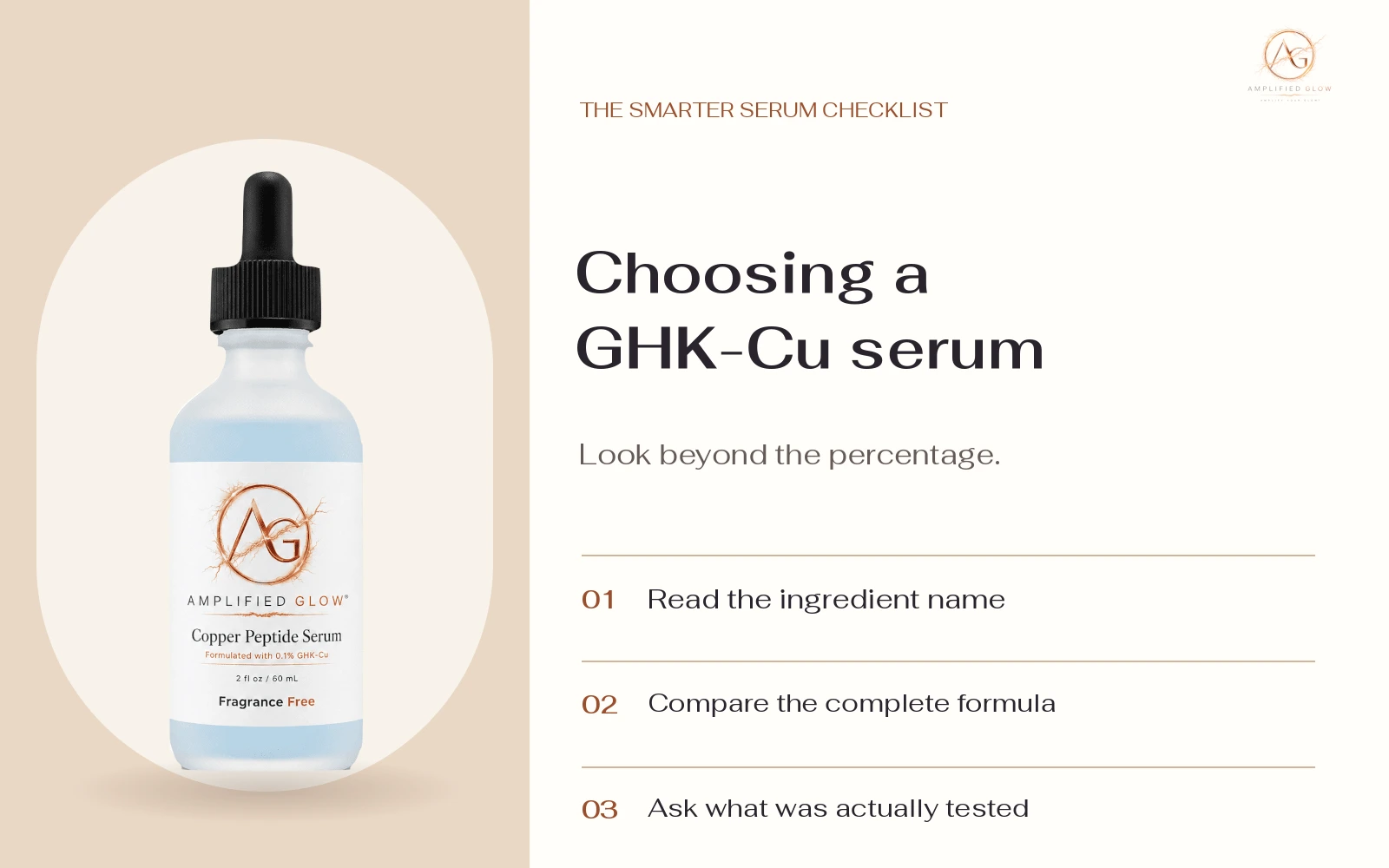
Start with the actual ingredient name
A product's trade name, its marketing description, and its actual ingredient listing are three different things, and they don't always tell the same story. "GHK-Cu" is a common shorthand; "Copper Tripeptide-1" is the INCI (label) name for the same complex. Both should point to one consistent ingredient — if a product's page and its package disagree, or if a listing names two similar-sounding peptide terms side by side without clarifying whether they're the same ingredient or two different ones, that's worth asking the brand to confirm before treating either name as settled. This kind of naming gap isn't unusual in cosmetics generally: INCI names are standardized for regulatory labeling, while trade names are chosen for marketing, and a brand doesn't always spell out the connection between the two as clearly as it could. A current label photo, an INCI sheet, or a direct answer from the manufacturer is the right way to resolve that kind of discrepancy — not a guess based on which name sounds more familiar.
If you're comparing GHK-Cu against a different peptide with a similar-looking name, see GHK-Cu vs SNAP-8 for how those two specific complexes differ.
Understand what a concentration claim measures
A "0.1%" or "0.15%" figure on a product page is only useful once you know what it's a percentage of. Depending on how a brand sources and reports it, a stated percentage might refer to the finished product, or to a pre-diluted ingredient blend purchased from a supplier — and those aren't the same basis for comparison. For example, a supplier might sell "GHK-Cu" pre-mixed into a carrier at a fixed strength; a brand could then report the percentage of that pre-mixed blend used in the final formula, which is a different number from the percentage of pure GHK-Cu itself. Without knowing which basis a brand means, you can't accurately calculate how much of the actual active peptide two differently labeled products actually contain, and this guide won't attempt that calculation without a clear specification behind it.
What follows from this: a higher advertised number isn't automatically a stronger or better product, and "stronger" itself isn't a well-defined claim for a cosmetic peptide serum. If concentration matters to you, ask the brand what basis their percentage is reported on, rather than comparing two numbers at face value.
Compare the supporting formula
The ingredients around the featured peptide are a separate decision dimension from the peptide itself. Hydrating ingredients (like hyaluronic acid), emollients, and fragrance status each affect how a serum feels and fits your routine, independent of which peptide is used or at what concentration.
Be cautious about inferring more than a formula list actually tells you. An ingredient list alone doesn't establish a product's pH, how well it's absorbed, its stability over time, or whether it suits sensitive skin — pH, absorption and stability require appropriate testing or manufacturer documentation. Your experience can help you judge comfort and texture, but it cannot verify those technical properties. Texture and format are their own separate question, too; see peptide serum vs peptide cream if you're also deciding between those formats.
Read directions, packaging, and storage information
Directions, net contents, and any storage guidance are usually printed on the package or listed on the product page — that's the reliable source, not a general assumption based on what similar products typically require. This is worth checking rather than skipping: peptide stability can be a formulation challenge, as discussed in the 2025 GHK review. Packaging alone does not prove a product is more stable; check the manufacturer’s storage guidance. Follow the specific manufacturer's directions for how much to use, how often, and how to store the product. If a detail isn't stated (a refrigeration requirement, an exact drop count, a shelf-life date, or a mixing restriction with other products), the honest answer is that it isn't specified — not a default you should assume one way or the other.
Ask what was actually tested
Evidence for a peptide comes in different forms, and it's worth knowing which one you're looking at: research on the raw ingredient in a lab setting, data a supplier provides about their own ingredient, and a clinical study of the actual finished product are three different levels of evidence, and none of them substitutes for another. A certificate of analysis reports specified quality-control tests for a batch; it is not proof of a clinical benefit. For the fuller evidence picture behind GHK-Cu specifically, including what current research does and doesn't establish, see copper peptides for skin rather than expecting a full research review on this page.
A shopper's comparison checklist
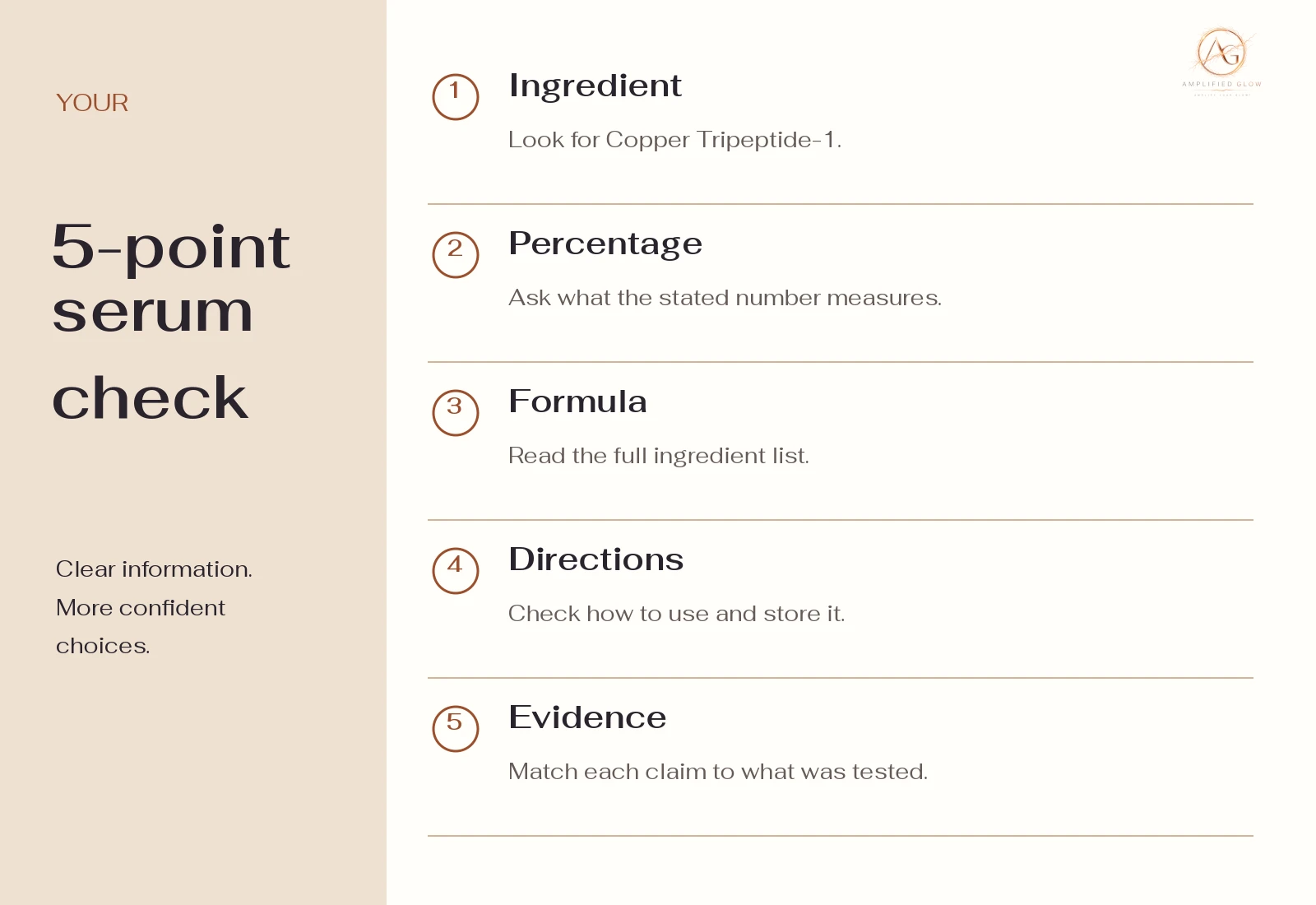
Apply these five checks to any GHK-Cu serum you're considering — including ones outside this guide:
| Check | What to look for |
|---|---|
| Exact ingredient listing | The full INCI name (e.g., Copper Tripeptide-1), not just a trade name or marketing term |
| Concentration basis, if stated | What the percentage is measured against — the finished product or a supplier's pre-diluted blend |
| Full formula | The complete ingredient list, not just the featured peptide |
| Current directions | Amount, frequency, and routine placement, from the product's own current label |
| Evidence/claim match | Whether a specific claim is backed by evidence on that exact ingredient, or borrowed from a different one |
Mark anything you can't verify as "not confirmed" rather than assuming it in either direction — that's a more useful shopping note than guessing.
Common questions
Is a higher copper-peptide percentage always better?
No. A percentage is only meaningful once you know its basis, and a higher number doesn't establish a more effective finished product. Formula, directions, and your own skin's response matter more than the number alone.
Can serum color tell me its strength or purity?
No. Color can come from the peptide complex itself, from added colorants, or from other formula choices, and it isn't a reliable indicator of concentration or quality. Check the stated ingredient information instead of judging by appearance.
Does "multi-peptide" mean a product contains GHK-Cu?
Not necessarily. "Multi-peptide" describes a formula with more than one peptide ingredient, but it doesn't specify which ones. Check the actual ingredient list to confirm whether GHK-Cu (Copper Tripeptide-1) is included.
How can I compare two formulas if a concentration isn't disclosed?
Compare what is disclosed — the full ingredient list, the directions, and any specific evidence behind a claim — rather than assuming an undisclosed concentration in either direction. You can also ask the brand directly.
Is a finished-product study the same as an ingredient study?
No. A study of the raw ingredient in a lab setting tells you about that molecule's properties; it doesn't confirm how a specific finished serum, at its actual formula and concentration, performs. Ask which one any specific claim is actually based on.
References
- Mortazavi SM, Mohammadi Vadoud SA, Moghimi HR. Topically Applied GHK as an Anti-Wrinkle Peptide: Advantages, Problems and Prospective. BioImpacts. 2025;15:30071. PubMed
- For a broader explanation of the evidence and routine context, see copper peptides for skin.