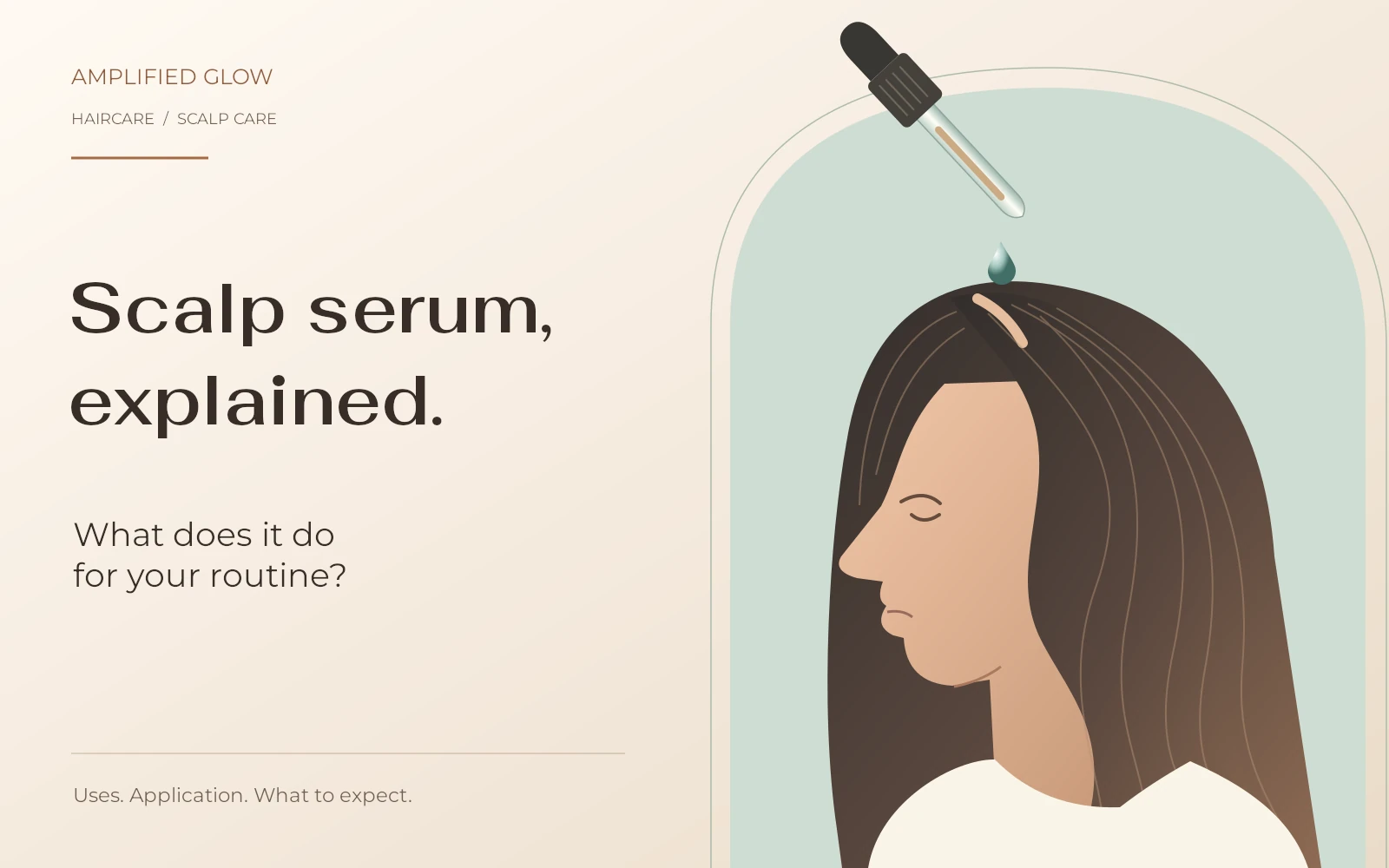
A scalp serum is a product meant for the skin of your scalp, not just the lengths of your hair. What it does depends on the product: some are hydrating leave-in formulas, others are exfoliating treatments used before shampooing. The word "serum" doesn't promise hair growth, tell you whether to rinse the product out, or mean you need one at all. Choose by what you want it for and what the directions say.
The 30-second version
- A scalp serum is made for scalp skin, not just the lengths of your hair.
- Purpose varies. Some hydrate and stay on; some exfoliate before shampoo and rinse out. They aren't interchangeable.
- The label answers three questions: where it goes, whether it stays, and how often to use it.
- A cosmetic scalp serum isn't a hair-loss treatment, and it isn't a must-have for a healthy routine.
Start with the purpose, not the word "serum"
Scalp products that call themselves serums are built for different jobs. This table uses real products to show how the formats differ. They're examples, not recommendations.
| Purpose | Example of the format | The direction that matters |
|---|---|---|
| Hydration | The Ordinary's Natural Moisturizing Factors + HA for Scalp is a hydrating scalp serum. Its directions call for applying it to clean, dry scalp and not washing afterward. | Leave-in: don't rinse |
| Exfoliating, before washing | The INKEY List's Salicylic Acid Exfoliating Scalp Treatment, a pre-wash scalp formula, is applied before shampooing, then rinsed out and followed by shampoo. | Rinse-out: not meant to stay on |
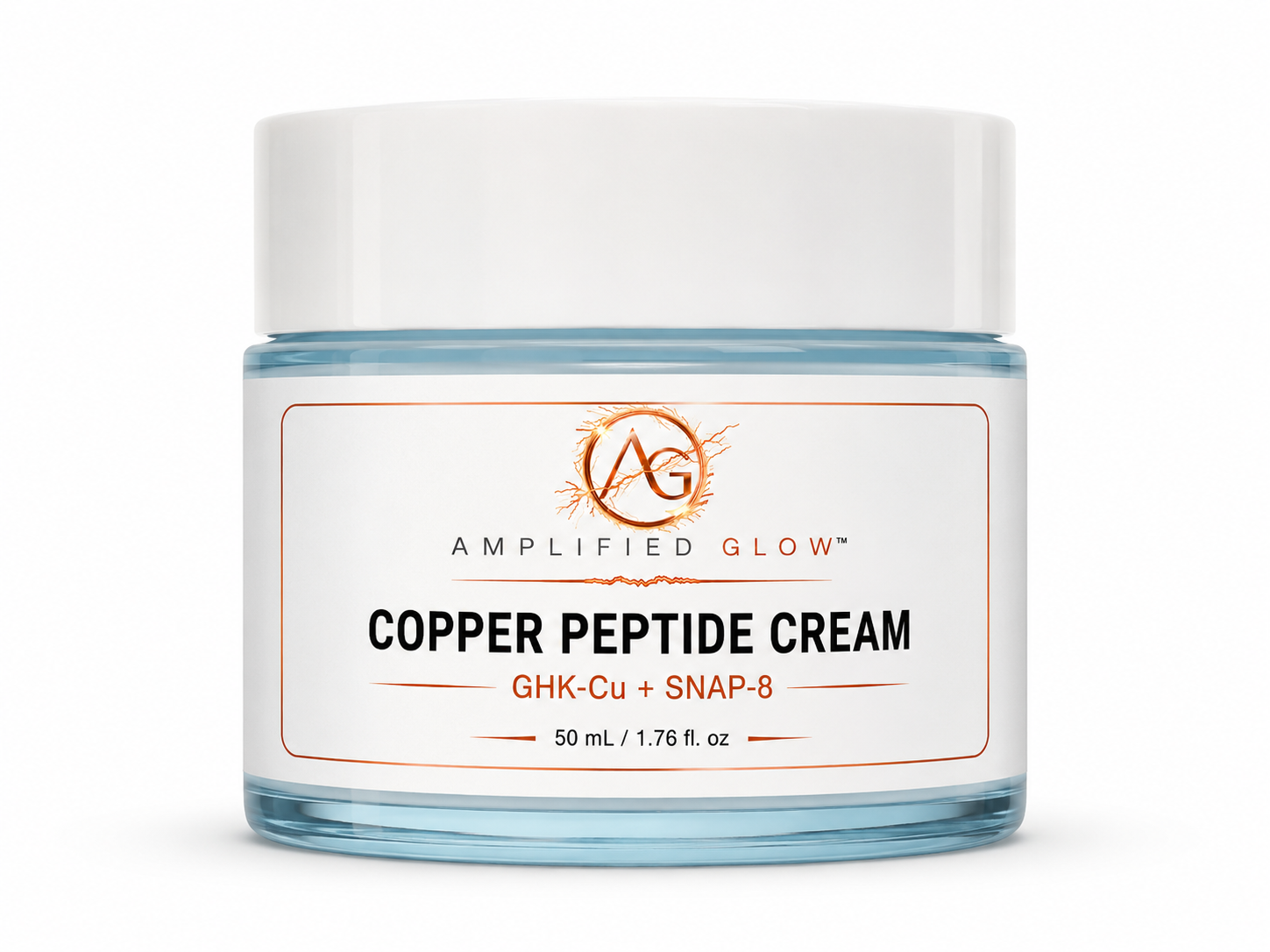
| Cosmetic peptide scalp care | Amplified Glow™ GHK-Cu + AHK-Cu Scalp Serum is described as a lightweight leave-in applied directly to the scalp, with no rinsing. | Leave-in: follow its own directions |
| Hair-loss treatment | A medical category, separate from cosmetic scalp serums. | Needs a cause-based decision, not a cosmetic purchase |
The same word covers a leave-in moisturizer and a rinse-out treatment, which is why the label comes first. You don't want to leave a rinse-out product on, or rinse off one that's meant to stay.
Decode your label
Not sure what kind of product you're holding? The directions are the place to look.
| If the directions say… | That points to… | An example from above | What to check |
|---|---|---|---|
| Apply to clean, dry scalp; don't wash afterward | A hydrating leave-in scalp product | The Ordinary's hydrating serum | The labeled amount and how often to use it |
| Apply before shampooing, then rinse | A pre-wash, rinse-out treatment | The INKEY List's exfoliating treatment | That you rinse it out and shampoo as directed |
| Mist onto wet or dry hair, mid-lengths to ends | A length-focused styling or shine product | OLAPLEX's No.7 Shine Serum Oil Mist | That it's meant for the hair, not the scalp |
| Use as a clinician advised or prescribed | A medical treatment | None. This guide covers cosmetic products only | Your clinician's directions, not a cosmetic label |
Flaking isn't always dryness, either. The American Academy of Dermatology (AAD) says dandruff can come from several causes, including medical conditions, hair-care habits and oily skin. A hydrating serum isn't automatically the answer, and neither is exfoliating.
Scalp serum, hair serum and hair oil: what changes?
Where a product is meant to go matters more than whether it says "serum" or "oil."
| Product type | Where it's meant to go | What to verify |
|---|---|---|
| Scalp-focused product | Scalp skin | That the directions name the scalp, and whether it's leave-in or rinse-out |
| Length-focused styling serum | The hair itself, often mid-lengths and ends | Its styling or shine purpose. OLAPLEX's No.7 Shine Serum Oil Mist is directed to the mid-lengths and ends of wet or dry hair, so a similar texture doesn't mean a product belongs on your scalp |
| Hair oil | Depends on the product | "Oil" describes the format, not one application site. A product may be for the scalp, the lengths or both, and the label decides |
That OLAPLEX product calls itself a "serum oil mist," so "serum" and "oil" can sit in one name. Marketing categories overlap, which is why the first question is where the product is meant to go, and only then whether it's an oil or a serum. This is a label-reading approach, not a claim about how every hair serum or oil is made.
What results are realistic, and does it grow hair?
Judging a cosmetic scalp serum mostly means judging what you can see and feel: whether your scalp feels comfortable, whether the formula leaves residue, how your hair sits afterward. Those are reasonable things to evaluate. They aren't evidence of hair growth, and a comfortable scalp doesn't guarantee regrowth.
Peptide research shows why the distinction matters. A laboratory study tested AHK-Cu, a different copper complex from GHK-Cu, on isolated human hair follicles and cultured cells. It wasn't a test of a finished leave-in serum used by people, so it doesn't establish results for a finished cosmetic scalp serum. For the details and limits, see what copper-peptide hair research shows.
None of that means nothing applied to the scalp can treat hair loss. Dermatologists do use medical treatments. The AAD's overview of hair-loss diagnosis and treatment lists options such as minoxidil, and it stresses that effective treatment starts with finding the cause. A cosmetic scalp serum's name, or a peptide ingredient, isn't evidence of that outcome.
How to use a scalp serum: a label-first checklist
There's no universal dose or schedule, so the label is the instruction. Look for these things:
Why one-size advice doesn't work
Here are two real labels side by side. Neither is a schedule to copy; the point is how different they are.
| Hydrating leave-in example | Pre-wash exfoliating example | |
|---|---|---|
| Goes on | Clean, dry scalp | Dry or damp scalp, before shampoo |
| What the label says about frequency | Once daily, ideally at bedtime | One to two times a week |
| After you apply it | Don't wash your hair or scalp | Rinse it out, then shampoo |
If a product's label differs from either of these, the label wins. For wash-day steps, see our shampoo and conditioner routine guide.
Myth or fact?
Tap a myth to see what the sources say.
Myth: “Scalp serums grow hair.”
Fact: A scalp serum's name, or a peptide ingredient, isn't evidence that it grows hair. The laboratory research on a copper complex used isolated follicles, not a finished product on people. The AAD says treatment for hair loss starts with finding the cause, and a dermatologist can help with that.
Myth: “A scalp serum, a hair serum and a hair oil are all the same thing.”
Fact: Where the product is meant to go is what matters. One real "serum oil mist" is directed to the mid-lengths and ends of wet or dry hair, not the scalp. The label decides.
Myth: “A flaky scalp just needs moisture.”
Fact: The AAD says dandruff has several possible causes, including medical conditions, hair-care habits and oily skin. Moisture isn't automatically the answer.
Myth: “Using it more often works faster.”
Fact: More frequent use isn't a demonstrated shortcut. Frequency is set by each product's label, and the labels above differ a lot.
Myth: “A healthy scalp needs a scalp serum.”
Fact: A cosmetic scalp serum is optional. If your routine is working, you don't have to add one.
Do you need one, and what should you check before buying?
A cosmetic scalp serum is optional. If your current routine is working, you don't have to add one. And if you've been advised to use a medical treatment, a cosmetic serum is no reason to stop it.
If you're considering one, compare:
- Purpose: hydration, exfoliation or something else.
- Ingredients: the complete list, and any ingredients you know you react to.
- Application target: scalp, lengths or both.
- Rinse status: leave-in or rinse-out.
- Frequency: how often the directions call for it, and whether that suits your routine.
- Texture: whether you'll actually enjoy using it.
If dandruff or flaking is severe or doesn't improve with appropriate care, the AAD recommends partnering with a board-certified dermatologist, since dandruff can be a sign of a medical condition. If your concern is hair loss rather than how your scalp feels, a dermatologist can look for the cause before you decide on anything else.
Where Amplified Glow's scalp serum fits
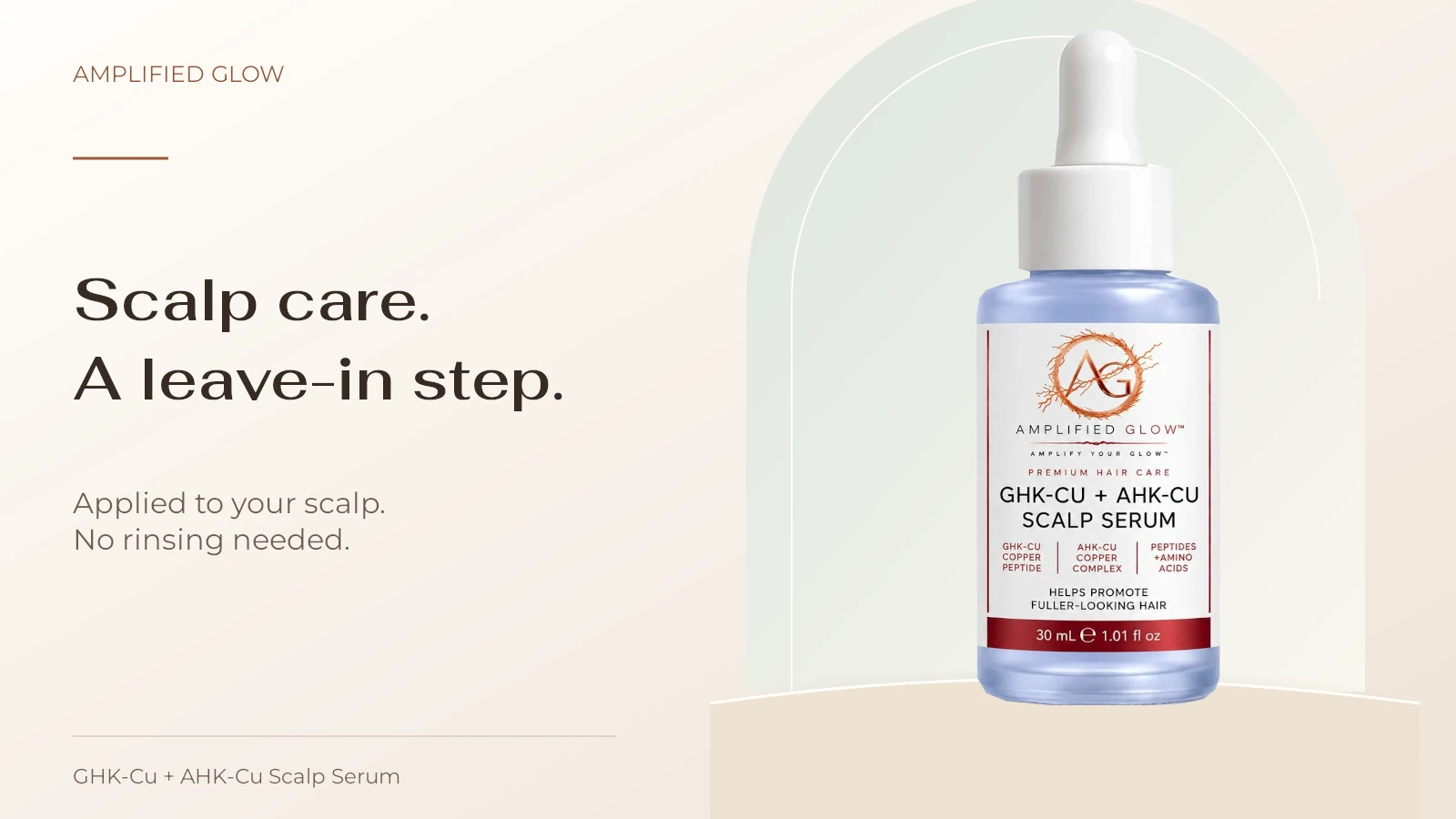
The product page describes the Amplified Glow™ GHK-Cu + AHK-Cu Scalp Serum as a lightweight leave-in formula applied directly to the scalp, without rinsing. It lists Copper Tripeptide-1, other cosmetic peptides, niacinamide, panthenol and sodium hyaluronate. That's the brand's own description of the product, not independent testing.
It's a cosmetic leave-in product, not a hair-loss treatment, and the AHK-Cu laboratory research above doesn't show how this finished product performs. Its own directions are the source for how much to use, how often and what condition the scalp should be in. View the scalp serum's ingredients and directions to judge the formula itself.
Your questions about scalp serum
These are questions that come up around this topic, answered from the sources above. Tap a question to open it.
The basics
Does scalp serum actually work?
It depends on what you're asking it to do. Hydrating, exfoliating and cosmetic peptide scalp products are different formats with different purposes, and the sources reviewed support only each manufacturer's format-level description, not results for scalp serums as a group. A practical way to judge a cosmetic scalp serum is by what you can see and feel: comfort, residue and how your hair sits afterward.
Is a scalp serum necessary?
No. It's an optional step. If your routine is working, you don't need to add one, and it's never a reason to stop a treatment a clinician advised.
Does scalp serum make hair grow?
A cosmetic scalp serum's name, or a peptide ingredient, isn't evidence that it does. The laboratory study discussed above tested a different copper complex on isolated follicles, not a finished product used by people. For hair loss, the AAD says treatment depends on the cause, so a dermatologist is the right person to ask.
Using it
Should I apply it to wet or dry hair, and before or after shampoo?
Products differ. The hydrating example above goes on clean, dry scalp and isn't washed off afterward. The exfoliating example is applied before shampooing, on dry or damp hair, then rinsed out and followed by shampoo. Read your product's label, and ask the manufacturer if it isn't clear.
Can I leave it on overnight?
Only if the label says it's a leave-in and says that's fine. One hydrating leave-in's directions suggest applying at bedtime and not washing afterward. A pre-wash exfoliating treatment is meant to be rinsed out. Don't assume from the word "serum" that a product is an overnight one. For Amplified Glow's scalp serum, the product page's own directions are the source for timing.
How often should I use it?
That's product-specific. One hydrating leave-in's label says once daily; one pre-wash treatment's label says one to two times a week. That's why this guide doesn't set a category-wide schedule. Check your own label, and remember that more frequent use isn't a demonstrated shortcut.
Will a scalp serum make my hair greasy?
Texture and ingredients vary by product, so there's no answer for the whole category. If a product leaves your hair feeling coated, check that you're using the labeled amount, that it's meant for the scalp and not the lengths, and whether it's a leave-in or a rinse-out. If it still doesn't suit you, it may simply not be the right product.
Scalp concerns and safety
What if my scalp is flaky or itchy, or I have dandruff?
The AAD says dandruff can come from several causes, including medical conditions, hair-care habits and oily skin, and that mild dandruff can usually be treated at home with regular washing and a dandruff shampoo. If it doesn't go away or is severe, a board-certified dermatologist can tell whether it's a sign of a condition such as seborrheic dermatitis, psoriasis, a fungal infection or eczema. A cosmetic hydrating serum isn't presented as a dandruff treatment.
Can I use a scalp serum with minoxidil or another hair-loss treatment?
If a clinician has advised a treatment, follow their directions. A cosmetic scalp serum is no reason to stop it, and we can't tell you how any cosmetic product combines with a medication, so ask your prescriber. The AAD stresses that effective hair-loss treatment starts with finding the cause, and lists minoxidil as one option.
Is scalp serum safe during pregnancy?
We can't give a category-wide answer, and this guide doesn't make a pregnancy-safety claim for any scalp product, including ours. Ingredients differ from product to product. If you're pregnant or planning a pregnancy, ask your clinician to review the actual ingredient list.
Sources
- American Academy of Dermatology. How to treat dandruff
- American Academy of Dermatology. Hair loss: Diagnosis and treatment
- Pyo HK, et al. The effect of tripeptide-copper complex on human hair growth in vitro. Archives of Pharmacal Research. 2007;30(7):834–839. PubMed
- The Ordinary. Natural Moisturizing Factors + HA for Scalp (manufacturer description and directions; Canadian site).
- The INKEY List. Salicylic Acid Exfoliating Scalp Treatment (manufacturer description and directions).
- OLAPLEX. What is °7 Shine Serum Oil Mist? (manufacturer instructions).