A hyaluronic acid body mist can replace your body lotion only if it's made and labeled to be your leave-on body moisturizer, meaning you apply it as the moisturizing step and leave it on. The spray bottle and the hyaluronic acid don't decide that. The finished formula and the directions on its label do.
Some body sprays are mostly water plus a water-holding ingredient, and their directions tell you to put lotion on top. That kind of spray isn't a replacement. It's an extra step. Other sprays are spray-on lotions that also contain softening and water-loss-reducing ingredients, and those can be your moisturizer. So the better question isn't 'mist or lotion?' It's this: is the product meant to be your leave-on body moisturizer, and will you actually enjoy using it?
Quick takeaway: Choose one leave-on body moisturizer whose directions make it the moisturizing step, in a texture you'll use consistently. Add a separate hyaluronic acid mist only if you want one. Watch for mists whose own label says to follow with lotion, because that brings back the extra layer you were trying to drop.
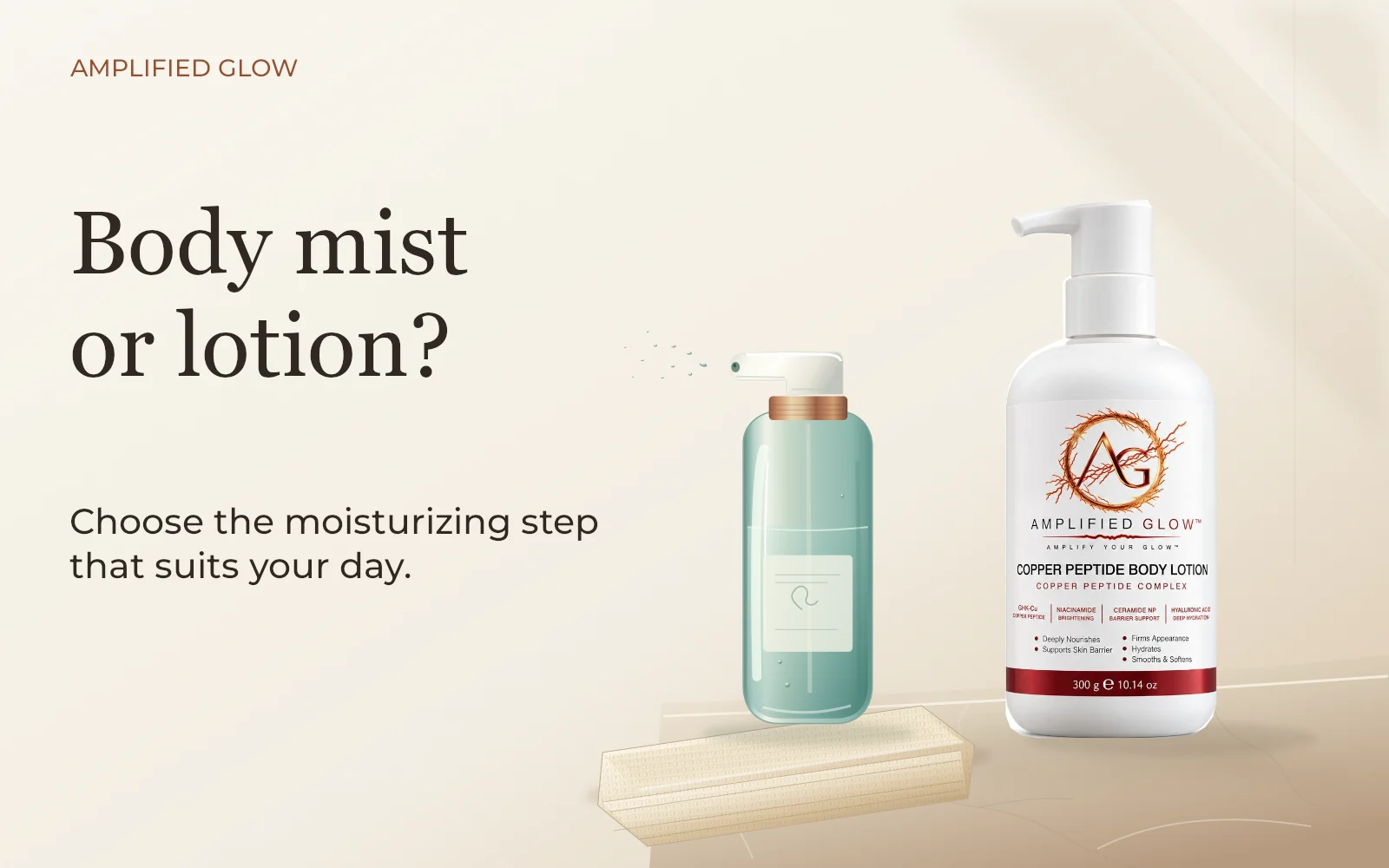
Hyaluronic acid is an ingredient, not a product type
Hyaluronic acid (often listed as sodium hyaluronate) holds onto water. It shows up in creams, lotions, gels, serums and other topical formats (Cleveland Clinic). It isn't the opposite of lotion, and plenty of body lotions already contain it.
Moisturizers generally rely on three ingredient roles, and one finished product can combine all three (DermNet):
- Humectants attract and hold water. Hyaluronic acid and glycerin both fall here.
- Emollients soften and smooth the skin's surface. Lanolin and glyceryl stearate are examples.
- Occlusives form a layer that slows water evaporating from the skin. Examples include petrolatum (petroleum jelly), mineral oil and dimethicone.
Spotting one of these names shows which roles a formula covers. It doesn't, on its own, make the product a good fit. A spray made almost entirely of humectant in water does a different job from a lotion that combines all three roles. That's why seeing 'hyaluronic acid' on a label tells you very little about whether a product can work on its own, or how it will feel. If you want more depth on the ingredient itself, our guide to peptides and hyaluronic acid covers it separately.
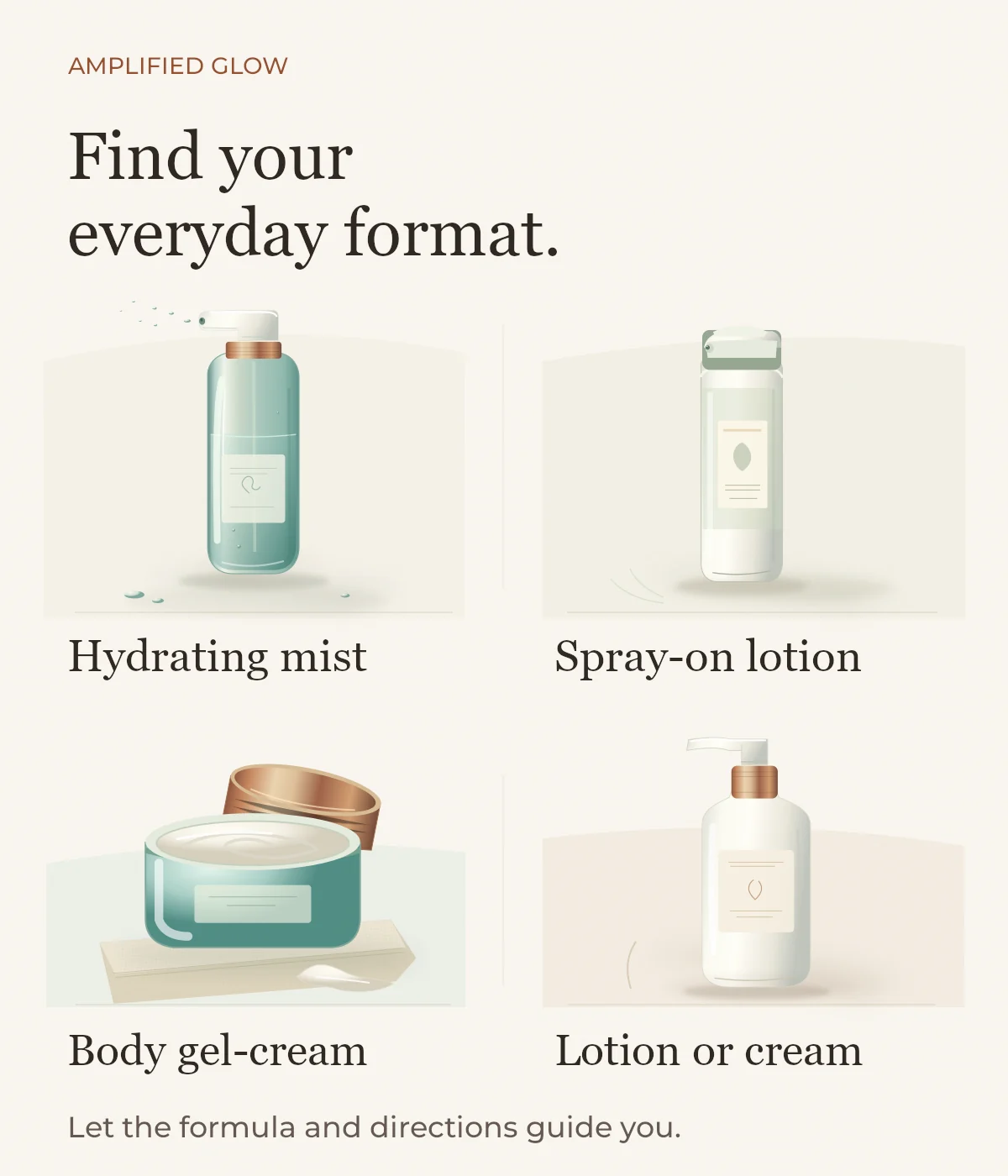
Compare the four formats by what's in the bottle
| Format | What to inspect | What it may offer | Decision caveat |
|---|---|---|---|
| Watery hydrating mist | Ingredient list, what the directions say to apply afterwards, and whether it's for the body or the face | A light spritz of humectant | If the label says to layer it under lotion, it adds a step instead of replacing one |
| Spray-on lotion | Whether it lists emollient or occlusive ingredients, and whether you're told to massage it in | Lotion-style moisturizing from a spray dispenser | The spray format alone doesn't predict the finish |
| Body gel or gel-cream | Body-use directions and the full ingredient list | Usually a lighter feel than cream | Formulas vary, and some gels still include richer ingredients |
| Lotion or cream | Directions, ingredient list and net quantity | Creams are generally richer, which can suit drier skin | Richer doesn't automatically mean more comfortable for you |
Three published product labels show how differently 'spray' and 'gel' products can be built. These examples aren't recommendations or performance claims.
- Cosmedica's hyaluronic acid body spray has a short ingredient list that includes water, sodium hyaluronate and glycerin. Its directions say to layer it under a body lotion, and the brand says it's for the body, not the face (Cosmedica).
- Vaseline Intensive Care Aloe Soothe spray isn't a hyaluronic acid product. It does show that a spray can be a lotion: its ingredients include glycerin, dimethicone and petrolatum, and you massage it in after spraying (Vaseline).
- Neutrogena Hydro Boost Body Gel Cream lists sodium hyaluronate alongside glycerin, petrolatum and dimethicone. Its directions say to apply it to dry skin as needed (Neutrogena).
What about fragranced body mists? A perfume-style body mist, a hydrating mist and a spray-on lotion are different products, even if all three mention hyaluronic acid. Read the stated purpose and directions before you treat any of them as a moisturizer. If your skin is dry or easily irritated, dermatologists generally favor fragrance-free products, and 'unscented' isn't the same promise as 'fragrance-free' (AAD).
Choose a finish you'll actually use
If a sticky feel is the reason you skip lotion, that's worth solving, because a moisturizer you avoid can't help you. Texture really does vary by format. The American Academy of Dermatology describes gels as generally lighter and creams as richer (AAD). If you love a water-gel on your face, a gel or gel-cream whose directions cover the body is a natural place to start. A thin mist isn't the same kind of product. If you're thinking of using a face moisturizer on your body, check which areas its label is meant for and follow those directions.
No label word guarantees a non-sticky result: not 'hyaluronic', not 'mist', not 'lightweight' and not 'gel'. How a product feels depends on the whole formula, how much you apply and your own skin. These are better guides than ingredient names:
- A tester, sample or real application demonstration
- Body-use directions you can realistically follow every day
- Ingredient and fragrance information you're comfortable with
- How it feels over a few ordinary uses, not just the first minute
A simple way to compare: change only the moisturizer and keep the rest of your shower routine the same. Apply it the way its label says, then ask yourself:
- Did it spread easily?
- Was there a tacky or greasy feel once you got dressed?
- Did your skin feel dry again later in the day?
- Was the scent okay?
- Do you want to use it tomorrow?
This is a personal comfort check, not a clinical test. It also can't tell you which single ingredient caused a sticky feel. Disliking a texture is also different from stinging, burning or irritation. If a product does any of those, stop using it.
Keep the after-shower routine simple
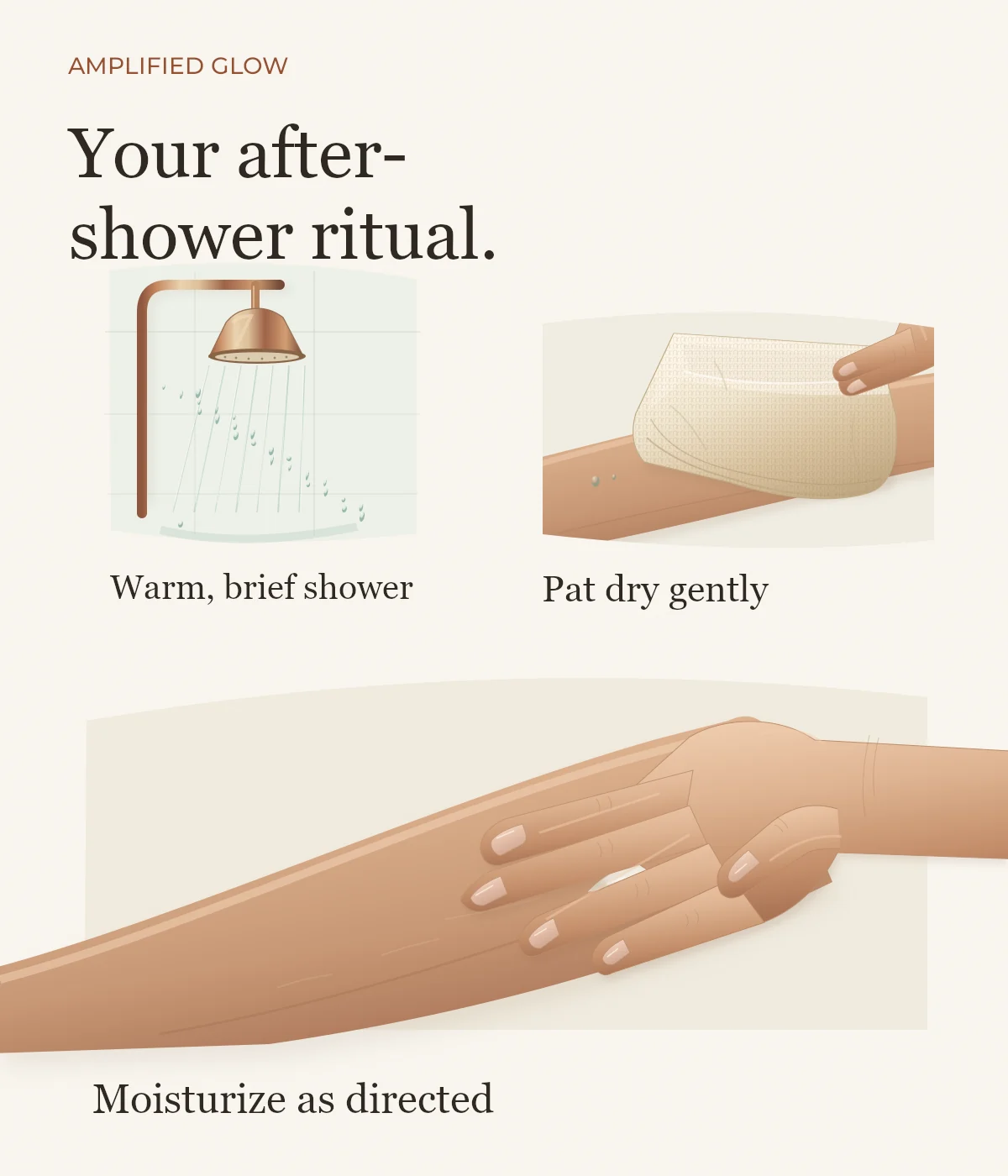
- Wash and rinse as usual.
- Towel off gently.
- Apply your leave-on body moisturizer as its label directs. As a general rule, dermatologists suggest moisturizing after a shower while skin is still slightly damp (AAD). A product's own directions still come first: some say dry skin, and others allow dry or slightly damp skin.
- That's it. If your current moisturizer keeps you comfortable, nothing is missing.
If you decide to try a different body wash later, keep your moisturizer the same while you see how the new wash feels, so you’re only changing one product at a time, and use this guide to picking a rinse-off body wash when skin feels dry.
You don't need to keep re-wetting your skin, mix products in your palm, or stack a mist, serum, lotion, balm and oil by default. A separate hyaluronic acid mist is optional, not a missing step. A hydrating product also doesn't replace sun protection, so keep sunscreen as its own step where you need it (AAD).
Compare price by labeled quantity, not bottle size
What a moisturizer costs you over time depends on how much skin you cover and how often you apply it, so it's worth comparing prices fairly. Unit pricing helps: divide the price by the net quantity and express both products in the same unit (NIST).
Hypothetical example (made-up prices, not real products):
- Product A: $12 for 200 g, so $12 ÷ 2 = $6.00 per 100 g
- Product B: $18 for 400 g, so $18 ÷ 4 = $4.50 per 100 g
Keep two cautions in mind.
- Weight and volume don't mix. Grams and ounces (oz) measure weight, or mass. Milliliters and fluid ounces (fl oz) measure volume, so an 'oz' figure and a 'fl oz' figure aren't the same kind of unit. You can't assume a 300 g lotion holds 300 mL. Converting between the two depends on the product's density, which a net quantity doesn't tell you. That means a 300 g lotion and a 120 mL mist can't be unit-priced against each other directly. Compare weight with weight and volume with volume. If two products give only different kinds of unit, unit price can't tell you which is cheaper.
- Unit price isn't use-life. It won't tell you how much you'll use each time, how many pumps or sprays that takes, how long the bottle will last or how well the product works. Bottle life depends on how much skin you cover, how often you apply and how much actually comes out.
Also remember that a mist whose label says to follow with lotion means paying for two products, not one.
One current lotion option to check
If you'd like one leave-on lotion that already includes hyaluronic acid, the Amplified Glow Copper Peptide Body Lotion is one option to look at.
- Size and role: a 300 g leave-on body lotion
- Listed ingredients include: Copper Tripeptide-1, sodium hyaluronate, Ceramide NP, squalane, jojoba seed oil and panthenol
- How to use it: apply to clean body skin that's dry or slightly damp, after bathing or whenever skin feels dry. Pump an appropriate amount into your hands, massage it in with extra attention to legs, elbows and knees, and leave it on. Use daily or as needed.
- Before first use: try a small amount on a small area. Keep it away from your eyes, and stop if irritation occurs.
It's a lotion, not a gel or a mist. If finish is your priority, judge it against your own checklist. You can read its current details and directions on the Copper Peptide Body Lotion page, or browse the body care collection to see how washing and leave-on products play different roles. If you already have a moisturizer you like, keeping it is a perfectly good choice.
When switching formats isn't the whole answer
Preferring a lighter texture is one thing. Skin that stays uncomfortable is another. If your skin still feels very dry, a richer format is worth considering before you add more layers of mist: creams are generally richer than gels, and ointments are thicker still (AAD). See a dermatologist if dryness continues or gets worse, or if your skin becomes painful, cracked, bleeding, stinging or very irritated (AAD).
Switching formats can make your routine more pleasant, but choosing a product yourself can't diagnose what's behind persistent symptoms or replace care from a dermatologist. Moisturizers do have a role in caring for some skin conditions (DermNet), so if a clinician has recommended a particular product or routine, follow that advice.
The simplest version of this whole decision: find one body moisturizer that's meant to do the job, feels good enough that you'll use it, and fits your budget by the right unit.