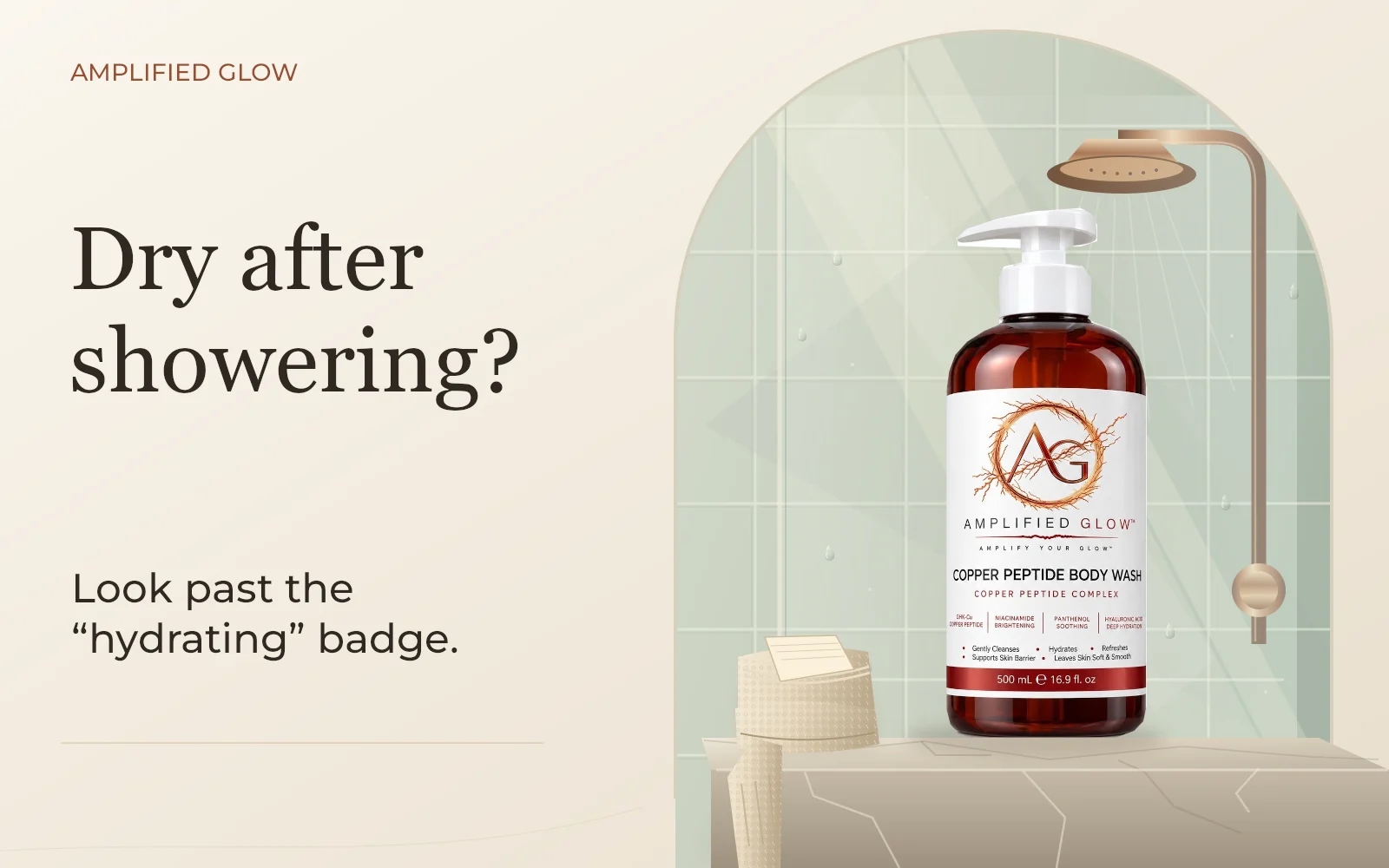
If your skin feels tight or dry after a shower, choose your next body wash by its complete label and by how your skin feels after ordinary use. A 'hydrating' badge on the front doesn't tell you much. Four checks do most of the work:
- The full ingredient list, not just the few ingredients the front of the bottle highlights.
- Fragrance information that fits what you know about your skin. For dry skin, dermatologists generally suggest a gentle, fragrance-free cleanser (AAD).
- Body-use directions you'll actually follow, including a thorough rinse.
- How your skin feels after a normal shower, rather than how much the wash foams.
Before blaming the bottle, also check the routine around it. The shower steps below are a quick place to start.
Read the whole label, not the badge
Front labels and product pages often spotlight a handful of ingredients, such as a peptide, hyaluronic acid or a vitamin. That's useful information, but it isn't the whole formula. For cosmetics sold at retail in the US, ingredients are generally listed in descending order of predominance (FDA). Use that as a rough guide to what a formula is mainly built from, not as a precise ranking of every ingredient's amount. The list doesn't give percentages either.
Here's why the whole formula matters. A body wash cleans with surfactants, ingredients that let oil and grime mix with water so they can be rinsed away. How a cleanser treats your skin depends on the complete system. Supporting ingredients such as co-surfactants, glycerin and certain polymers can change how the surfactants behave (formulation review). That's why one featured ingredient, or one 'free-from' claim, rarely tells the full story. The same goes for hyaluronic acid or a peptide in a rinse-off product: its presence doesn't, by itself, establish how the cleansing system behaves.
| What to check | Why it matters | How to use it |
|---|---|---|
| Complete ingredient list | Featured ingredients aren't the full formula | Compare candidates on their full lists, and look for anything you already know bothers you. If a list is missing, incomplete or hard to read, ask the seller or manufacturer for the complete current list (FDA) |
| Fragrance wording | 'Unscented' products can still contain masking fragrance (FDA). Fragrance ingredients may be grouped together rather than named one by one (FDA), and plant-derived fragrance can matter too (FDA) | If fragrance has bothered you before, look for 'fragrance-free' and still read the list. Ask the manufacturer about anything unclear |
| 'Hypoallergenic' or 'for sensitive skin' | These claims don't guarantee you won't react (FDA) | Treat them as a starting point, not a final answer |
| Directions and intended area | Products differ on body versus face use and on how to rinse | Follow the directions and use the product only where its label covers |
If the ingredient names mean nothing to you, that's normal. You don't need to decode them, and an unfamiliar name doesn't tell you whether a wash is mild or harsh. Focus on what you can check: whether the list includes anything you already know bothers you, what the label says about fragrance, and whether the directions and intended body area fit how you'll use it. If any of those is missing or unclear, get the answer before you buy.

Lather is a preference, not a dry-skin test
Plenty of people like a rich lather, and a low-foam wash can feel as if it didn't clean properly. That's a reasonable preference. Foam alone, though, isn't enough to judge whether a wash is mild or suits dry skin. How much a product foams depends on its whole formulation, and formulation research treats foaming and mildness on the skin as separate questions (formulation review).
For dry skin, the AAD advises using only enough cleanser to remove dirt and oil, without working up a thick lather (AAD). So a low-foam wash that otherwise feels comfortable doesn't need extra pumps. If foam really matters to you, look for a wash that lathers and still passes your comfort check after rinsing.
Shower gel isn't your only option. Body cleansers also come as:
- non-foaming lotions and creams
- foaming gels, creams and oils
- soap-free bars
Some brands sell both a non-foaming cleanser and a foaming oil cleanser labeled for body use (CeraVe). Still, the format name doesn't settle comfort. A creamy-looking wash isn't automatically milder, and not every bar is traditional soap. Read the label and the rinse directions either way.
Check the shower before buying another wash
Start with these basics (AAD):
- Use warm, not hot, water and keep showers brief.
- Use the amount your wash's label suggests, and wash gently.
- Rinse thoroughly.
- Pat dry instead of rubbing.
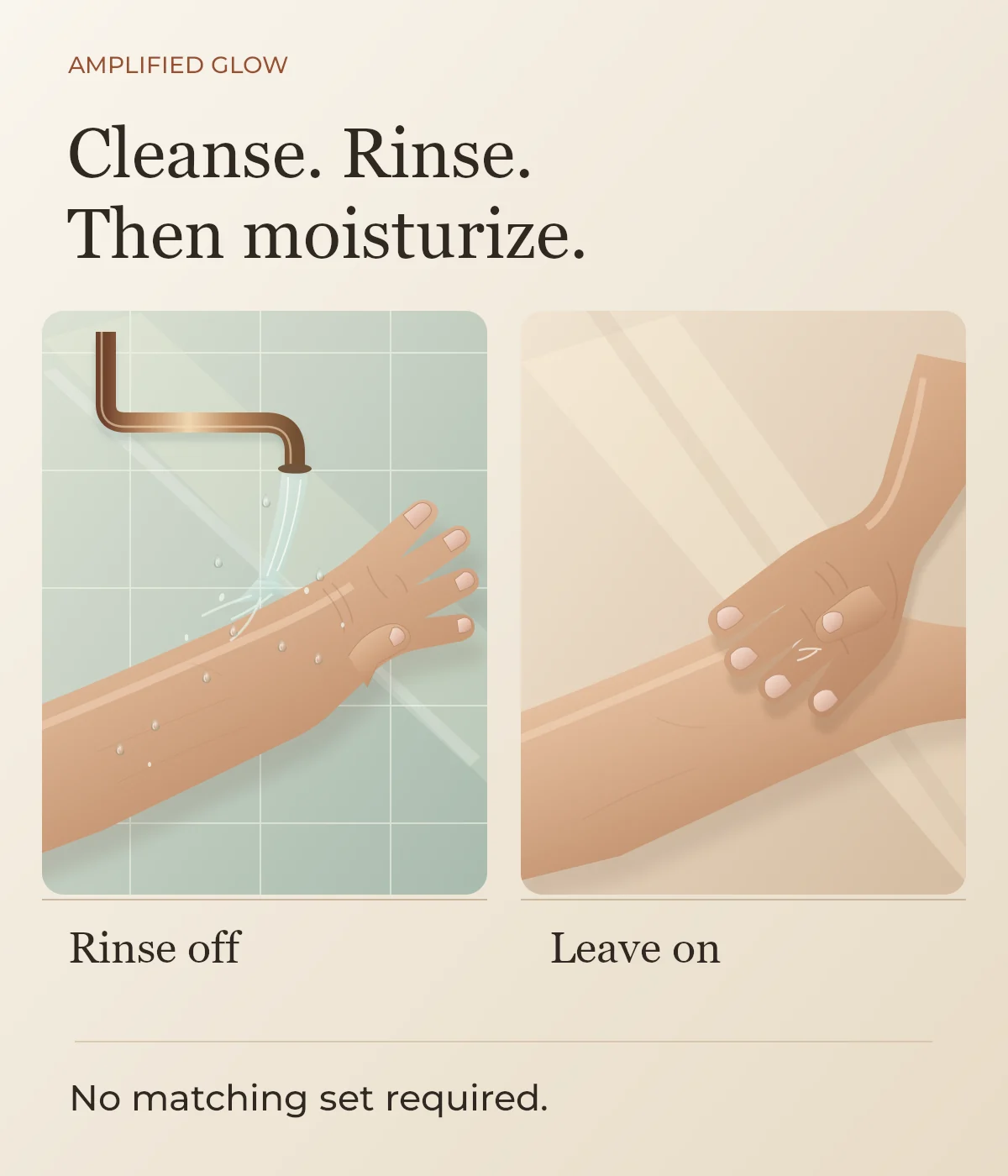
- Apply a leave-on moisturizer while your skin is still slightly damp (AAD).
One point often causes confusion: a body wash is rinsed away, even when it's called 'hydrating' or contains hyaluronic acid. Moisturizer is the separate, leave-on step (AAD). Choose a body moisturizer suited to dry skin, such as a lotion or cream labeled for the body. A leave-on product you enjoy for another purpose, like a perfume, serum or sunscreen, isn't necessarily a substitute. Your moisturizer doesn't have to match your wash. There's no need to add a scrub or a second cleanse to this routine.
Replacing a body wash you liked
If a favorite has been discontinued or reformulated, start by writing down what you actually liked about it. Copy the table below into a notes app or onto paper and fill it in as you shop. A shared headline ingredient, such as the same peptide, doesn't make a new product a duplicate. Different formulas can feel very different.
| What you liked | Your old wash | Candidate | Confirmed how? |
|---|---|---|---|
| Lather level | |||
| Scent, or lack of scent | |||
| Texture in the hand | |||
| How skin felt after rinsing | |||
| Directions (amount, body area) | |||
| Ingredients you know you react to |
In the last column, note where the information came from: the label, a tester, a sample or an answer from the manufacturer. Treat marketing adjectives as unconfirmed until something backs them up. This method works whatever brand you end up choosing.
Hypothetical example (invented products, for illustration only): Say your old wash was fragrance-free, labeled for body use, and left your skin comfortable after rinsing. A candidate's front label says 'unscented', and its product page shows only a few featured ingredients. Your notes might read:
- Scent: the candidate says 'unscented', which isn't the same as fragrance-free. Confirmed how? Not yet. Check the full list or ask.
- Ingredients you react to: can't be checked until you have the complete list.
- Directions: body use, rinse thoroughly. Confirmed how? Label.
- How skin felt after rinsing: unknown until you've tried it following its label.
That candidate isn't ruled out, but two label checks are still open before you buy: scent and the complete ingredient list. Ask for the complete current ingredient and fragrance information first. How your skin feels after rinsing is something you'll only learn later, by following its label and the small-area approach below.
Trying a new wash safely
Before using a new wash all over, try it on a small area, following its label. One use isn't the whole test: the American Academy of Dermatology describes repeating a small-area test before moving to wider use. Follow the complete approach in its guide to testing skin care products before you use the wash on your whole body. It's still a rinse-off product, so each time, wash and rinse as directed instead of leaving it on like a treatment. If redness, itching or stinging develops, wash the product off and stop using it. A home test isn't medical allergy testing, and a calm result doesn't guarantee you'll never react.
Some situations call for a dermatologist rather than another product switch (AAD):
- dryness that continues despite a gentler routine and regular moisturizing
- skin that becomes painful, cracked or bleeding
- skin that stings or is very irritated
Choosing among everyday cosmetic body washes like the ones discussed in this guide, including Amplified Glow's, can make a shower more comfortable, but none of them is a treatment for an ongoing skin problem.
Where Amplified Glow's body wash fits
The Amplified Glow Copper Peptide Hydrating Body Wash is a 500 mL / 16.9 fl oz rinse-off body cleanser.
- Featured ingredients: Copper Tripeptide-1, niacinamide, panthenol, sodium hyaluronate and tocopheryl acetate, along with botanical extracts.
- How to use it: wet your body with warm water and put an appropriate amount on your palms or a loofah. Lather, massage gently, rinse thoroughly, then follow with a body lotion.
- Before first use: the product page suggests a small-area lather-and-rinse test first, and stopping if irritation occurs.
Run it through the same checks as any other wash. Look at its current product details and the bottle label for ingredient and scent information. If you can't find a complete, current ingredient list or clear fragrance information in either place, ask Amplified Glow for it before buying, especially if you know certain ingredients or fragrance bother you. Then use the small-area approach above and judge how your skin feels after normal use. You can review the Copper Peptide Hydrating Body Wash details and directions there.
If you'd like a leave-on step to follow, the Copper Peptide Body Lotion is a 300 g body moisturizer sold separately. It's an optional choice, and you can keep using a suitable body moisturizer you already have instead. The body care collection shows how the wash and leave-on products play different roles.
Your next step
You don't need to apply every check at once. Pick the two or three that match your situation:
- Skin tight after every shower: review the shower steps and the full label.
- Fragrance has bothered you before: focus on fragrance wording and your known sensitivities.
- Replacing a favorite: fill in the worksheet before you shop.
Then judge your choice by how your skin feels as you keep using it in normal showers. That's a comfort check, not a countdown: if redness, itching or stinging develops at any point, wash the product off and stop using it.
A few quick answers
Does 'sulfate-free' mean a wash won't dry my skin? Not necessarily. How a cleanser treats your skin depends on its whole surfactant system and the ingredients supporting it, so a single 'free-from' claim doesn't predict comfort (formulation review).
Can I use body wash on my face? Only if its label includes the face. Some cleansers are labeled for both face and body, while others are made for the body only. The Amplified Glow Copper Peptide Hydrating Body Wash is a body cleanser, so keep it to the body.