Original research
Peptide skincare prices and ingredient disclosures
A 200-product snapshot, with serum and moisturizer findings reported separately.
What the 200-product snapshot found
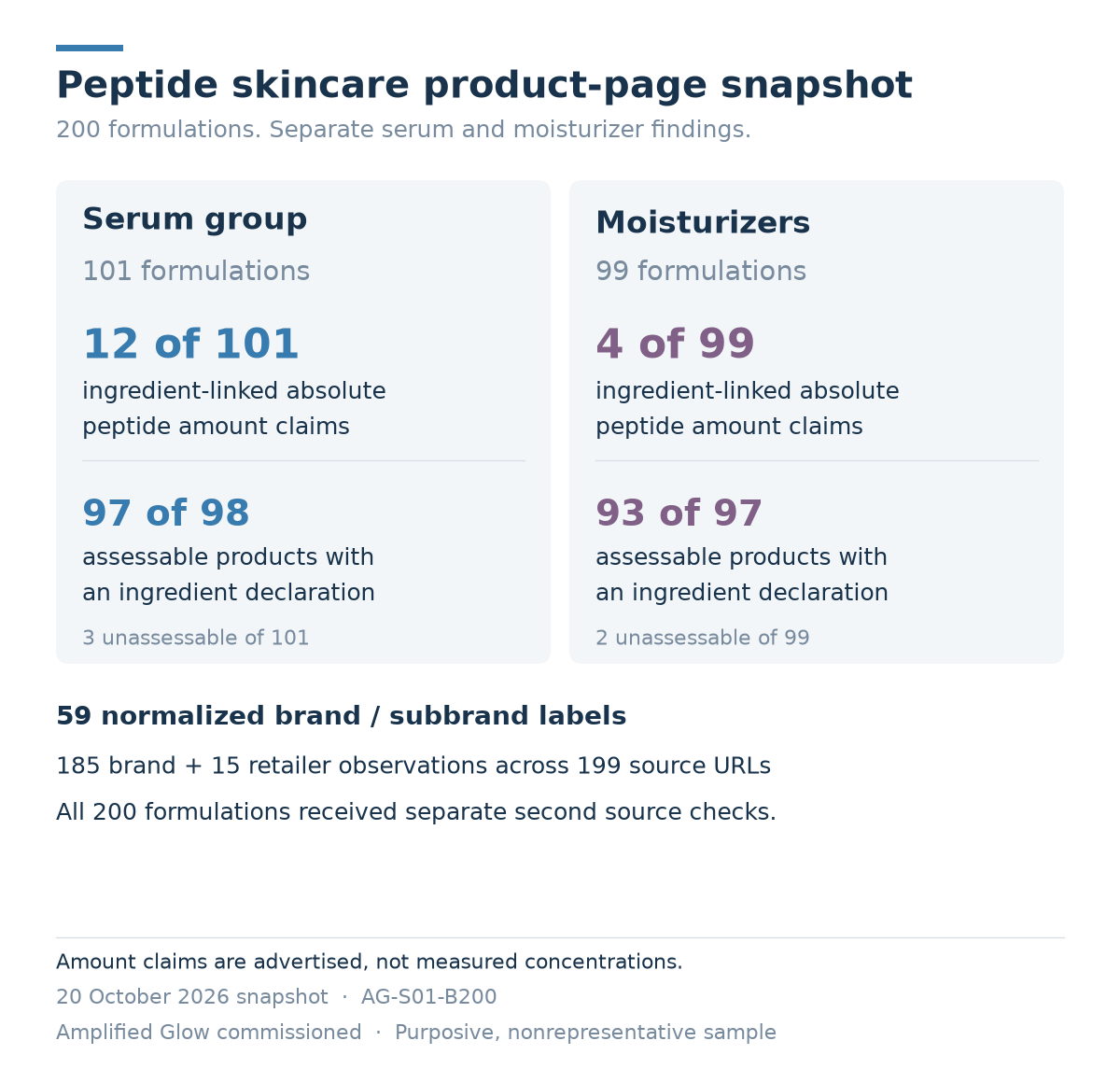
On 20 October 2026, we recorded price and ingredient information from the product pages of 200 distinct peptide face serum and moisturizer formulations offered to US shoppers.
- Ingredient declarations: almost every product we could assess had one on its page. That held for 97 of 98 assessed serum-group products and 93 of 97 assessed moisturizers.
- Peptide amounts: far fewer pages stated an absolute amount tied to a named peptide or peptide family. That appeared for 12 of 101 serum-group products and 4 of 99 moisturizers.
- Prices: for products sold by volume, the median current one-time price was $28.95 per 30 mL for serums (95 products) and $22.80 per 30 mL for moisturizers (62 products). Every price group spanned a wide range.
Who commissioned this study
Amplified Glow operates a skincare business and commissioned this benchmark. It is a brand-led study. It is not the work of an independent testing laboratory or a clinical institution. None of our own products are in the sample.
We asked two questions:
- What prices do US-facing sellers advertise for topical peptide face serums and moisturizers?
- What ingredient information can a shopper see before buying?
The product-level observations behind every figure below are in the accompanying study workbook. This includes the source URL for each of the 200 products.
Serum prices per 30 mL and 30 g
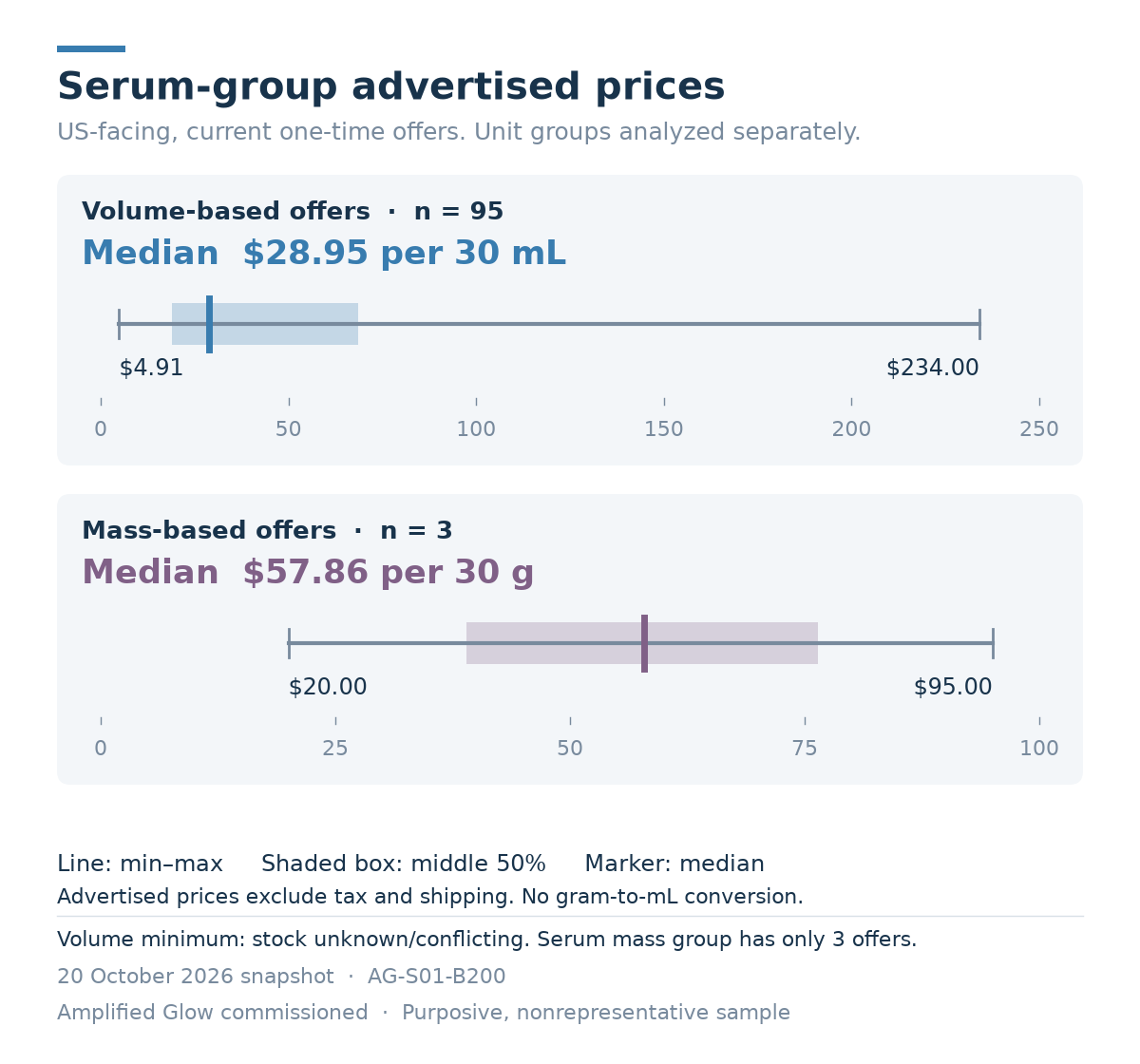
Of the 101 serum-group products, 95 were sold by volume and 3 by declared mass. The other 3 had sizes we could not resolve, such as an ounce figure with no fluid or net-weight qualifier. Those 3 are left out of the unit price figures only. They remain in every disclosure count.
Serum group in USD per 30 mL
| Price basis | Products | Median | Lowest | Highest |
|---|---|---|---|---|
| Current one-time price | 95 | $28.95 | $4.91 | $234.00 |
| Advertised regular or reference price | 95 | $28.95 | $5.00 | $234.00 |
| Current price, in-stock listings only | 80 | $28.98 | $5.00 | $234.00 |
Current sale prices lowered the bottom of the range. The median was the same on current and reference prices.
The lowest current offer, $4.91 per 30 mL, had unknown or conflicting stock status. The ranges describe advertised listings and do not show that every offer could be bought that day.
Serum group in USD per 30 g
| Price basis | Products | Median | Lowest | Highest |
|---|---|---|---|---|
| Current one-time price | 3 | $57.86 | $20.00 | $95.00 |
For these three products, advertised reference prices and in-stock figures matched the current prices. With only three products in this group, the figures describe those listings and not serums sold by mass in general.
Product-level prices, sizes and detailed quartiles for both serum groups are in the study workbook.
Serum group disclosure findings
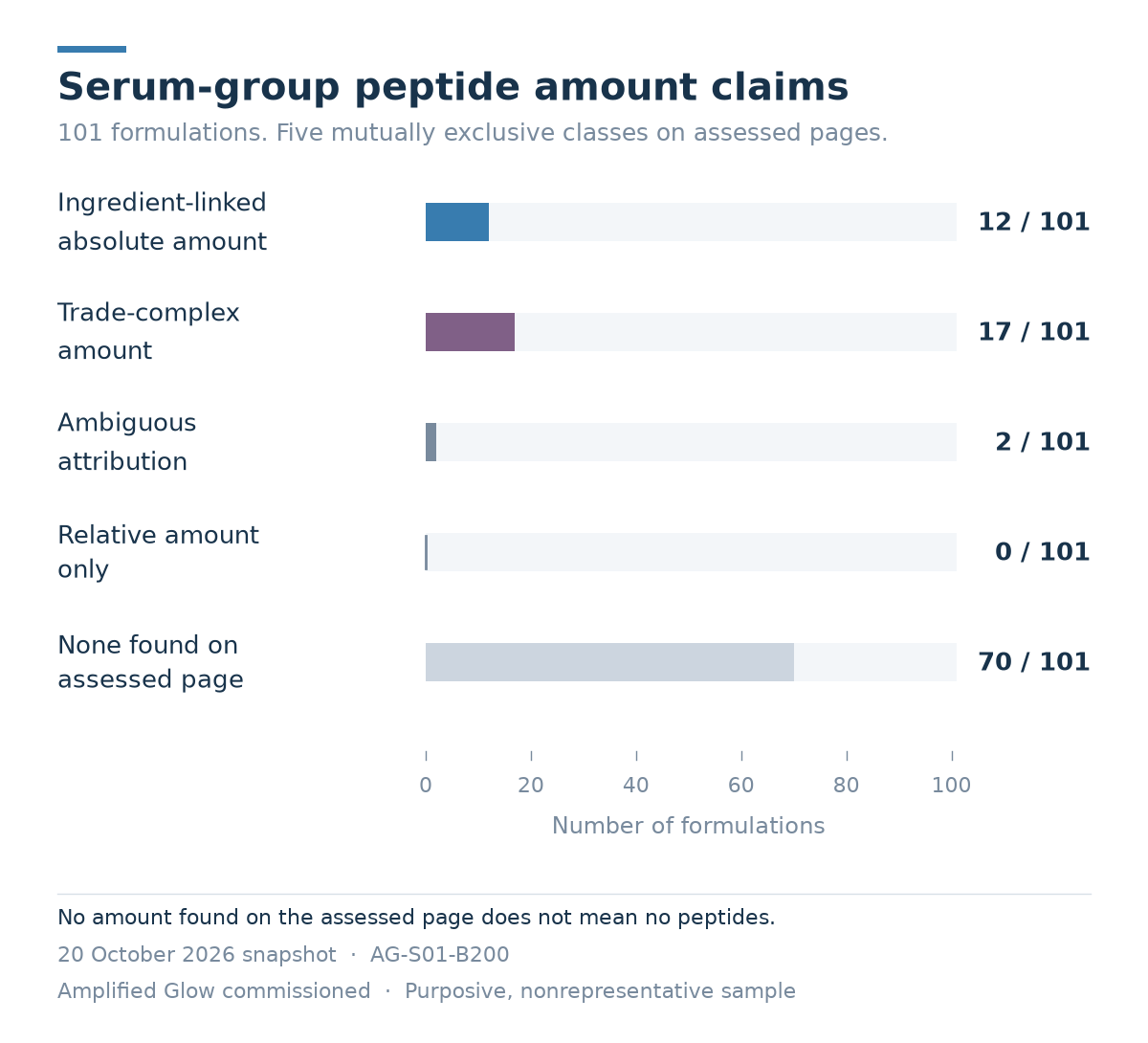
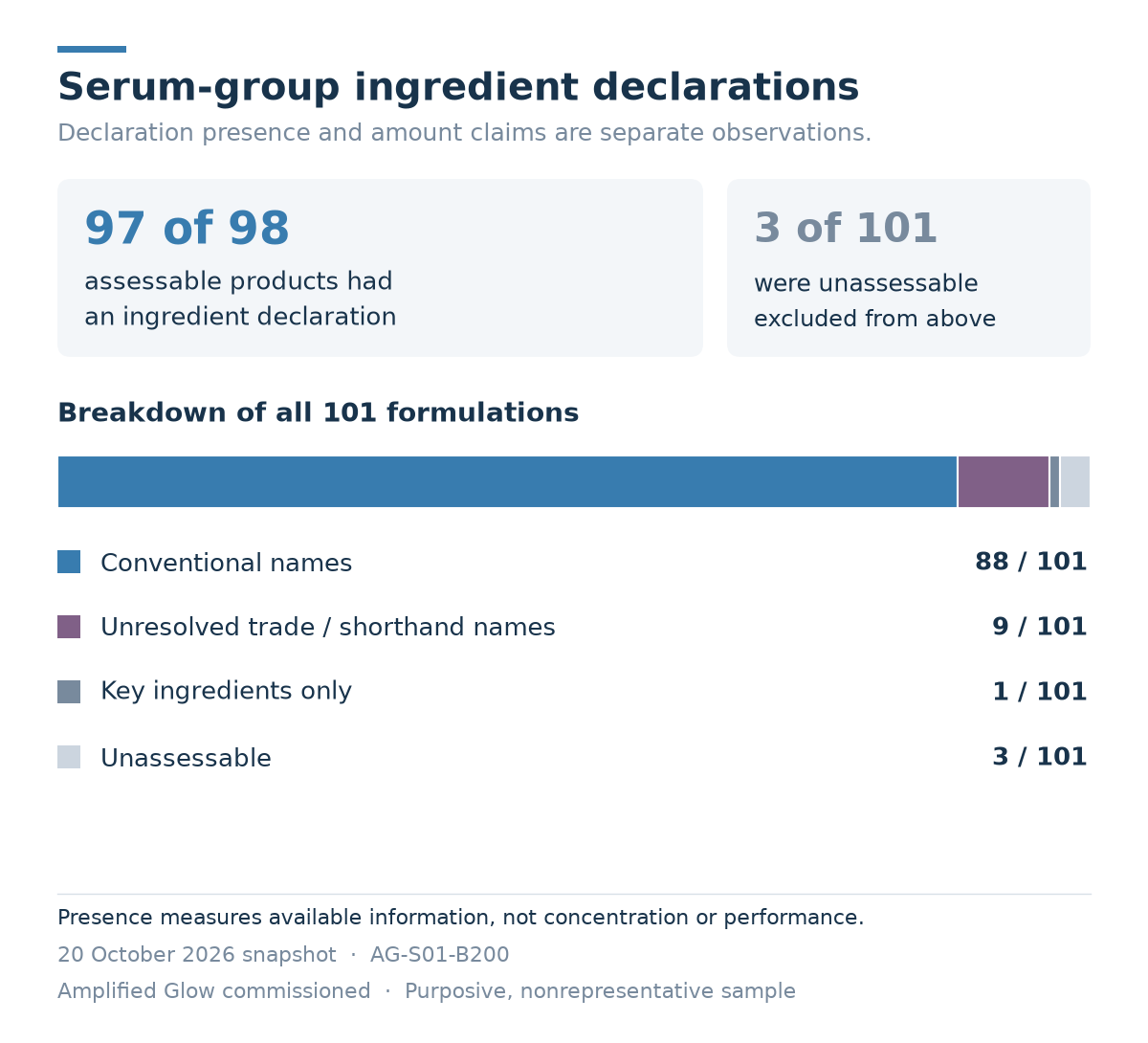
Ingredient declarations were assessable for 98 of the 101 serum-group products. Amount codes were assigned for all 101.
| Finding | Serum group products |
|---|---|
| Declaration with conventional ingredient names | 88 of 98 assessed |
| Declaration including unresolved trade or shorthand names | 9 of 98 assessed |
| Key ingredients only | 1 of 98 assessed |
| Ingredient-linked peptide amount | 12 of 101 |
| Complex amount | 17 of 101 |
| Ambiguous number | 2 of 101 |
| Relative only | 0 of 101 |
| None found | 70 of 101 |
Ingredient declarations were present for 97 of 98 assessed serum-group products, and 3 were unassessable.
In total, 31 of 101 serum-group products were coded into an amount-related category:
- 12 ingredient-linked
- 17 complex
- 2 ambiguous
This total is not a count of every page carrying peptide-related numbers. Products coded none found can still show peptide-type counts, numbers in product names or performance figures. Among the 31, a stated figure was more often attached to a trade complex than to a named peptide.
One of the treatment essences shows why product names need care. On Jumiso's Snail Mucin 95% + Peptide Essence page, the 95% is attached to snail mucin, not to peptides. The page's reference to five peptides is a count of peptide types, not an amount.
The product-level coding is on the Benchmark disclosures sheet of the study workbook.
Moisturizer prices per 30 mL and 30 g
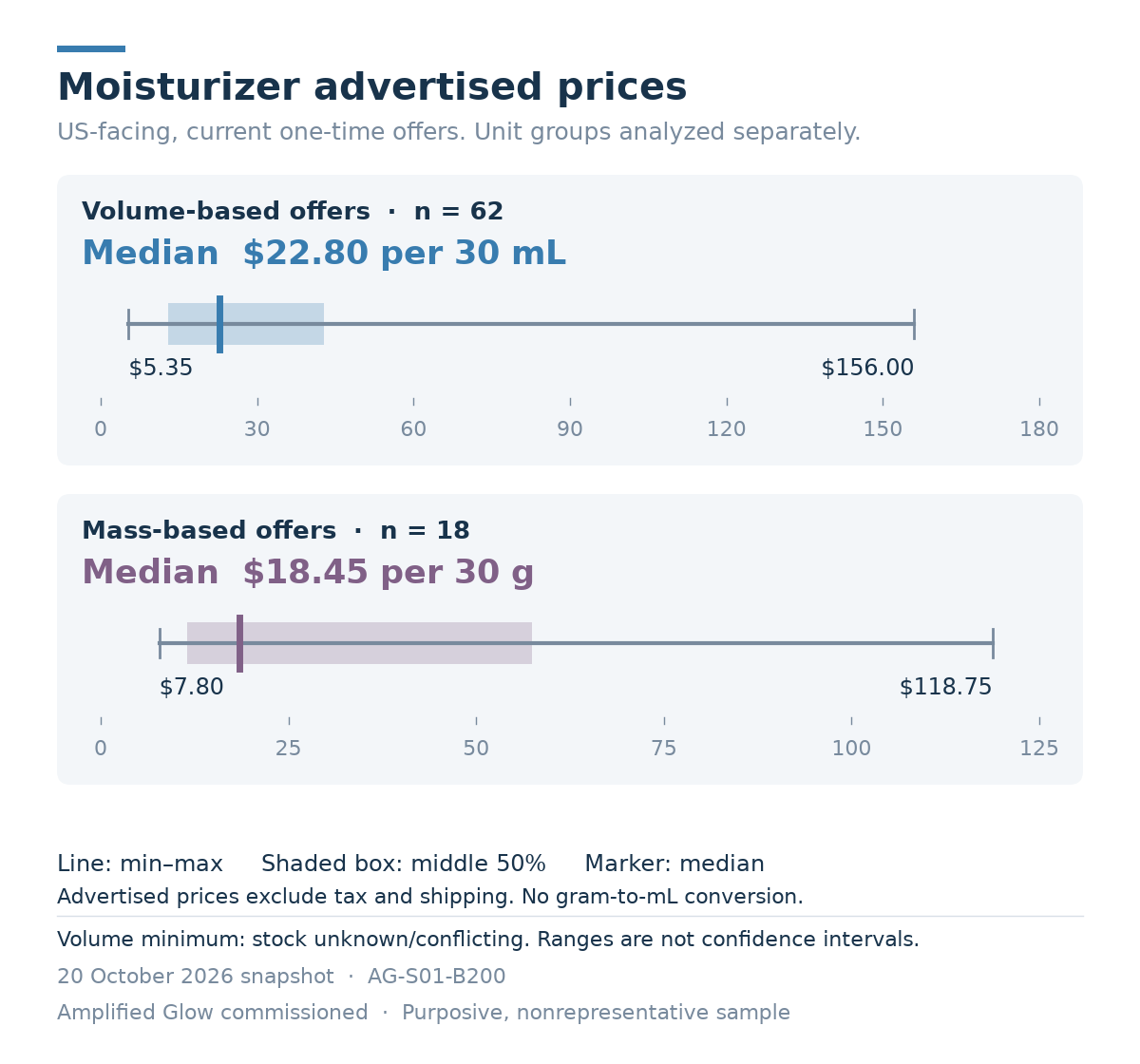
Of the 99 moisturizers, 62 were sold by volume and 18 by declared mass. The remaining 19 had unresolved units and are left out of the unit price figures only.
Moisturizers in USD per 30 mL
| Price basis | Products | Median | Lowest | Highest |
|---|---|---|---|---|
| Current one-time price | 62 | $22.80 | $5.35 | $156.00 |
| Advertised regular or reference price | 62 | $22.80 | $7.50 | $156.00 |
| Current price, in-stock listings only | 55 | $25.20 | $6.38 | $156.00 |
Moisturizers in USD per 30 g
| Price basis | Products | Median | Lowest | Highest |
|---|---|---|---|---|
| Current one-time price | 18 | $18.45 | $7.80 | $118.75 |
| Advertised regular or reference price | 18 | $19.40 | $7.80 | $118.75 |
| Current price, in-stock listings only | 12 | $17.40 | $7.80 | $118.75 |
The lowest current per-30-mL offer, $5.35, also had unknown or conflicting stock status. Limiting the volume group to in-stock listings raised its median from $22.80 to $25.20.
In the mass group, the median was $18.45 on current prices and $19.40 on advertised reference prices.
Stock status across all 200 products on 20 October 2026:
- 170 listings were in stock.
- 2 were out of stock.
- 28 had unknown stock.
Product-level prices, sizes and detailed quartiles for both moisturizer groups are in the study workbook.
Moisturizer disclosure findings
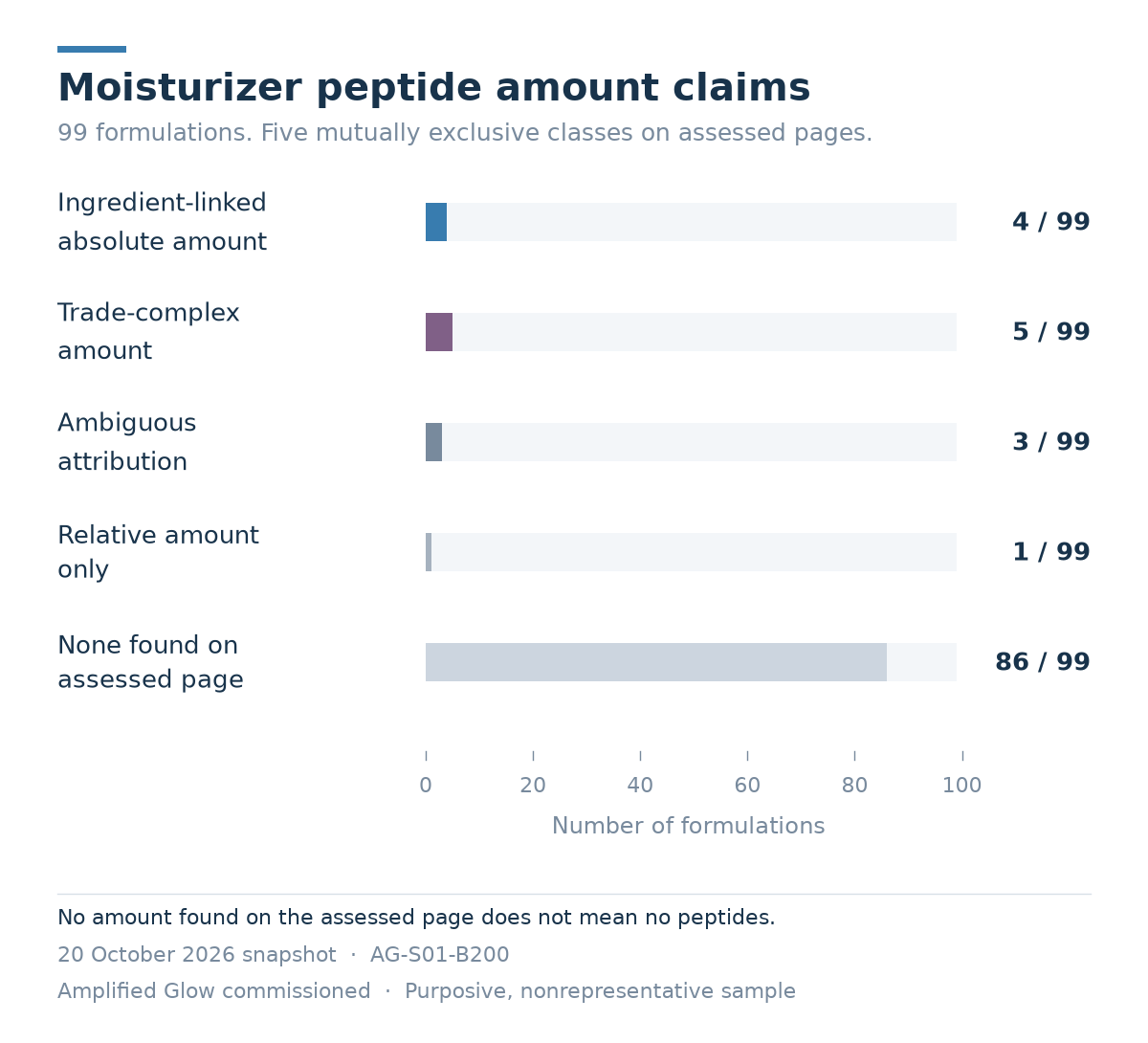
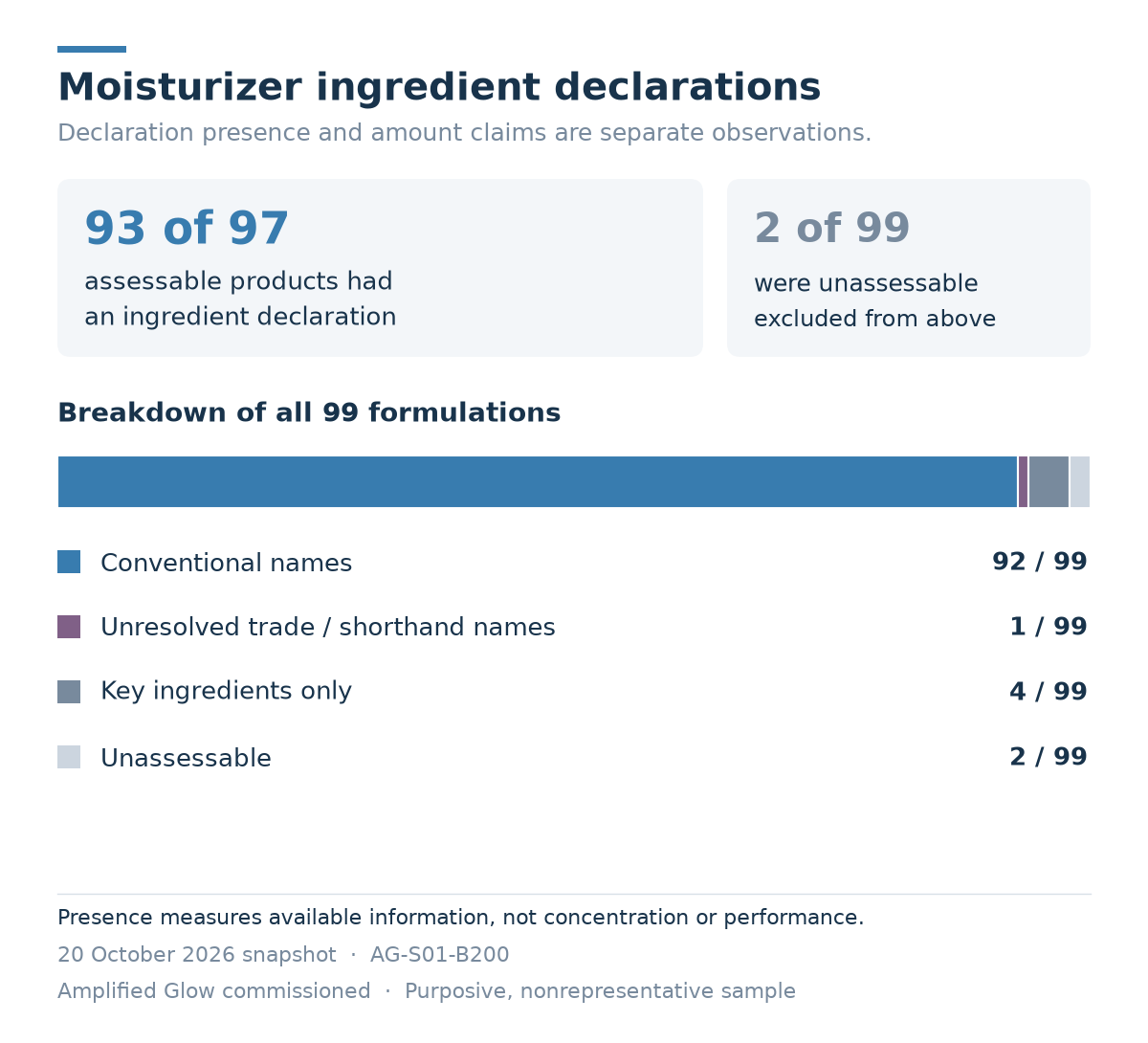
Ingredient declarations were assessable for 97 of the 99 moisturizers. Amount codes were assigned for all 99.
| Finding | Moisturizers |
|---|---|
| Declaration with conventional ingredient names | 92 of 97 assessed |
| Declaration including unresolved trade or shorthand names | 1 of 97 assessed |
| Key ingredients only | 4 of 97 assessed |
| Ingredient-linked peptide amount | 4 of 99 |
| Complex amount | 5 of 99 |
| Ambiguous number | 3 of 99 |
| Relative only | 1 of 99 |
| None found | 86 of 99 |
Ingredient declarations were present for 93 of 97 assessed moisturizers, and 2 were unassessable.
In total, 13 of 99 moisturizers were coded into an amount-related category:
- 4 ingredient-linked
- 5 complex
- 3 ambiguous
- 1 relative only
As with serums, this is not a count of all peptide-related numbers on moisturizer pages.
The product-level coding is on the Benchmark disclosures sheet of the study workbook.
How we built the sample
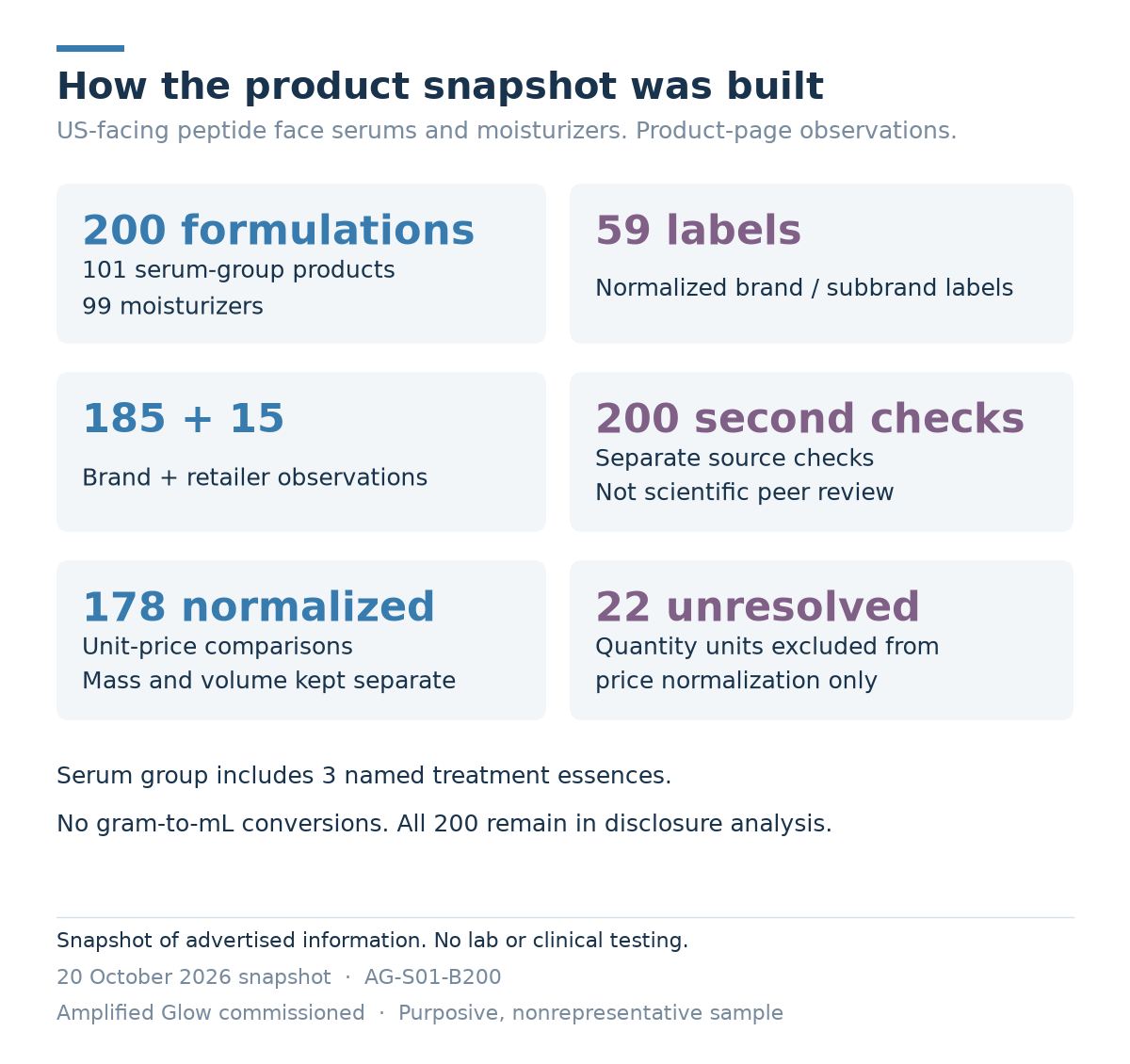
This is a purposive benchmark of products. It is not a random or representative sample of the US market, and it is not comprehensive.
The unit of observation is the product formulation, not the web page. One shared Medicube serum page offered two distinct formulas, Salmon DNA PDRN and Rose PDRN (Vegan). Each had its own ingredient declaration. We recorded them as two separate products.
We kept the 20 formulations from an earlier pilot, counting each once. We then added 180 more eligible formulations. The final set covers 59 normalized brand and sub-brand labels. The workbook's raw brand column shows 60 strings only because Paula's Choice is entered with both a straight and a curly apostrophe. These labels are not necessarily 59 separate companies. Brands contribute unequally, from one product to eight, under an intended cap of eight per brand.
Which products qualified
A product qualified if it met both of these conditions:
- It was a leave-on cosmetic face serum or face moisturizer.
- It marketed peptides explicitly or named a peptide in an accessible ingredient declaration.
Overnight sleeping creams and masks counted as moisturizers when their directions called for full-night facial use.
The study was limited to cosmetics. We excluded:
- oral, injectable, eye-only, scalp, rinse-off and body-only products
- sunscreens
- peptide products sold for research use only
- over-the-counter drug products
Extra sizes, refills, bundles and duplicate retailer listings of the same formula did not add observations.
How we grouped serums and moisturizers
The serum group holds 101 products. Three of them are leave-on treatment essences:
- Numbuzin No.9 NAD+ BIO Lifting-sil Essence
- Jumiso Snail Mucin 95% + Peptide Essence
- Medi-Peel Peptide 9 Volume All In One Essence
We grouped these three with serums because each is positioned as a leave-on treatment step. We did not do this simply because they are applied after cleansing, which is also true of many ordinary toners. Each placement had a specific basis:
- Jumiso's official store lists its essence in its Serum & Cream collection.
- YesStyle listed the Medi-Peel essence under Face Serums in the listing we captured on 20 October 2026 (dated extract). That category path did not appear in the page text we assessed on 21 October, so this placement reflects the retailer listing at the time of collection.
- Our analysts mapped the Numbuzin No.9 essence to the serum group based on its treatment-essence positioning and leave-on, all-over-face directions. Numbuzin calls it an essence, so this placement is our mapping, not a manufacturer serum label.
These are named exceptions. We did not treat essences or toners in general as serums, and we are not suggesting these makers call their products serums.
The moisturizer group holds 99 products.
Where the data came from
For 185 products, the source was an official US-facing brand page. For the other 15, it was a US-facing retailer page.
A page counted as US-facing if it offered a US dollar price and we verified that the product was eligible for delivery to the US. We checked delivery eligibility only. We did not place orders or confirm completed shipments. Some retailer listings come from overseas sellers. We excluded unaffiliated marketplaces and unknown third-party sellers.
How we recorded prices
Each price is the one-time USD price before tax and shipping for the default standard size. Where no default was set, we used the smallest standard full size of at least 15 mL or 15 g. We did not choose the cheapest size.
We excluded subscriptions, coupons, loyalty pricing and first-order offers. Some pages showed an unconditional public sale. In those cases we recorded the sale price and the advertised regular or reference price for the same size. Such a sale appeared on 36 listings.
Reference prices are recorded as each page displayed them. They do not establish a price history, and they do not show that shoppers paid that amount before the sale.
How we calculated unit prices
We converted ounces only when the page identified fluid ounces or net weight. We never converted grams to milliliters.
To compare packs of different sizes, we used this calculation:
- price divided by the declared pack amount, multiplied by 30
The result is a price per 30 mL or per 30 g. This is a comparison figure only, and a 30 mL or 30 g pack is not necessarily offered for sale. Values are rounded to the nearest cent.
How we checked the data
A second reviewer, separate from the original collector, rechecked all 200 rows against their sources. The check covered:
- price and size pairing
- currency and units
- ingredient declaration status
- peptide amount category
Disagreements were resolved and the corrections kept. This was a check of data collection, not scientific peer review.
Terms used in this article
Ingredient declaration codes
- Ingredient declaration present: we found a product ingredient list. It may use conventional ingredient names or include unresolved trade or shorthand names. A list of key ingredients alone does not count.
- Unassessable: we could not reliably read the declaration or match it to the selected formula. We treat this as unknown, not as missing.
Peptide amount codes
- Ingredient-linked amount: an absolute number that the product page attaches to a named peptide or peptide family. It may be printed as a percentage, ppm, ppb or ppt. This is the amount published on the page, whether a brand page or a retailer page. It is not a measured or verified pure peptide concentration.
- Complex amount: a figure the product page attaches to a trade material, solution or blend. It does not state the amount of each peptide within that material.
- Ambiguous: a number whose link to peptide content is unclear, such as an undefined measure of peptide "power".
- Relative only: a clear comparison of peptide content against an identified baseline, with no absolute figure.
- None found: no eligible numerical peptide amount on the assessed page. This does not mean the product lacks peptides or that anything was concealed.
Numbers that do not count as peptide amounts
Wherever they appear, these never count:
- counts of peptide types
- percentages assigned to nonpeptide ingredients
- arbitrary numbers in product names
We did not exclude product titles automatically. If a title explicitly linked an amount to a named peptide or peptide family, and the page supported that peptide identity, it could qualify like any other wording on the page.
How we assigned one code per product
Each product received one amount code. That code is the highest-priority category its page supported, in this order:
- ingredient-linked amount
- complex amount
- ambiguous
- relative only
- none found
The assigned code shows only the highest category reached. A product coded as ingredient-linked may also carry complex or relative wording elsewhere on its page.
We recorded ingredient declaration status separately. Content we could not assess was coded as unassessable, not as absent.
Four examples from the product pages
NIOD Copper Amino Isolate Serum 3 1:1
NIOD's Copper Amino Isolate Serum 3 1:1 (CAIS3) page assigns separate figures to two named peptides: "1% GHK-Cu and 1% GHK". We coded this as an ingredient-linked amount.
We found no mass or volume basis for those percentages in the assessed page content. We did not calculate chemical equivalence, purity or a basis for them. They are figures the brand advertises, not measurements.
Geek & Gorgeous Power Peptides
Geek & Gorgeous's Power Peptides page lists "3% Matrixyl 3000" along with percentages for three other named peptide materials. Because these figures describe trade materials, we coded the claim as a complex amount.
The assessed page does not state how much of each individual peptide those materials contain. We did not try to derive those amounts from the material percentages. Adding the four percentages together would not produce a peptide concentration.
Olay Collagen Peptide MAX Moisturizing Cream
Olay's Collagen Peptide MAX Moisturizing Cream page claims 2X the collagen peptide. A footnote names the base Collagen Peptide 24 formula as the comparison. This is the one relative-only claim in the sample.
The assessed page does not give an absolute amount for either formula, so 2X cannot be read as a percentage. The page separately advertises 24 hours of hydration. We did not treat the 24 in the comparator's name as a peptide amount.
Naturium Multi-Peptide Moisturizer
Naturium's Multi-Peptide Moisturizer page lists its standard pack as "Standard 1.7 OZ / 50 G" and links a separate 100 mL jumbo size.
We used the standard 50 g pack, priced at $20 on 20 October 2026 as recorded in the study workbook, and placed it in the moisturizer per-30-g group. Its unit price works out to $12.00 per 30 g ($20 divided by 50, multiplied by 30). We did not treat 50 g as 50 mL, and the jumbo did not count as a second product.
What labels let you compare
Using these rules, a shopper or journalist can check a few things directly from a product page:
- Is a full ingredient declaration published?
- Do named peptides appear in it?
- Is any stated amount attached to a named peptide, a trade complex or an earlier formula?
- What does the product cost per 30 mL or per 30 g, compared with products of the same format sold in the same unit?
Some comparisons are not supported by the label alone:
- A complex percentage and an ingredient-linked percentage describe different things.
- A relative claim has no absolute value to line up against a percentage.
- A count of peptide types, a percentage for a nonpeptide ingredient or an arbitrary number in a product name is not a peptide amount. Title wording can still count when it explicitly ties an amount to a named peptide and the page supports that identity.
- Prices per 30 mL and per 30 g cannot be compared without a density figure, and we had none.
None of these comparisons shows whether a product works, suits a particular skin type or is better than another. We did not test any product, and nothing here is medical advice.
Limitations
Scope
The sample is purposive and not comprehensive. It is unweighted by brand or sales, and its 59 normalized brand and sub-brand labels contribute unequally. These labels are not necessarily separate companies. The figures describe these 200 product formulations and do not estimate the US market.
We did not test for any correlation between price and disclosure. We draw no causal, clinical, safety, purity or regulatory compliance conclusions. A declaration that uses unresolved trade names is a naming limitation, not a compliance finding.
Timing and sources
All data are a snapshot from 20 October 2026. Prices, stock and formulas change. An ingredient list on a page may differ from the packaging in some regions or over time.
When a page showed several variants and we could not match a declaration to the selected formula, we coded it as unassessable. Amounts taken from retailer pages are recorded as those pages published them. We did not separately confirm them against each brand's current specification.
Prices
Prices exclude tax and shipping and are not landed costs. US delivery eligibility was checked, but no orders were placed, and some US-facing retailers fulfill orders from overseas. Advertised reference prices are not a record of past selling prices.
Method
Coding categories were calibrated and amended during collection, and the corrections were kept. The operational definitions are set out in the study protocol and codebook as well as the workbook. The 20 pilot products appear once and are not used as an earlier time point.
The second checks were source checks by a separate reviewer. They were not reviews by a laboratory or a cosmetic science expert.
Sources and data
The Amplified Glow 200 product study workbook (study AG-S01-B200) contains the source URL and observed data for all 200 product formulations. Study results are in these four Benchmark sheets:
- Benchmark findings
- Benchmark products
- Benchmark disclosures
- Benchmark method
On 21 October 2026 (Pakistan time), we reopened the eight product pages and one category page cited in this article to confirm the citations. Study prices, stock and disclosure observations remain as recorded on 20 October 2026.
- NIOD Copper Amino Isolate Serum 3 1:1 (CAIS3)
- Geek & Gorgeous Power Peptides
- Olay Collagen Peptide MAX Moisturizing Cream
- Naturium Multi-Peptide Moisturizer
- Jumiso Snail Mucin 95% + Peptide Essence
- Jumiso Serum & Cream collection
- Medi-Peel Peptide 9 Volume All In One Essence on YesStyle
- Numbuzin No.9 NAD+ BIO Lifting-sil Essence
- Medicube Rose PDRN Pink Peptide Serum page (Salmon DNA PDRN and Rose PDRN Vegan formulas)
Explore the product-level data
Find a product and inspect its recorded price, disclosure code and original source. Choose one format and one unit group at a time. These are historical observations from 20 October 2026.
| Product | Advertised pack price | USD per 30 mL | Ingredient declaration | Peptide amount class | Source |
|---|
Four research sheets: findings, prices, ingredient disclosures and methods. Every product record includes its source URL. The workbook includes recorded units, source evidence, disclosure codes and review notes.
Cite this study
Use the study date, format-specific denominator and the relevant limitations when quoting a finding. A product-page amount claim is not a laboratory measurement.
Amplified Glow. (2026, October 21). Peptide Skincare Prices and Ingredient Disclosures: 200-Product Study. Study AG-S01-B200. Product-page observations captured 20 October 2026. https://amplifiedglow.com/peptide-skincare-prices-ingredient-disclosures-study/
For source questions or corrections, contact info@amplifiedglow.com. Please include the product ID or chart you are referring to.