Research on copper-peptide-related compounds has explored hair growth, but the studies reviewed here do not establish that a rinse-off GHK-Cu shampoo regrows hair. Amplified Glow's shampoo and conditioner are cosmetic products for cleansing and conditioning. This guide explains what the evidence can — and cannot — tell you when choosing haircare.
Amplified Glow copper peptide haircare is available in Berry and Lavender shampoo and conditioner formulas. This guide looks at what copper-peptide hair research actually shows, why a lab study and a shampoo answer different questions, and how to choose a cosmetic haircare routine without expecting it to treat hair loss.
What are copper peptides for hair?
Copper peptides are short amino-acid chains bound to a copper ion. In haircare, they're used as one ingredient within a much larger formula — a shampoo or conditioner also depends heavily on its surfactants (the ingredients that actually cleanse), conditioning agents, proteins, humectants, and directions for use. The featured peptide is rarely the only thing determining how a product performs.
GHK-Cu (Copper Tripeptide-1) is the copper-peptide complex used in Amplified Glow's serums and creams. A related but distinct complex, AHK-Cu, is the one tested in the laboratory hair study discussed below — conflating the two is a source of confusion in copper-peptide marketing. For the fuller explanation of the molecule itself, see the complete guide to copper peptides in skincare.
A face serum is typically left on the skin, giving its ingredients more contact time. A shampoo, by contrast, is rinsed off according to its label, and a conditioner is usually rinsed off shortly after — check each product's own directions rather than assuming a universal timing. That shorter contact window is one more reason to treat "copper peptides in a serum" and "copper peptides in a shampoo" as related but distinct questions, rather than assuming a benefit in one format carries over to the other.
Do copper peptides help hair growth?
The honest answer: the studies reviewed here don't establish that copper peptides regrow hair in people, and the laboratory study reviewed here doesn't even test the ingredient (GHK-Cu) that Amplified Glow's products use.
Why the ingredient in a study matters
Hair-growth claims about "copper peptides" can blur together different molecules; which exact one was studied matters as much as the phrase itself. The table below tracks three things worth checking for any hair-growth claim: the exact ingredient, what was actually tested, and what the result can — and cannot — tell you about a shampoo.
| Source | Exact ingredient | Model / preparation | Endpoint measured | What it cannot establish |
|---|---|---|---|---|
| Pyo et al., 2007 | AHK-Cu — a related but distinct complex, not GHK-Cu | Isolated human hair follicles ex vivo; dermal papilla cells in vitro | Follicle elongation; increased cell proliferation; reduced cell death (not statistically significant) | Not a human trial, not GHK-Cu, not a rinse-off product |
| Lee et al., 2016 | A synthesized complex of 5-aminolevulinic acid (5-ALA) and GHK peptide ("ALAVAX"); does not contain copper | Randomized, double-blind, placebo-controlled study; 45 men with pattern hair loss; two ALAVAX concentrations vs. placebo over 6 months | The lower-concentration group showed a statistically significant hair-count change-ratio versus placebo; no significant difference in hair length or thickness across groups | A different, copper-free combination product, not a copper-peptide shampoo or any Amplified Glow product; the authors describe it only as a possible complementary option |
| Amplified Glow shampoo / conditioner | GHK-Cu (Copper Tripeptide-1), as listed on the product page | — | — | No relevant finished-product hair-growth trial was supplied or identified in this review — a gap, not a study |
The Lee et al. study is a good example of why this check matters: it's a genuine, randomized, placebo-controlled human trial, but the product it tested, ALAVAX, is a different, copper-free combination, not GHK-Cu. A real human study on a related peptide isn't the same as a human study on the ingredient in a copper-peptide shampoo.
Why cultured follicles are not a shampoo trial
The 2007 study above is a laboratory study of AHK-Cu and hair follicles. Three gaps separate it from a claim about a retail shampoo: the ingredient tested (AHK-Cu, not GHK-Cu), the setting (isolated cells and follicle segments outside the body, not a person's scalp), and the format (no rinse-off, short-contact-time application was involved). None of this makes the underlying research uninteresting — it means it can't be used as evidence that a consumer shampoo regrows hair.
Interesting ingredient research is not the same as finished-product proof.
Hair shaft, scalp, and follicle: three different targets
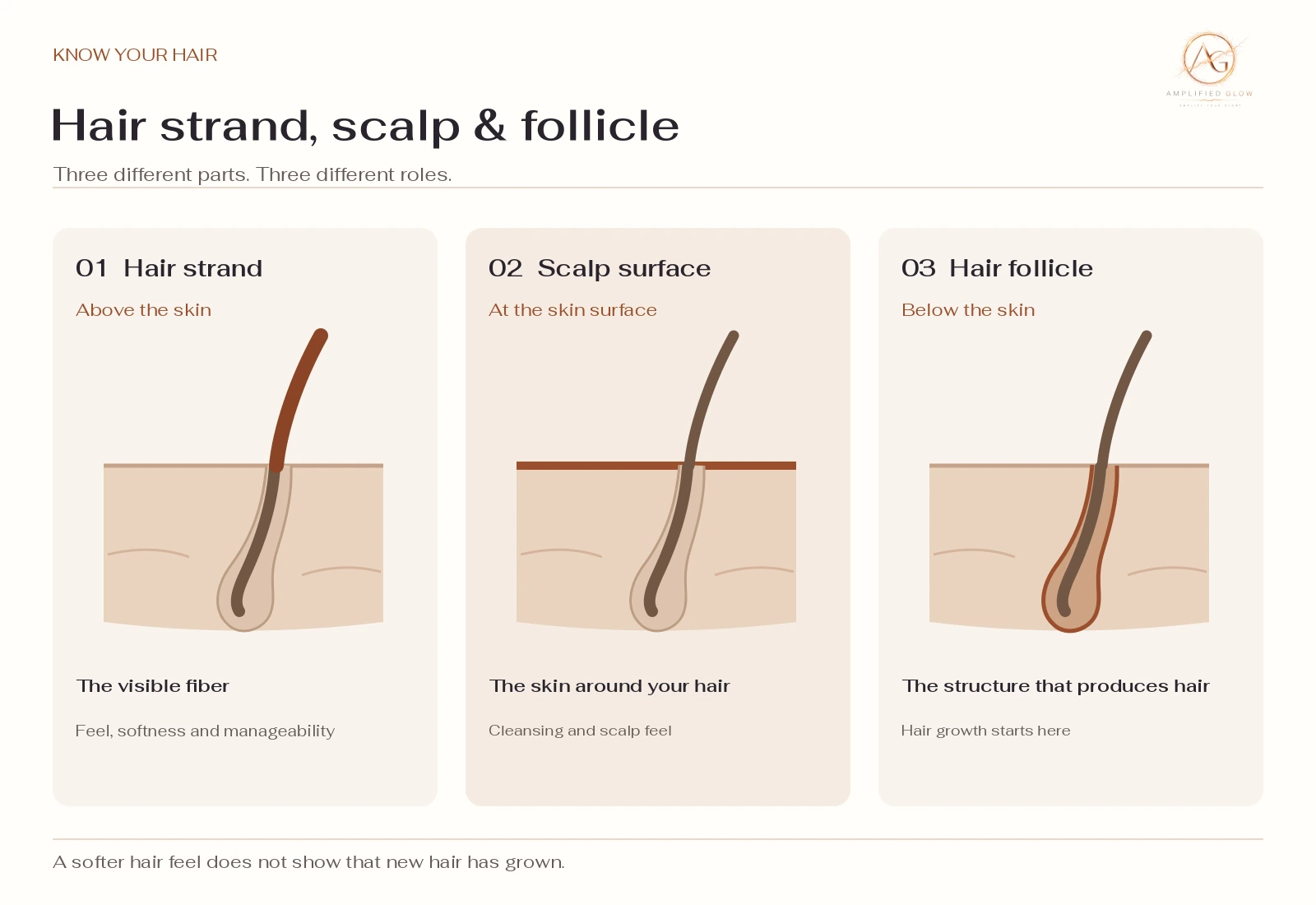
One of the most common sources of confusion in haircare marketing is treating the hair shaft, the scalp, and the hair follicle as if they were interchangeable. They're not, and the distinction matters for understanding what a shampoo or conditioner can reasonably claim.
| Area | What it is | What you may notice | What it cannot show |
|---|---|---|---|
| Hair shaft | The visible, non-living fiber that grows out of the scalp | Softer, smoother, shinier, more manageable hair | That living hair has been "regenerated" or repaired |
| Scalp surface | The skin being cleansed and conditioned | A cleaner scalp, or a less dry or tight scalp feel | That a scalp condition has been treated |
| Hair follicle | A structure beneath the skin's surface that produces hair | Very little on its own — follicle activity isn't something you can feel from washing | That hair has regrown or that alopecia has been treated |
A rinse-off shampoo or conditioner primarily interacts with the hair shaft and the scalp surface during a short contact window. Claims about the follicle — a structure below the surface — require a different, much stronger kind of evidence than claims about how hair feels after washing. Keeping these three targets separate is a useful filter for evaluating any haircare claim.
Shampoo, conditioner, and leave-on formulas
| Format | Main purpose | Contact pattern | Where it fits |
|---|---|---|---|
| Shampoo | Cleanse scalp and hair | Rinse-off, brief contact | First step after wetting hair |
| Conditioner | Improve feel and manageability | Rinse-off, typically after a short dwell time | Mid-lengths and ends, or as the label directs |
| Leave-on scalp product | Stays on the scalp | Leave-on | Only as its own specific label directs |
These formats aren't interchangeable, and one isn't inherently "stronger" than another — a leave-on product has more contact time by design, but that doesn't automatically make it more effective. A copper peptide shampoo isn't a substitute for a leave-on scalp serum, and the reverse is also true — don't apply a facial serum to the scalp just because it lists a similar peptide. For the full wash-day sequence, see the copper peptide haircare routine guide; this article focuses on the evidence question, not step-by-step directions.
How to choose a cosmetic haircare formula
A few things matter more than the headline peptide name:
- The exact peptide named, ideally by INCI name (Copper Tripeptide-1 for GHK-Cu), rather than assuming every "copper peptide" product is identical.
- The complete ingredient list on the specific product you're considering. Surfactants determine how a shampoo actually cleanses; conditioning agents and humectants shape how hair feels afterward. The featured peptide is rarely the only ingredient doing the work.
- Whether you need a shampoo, a conditioner, or both, and that specific product's current label directions.
- Fragrance preference and any known sensitivities.
- Responsible, appearance-focused claims — cleansing, softness, manageability, a refreshed scalp — rather than "cures baldness," "restores follicles," or a guaranteed hair-growth promise.
For amounts, frequency, and dwell time, see the copper peptide haircare routine guide rather than a generic rule here.
Amplified Glow haircare options
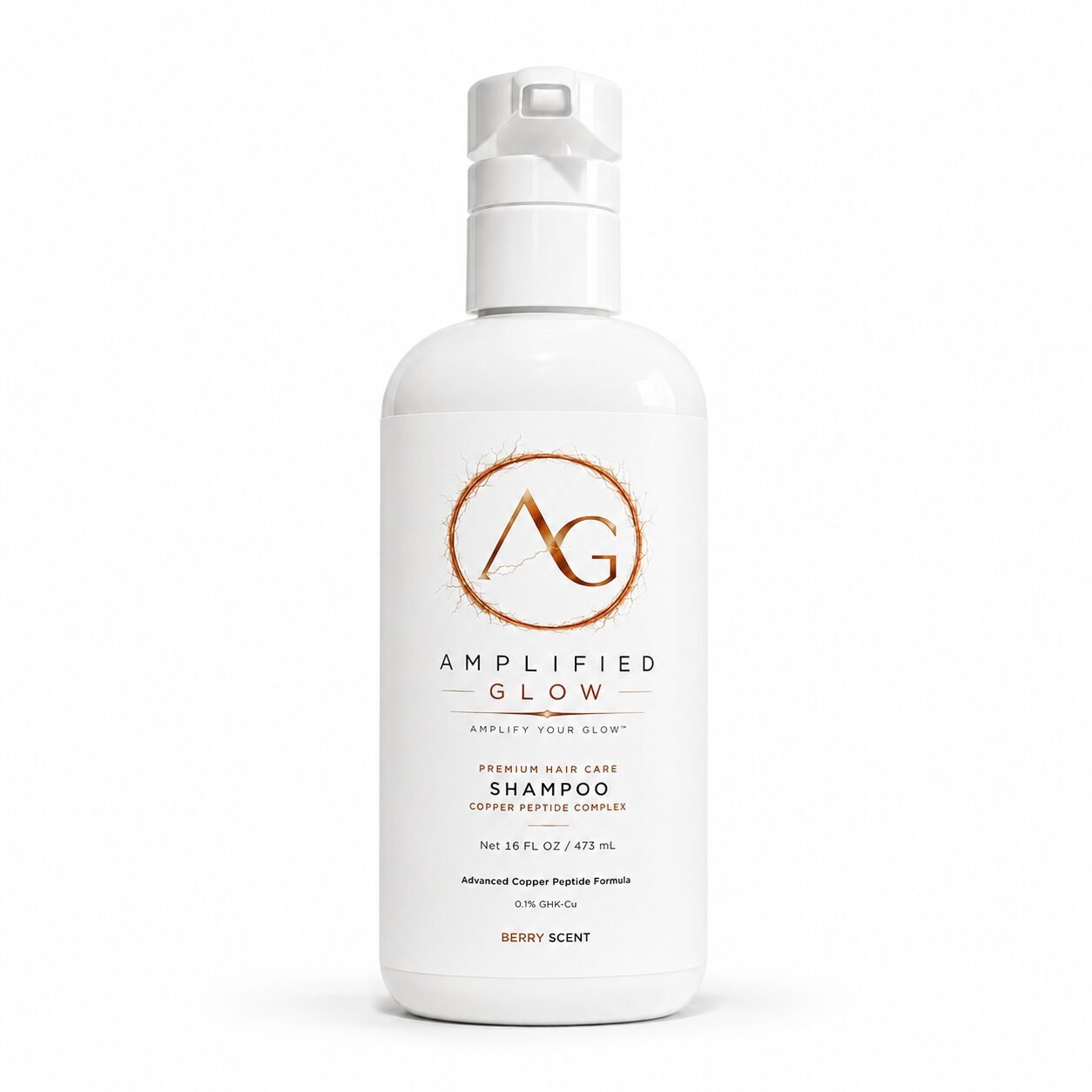
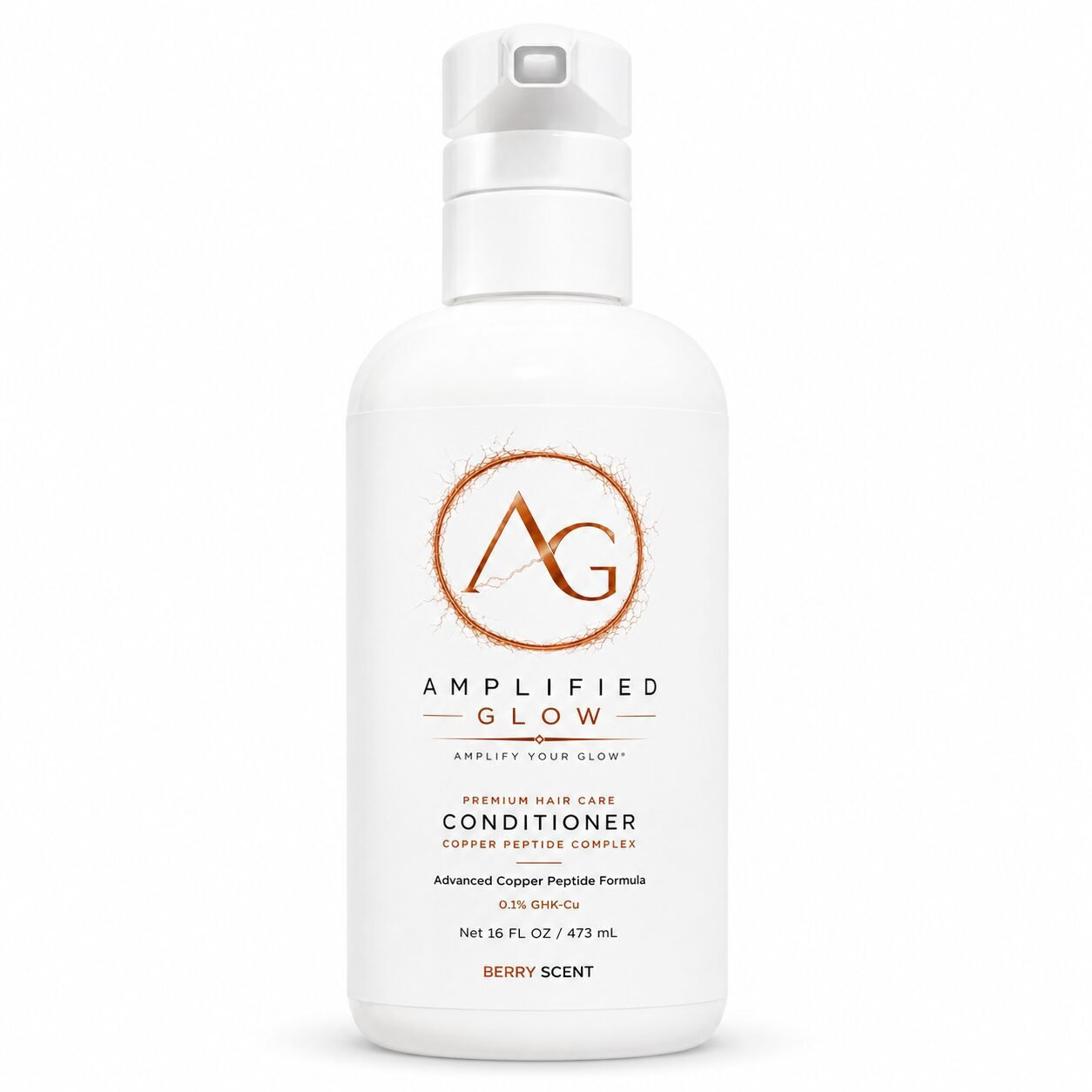
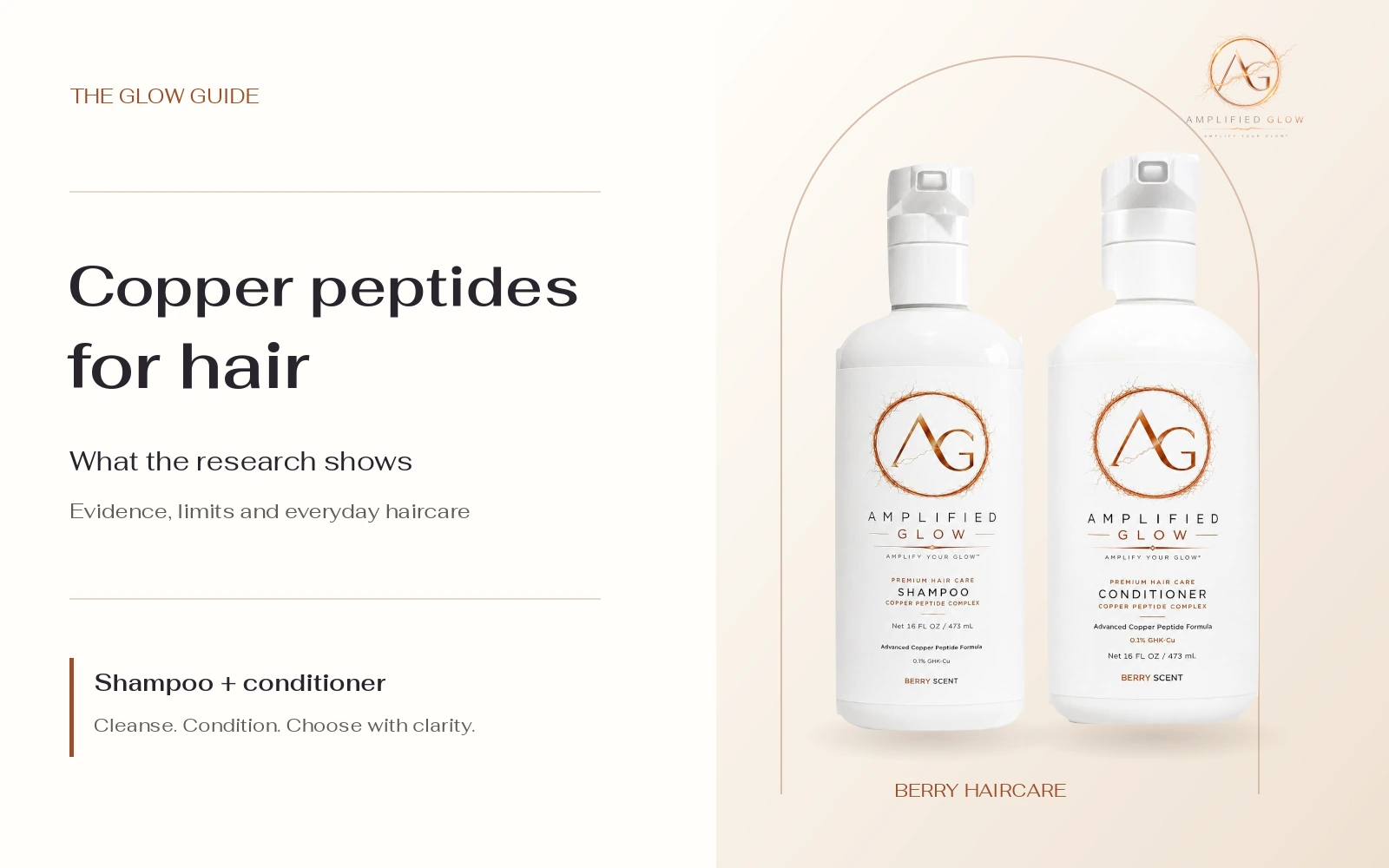
Amplified Glow's copper peptide haircare comes in Berry and Lavender shampoo and conditioner formulas, each listing GHK-Cu (Copper Tripeptide-1) as a featured ingredient. The copper peptide shampoo is the rinse-off cleansing step; the copper peptide conditioner is the conditioning step that follows. Neither is formulated or positioned as a hair-loss treatment — they're cosmetic products for cleansing, conditioning, and how hair looks and feels day to day.
Compare the Berry and Lavender shampoo and conditioner options, then check the full ingredient list and directions on each individual product page — the two scent families aren't guaranteed to share every supporting ingredient.
Explore Amplified Glow haircare and compare the shampoo and conditioner directions with your current routine.
When hair-loss concerns need professional advice
If you notice sudden, patchy, or rapidly progressing hair loss, or symptoms like scalp burning, itching, or tenderness, that's a conversation for a dermatologist or another licensed clinician rather than something to address through cosmetic shampoo and conditioner alone. The American Academy of Dermatology explains how professional assessment can help identify the cause of hair loss. This guide is educational, not a diagnosis or a substitute for clinical evaluation.
Related guides
- Copper peptide haircare routine — the practical wash-day sequence.
- Copper peptides in skincare — the ingredient and evidence picture on skin.
- What GHK-Cu is — a closer look at the core molecule.
Questions about copper peptides and hair
Are copper peptides proven to regrow hair in people?
Not based on the studies reviewed here. The laboratory research most directly relevant tested AHK-Cu — a different complex from GHK-Cu — on isolated follicles outside the body, not people using a shampoo. A separate human study tested a different, copper-free combination product, not a copper-peptide shampoo. If you're concerned about hair loss, a dermatologist can help identify the cause and appropriate options.
Is AHK-Cu the same as GHK-Cu?
No. Both are copper-peptide complexes, but they're chemically distinct, and research on one shouldn't be assumed to apply to the other. Product labels and marketing should specify which complex is actually used.
Is a copper peptide shampoo the same as a scalp serum?
No. Shampoo and conditioner are rinse-off products with brief contact time. A leave-on scalp serum has a different format and directions, and results from one shouldn't be assumed to apply to the other.
Can improved hair feel or less breakage show that new hair grew?
No. Softer feel, less breakage, and easier detangling are effects on the existing hair shaft — they don't indicate anything about new hair growing from the follicle, which is a separate, much harder claim to support.
Can I use a copper peptide shampoo alongside my usual routine?
Generally, yes, based on the product's current directions and your own tolerance — but that's a routine-fit question, not a hair-loss treatment plan. Introduce any new product gradually and follow its label.
Can copper peptide shampoo be used every day?
It depends on the formula and your hair and scalp. Many shampoos are suitable for regular use, but frequency is better guided by your scalp's oiliness, styling habits, and the product's own directions than by a fixed rule.
Should copper peptide conditioner go on the scalp?
Most conditioners are designed primarily for mid-lengths and ends, though directions vary by product. Check the specific product's label rather than assuming one universal application method.
Is copper peptide shampoo suitable for color-treated hair?
Amplified Glow's shampoo and conditioner product pages describe the formulas as suitable for color-treated hair, along with straight, wavy, curly, coily, dry, and normal hair types. That's a suitability description, not a "color-safe" performance claim — if color retention is a priority, check the manufacturer's specific guidance.
Can it be used with another brand's shampoo or conditioner?
Choose each product according to its directions and your hair and scalp preferences. Products don't have to come from the same brand. Using a matching pair is an option, not a requirement or proof of better results.
Conclusion
Copper peptides are a real, researched ingredient family, but the studies reviewed here don't establish that a rinse-off shampoo regrows hair. The laboratory study tested a different complex on isolated follicles, and the human study tested a different, copper-free combination product under clinical conditions — not a copper-peptide shampoo. Amplified Glow's shampoo and conditioner are cosmetic products built for cleansing and conditioning, and that's the choice worth making them on.
References
- Pyo HK, Yoo HG, Won CH, Lee SH, Kang YJ, Eun HC, Cho KH, Kim KH. The Effect of Tripeptide-Copper Complex on Human Hair Growth In Vitro. Archives of Pharmacal Research. 2007;30(7):834–839. PubMed
- Lee WJ, Sim HB, Jang YH, Lee SJ, Kim DW, Yim SH. Efficacy of a Complex of 5-Aminolevulinic Acid and Glycyl-Histidyl-Lysine Peptide on Hair Growth. Annals of Dermatology. 2016;28(4):438–443. PubMed
- American Academy of Dermatology. Hair loss: symptoms and diagnosis and treatment.