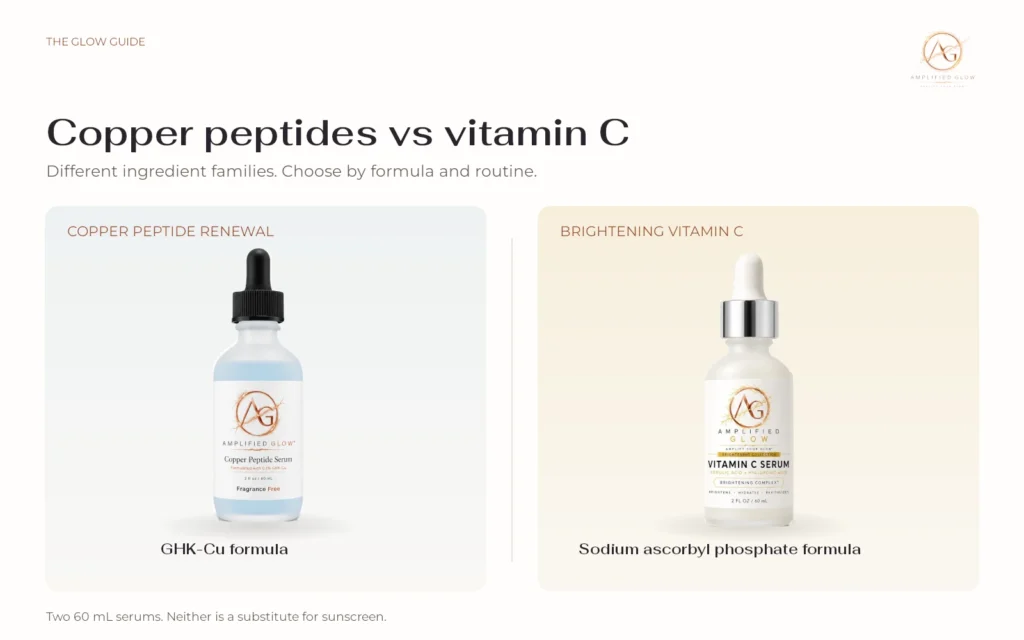
Copper peptides vs vitamin C is one of the most common skincare routine questions, and the honest answer is: neither one is universally "better." The right choice depends on your goal, the specific formula, and how your skin tolerates each ingredient. Both ingredients also show up in dozens of different formulas across the market, so two products carrying the same headline ingredient can still behave quite differently once you look at the complete formula.
Quick answer: Copper peptides and vitamin C are not direct substitutes. Copper peptide cosmetics are commonly chosen to support hydrated, smoother-looking skin, while vitamin C formulas are often chosen for antioxidant support and a brighter, more even-looking appearance. Some people use both, but the vitamin C form, the complete formulas, product instructions, and personal tolerance should guide the routine.
Copper peptides vs vitamin C at a glance
| Comparison point | Copper peptides | Vitamin C |
|---|---|---|
| Ingredient family | Peptide complex bound to copper | Antioxidant ingredient family with several forms |
| Common cosmetic goal | Hydrated, smoother-, refreshed-looking skin | Brighter, more even-looking tone and antioxidant support |
| Common label names | Copper Tripeptide-1 / GHK-Cu | L-ascorbic acid, sodium ascorbyl phosphate, and other derivatives |
| Routine timing | Formula-dependent; often convenient in the evening | Often convenient in the morning, followed by sunscreen |
| Can they be used together? | Potentially, depending on formulas and tolerance | Same qualification |
| Replaces sunscreen? | No | No |
The complete formula matters more than the headline ingredient. These examples describe cosmetic routine choices, not a head-to-head clinical trial of the finished products.
What copper peptides do in a skincare routine
Copper peptides, most often as GHK-Cu (labeled Copper Tripeptide-1), are typically included in a formula to support a hydrated feel, smoother-looking texture, and a softer appearance of fine lines. For the full picture — including what laboratory and human topical research does and doesn't show — see the complete guide to copper peptides in skincare. This article focuses on how copper peptides compare with vitamin C rather than repeating that evidence review in full.
Vitamin C is not one single formula
"Vitamin C" on a skincare label can mean several different things, and that distinction matters more than most comparison articles acknowledge.
L-ascorbic acid
L-ascorbic acid is one form of vitamin C used in topical skincare. The studies discussed below tested a specific combination of L-ascorbic acid, vitamin E and ferulic acid. Those results should not be treated as evidence for every product with vitamin C on its label.
Sodium ascorbyl phosphate and other derivatives
Other products use vitamin C derivatives, including sodium ascorbyl phosphate (SAP), magnesium ascorbyl phosphate or ascorbyl glucoside. These are distinct ingredients, not alternative names for L-ascorbic acid. Compare the finished formula and directions; the word "derivative" does not establish that a product is irritation-free or equally effective.
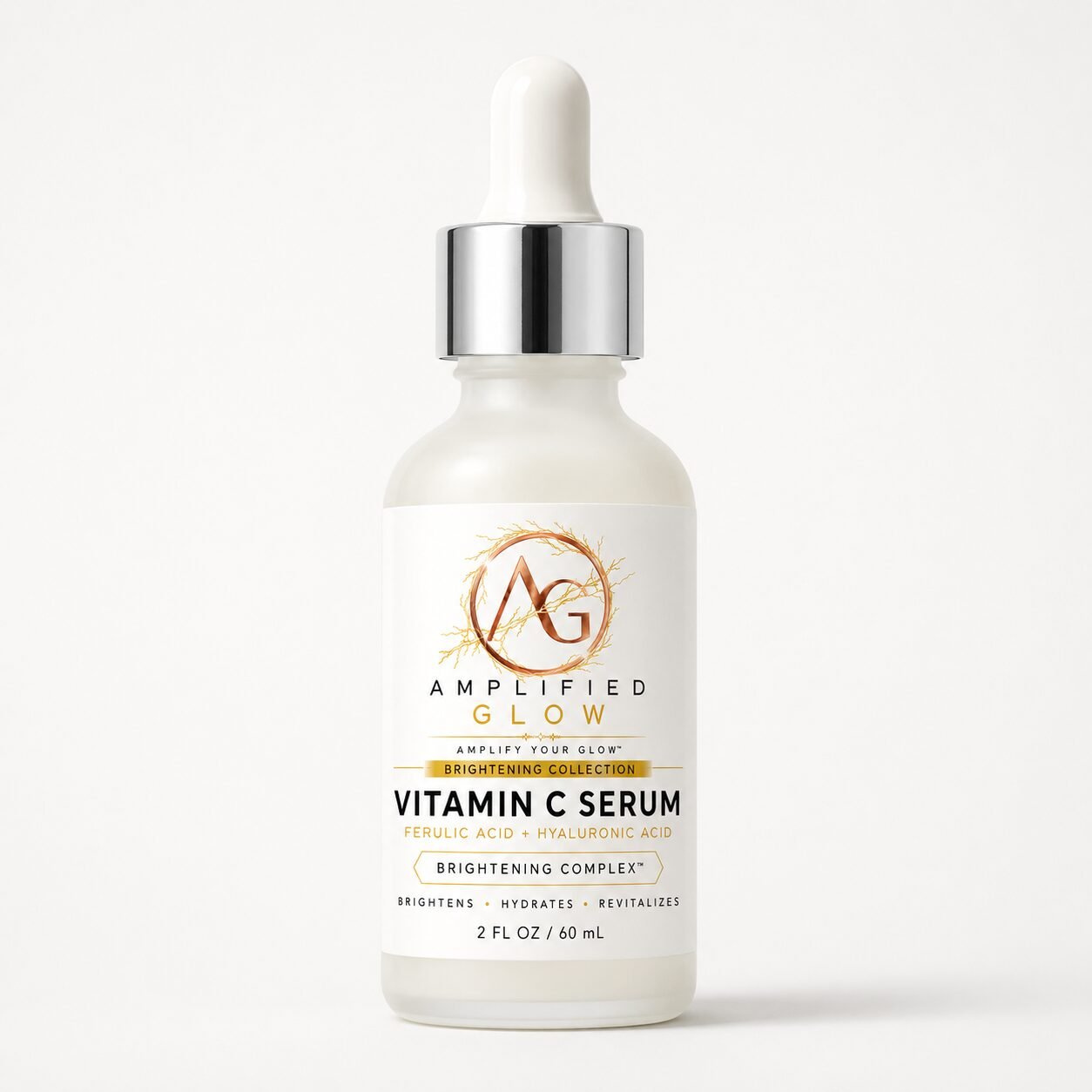
This distinction is directly relevant to Amplified Glow's own product: the Brightening Vitamin C Serum lists sodium ascorbyl phosphate, not L-ascorbic acid. That means the well-known studies of 15% L-ascorbic acid combined with vitamin E and ferulic acid cannot be used as direct proof of how this specific SAP-based formula performs — they describe a different ingredient in a different formulation.
How the evidence differs
| Research | Relevant takeaway | Correct limitation |
|---|---|---|
| Small topical copper tripeptide (GHK-Cu) study after laser resurfacing[1] | Human topical data exist for GHK-Cu | 13 participants; no significant objective improvement in erythema, wrinkles, or overall skin quality; higher patient satisfaction only; not the retail product |
| L-ascorbic acid + vitamin E + ferulic acid formulation studies[2] | A specific combination showed improved chemical stability and roughly doubled photoprotection under study conditions | Formula-specific to that exact combination; doesn't prove every vitamin C derivative or retail product performs identically |
| Human in vivo study of the same C+E+ferulic combination[3] | The specific stabilized formula measurably reduced UV-induced skin damage markers in human skin | Still describes L-ascorbic acid, not sodium ascorbyl phosphate; doesn't transfer directly to Amplified Glow's SAP-based serum |
The throughline across all three rows: exact wording, exact ingredient, and exact formula matter. A finding about "vitamin C" in general is really a finding about one specific form, concentration, and combination — not a blanket statement covering every vitamin C product on the market. These findings do not make a vitamin C serum a sunscreen or establish an SPF rating; use broad-spectrum sunscreen as a separate daytime step.
This is also why comparison articles that simply declare "vitamin C beats peptides" or the reverse tend to oversimplify. The vitamin C studies discussed here tested a particular L-ascorbic-acid combination. The copper-peptide study discussed here involved post-procedure care. Neither establishes which of these retail serums is better for an individual user.
Which ingredient fits which skincare goal?
Rather than naming a universal winner, it's more useful to match the ingredient to your main concern:
- Main concern: dull or uneven-looking tone → a well-formulated vitamin C product may be the more direct category fit.
- Main concern: hydration and smoother-looking texture → a hydrating copper peptide formula may fit better.
- Main concern: a simple, antioxidant-focused morning routine → vitamin C followed by moisturizer and sunscreen is a common structure.
- Main concern: a peptide-centered evening routine → a copper peptide serum followed by moisturizer is a common structure.
- Sensitive or reactive skin → introduce one product at a time, patch-test each, and don't assume a derivative or a peptide is automatically irritation-proof just because it's marketed as gentle.
Can copper peptides and vitamin C be used together?
Potentially — but a flat "yes, always compatible" or "no, never combine" statement is too simplistic either way.
A few things genuinely affect compatibility:
- "Vitamin C" can mean L-ascorbic acid or a derivative like sodium ascorbyl phosphate, and these behave differently in a formula (see above).
- Finished-formula pH, stability, and the manufacturer's own instructions matter more than general ingredient chemistry.
- Don't mix two separate serums together in your palm unless both manufacturers explicitly say to.
- A simple, conservative option is vitamin C in the morning and copper peptides in the evening — this sidesteps the compatibility question by using each product at a different time.
- Alternating days is another reasonable option, especially while you're monitoring tolerance to a new product.
- There's no need to prescribe an arbitrary 10-, 20-, or 30-minute wait between products; that specific figure isn't something this guide can substantiate.
You'll also see the online claim that vitamin C "destroys" copper peptides. That's an oversimplification — it isn't a settled, universal rule, and it isn't proven true for every formula pairing either. Splitting a routine by time of day is a practical, low-risk approach, not an admission that combining them is unsafe.
Three practical routines
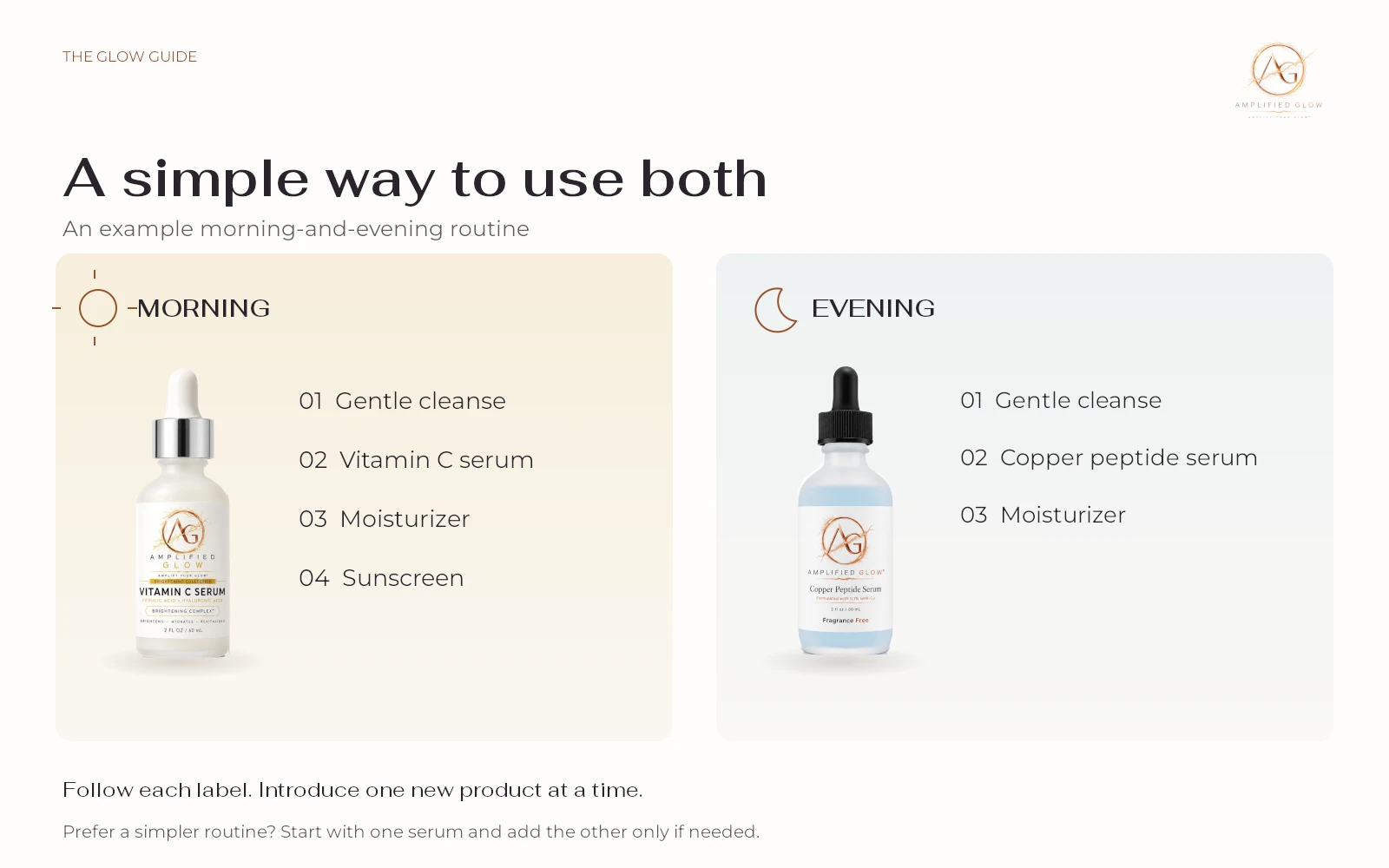
Routine A: Use both, split by time of day
AM: gentle cleanse → vitamin C serum → moisturizer → broad-spectrum sunscreen
PM: gentle cleanse → copper peptide serum → moisturizer
Routine B: Minimal copper peptide routine
AM: cleanse → moisturizer → broad-spectrum sunscreen
PM: cleanse → copper peptide serum → moisturizer
Routine C: Cautious introduction
- Introduce one product first and observe how your skin responds for a couple of weeks.
- Add the second product on alternate days, or at a different time of day, once the first feels well-tolerated.
- Reduce frequency, or stop, if irritation develops.
Whichever routine you start from, the product's own label directions take priority over any generic example here.
How the Amplified Glow formulas fit
Amplified Glow offers one vitamin C serum and several copper peptide formulas; the two most directly comparable are:
The Brightening Vitamin C Serum is a 2 fl oz / 60 mL formula listing sodium ascorbyl phosphate, ferulic acid, hyaluronic acid, vitamin E, coconut oil, jojoba oil, and riboflavin. Its directions place it in the morning: apply a few drops to clean skin, then follow with moisturizer and sunscreen.
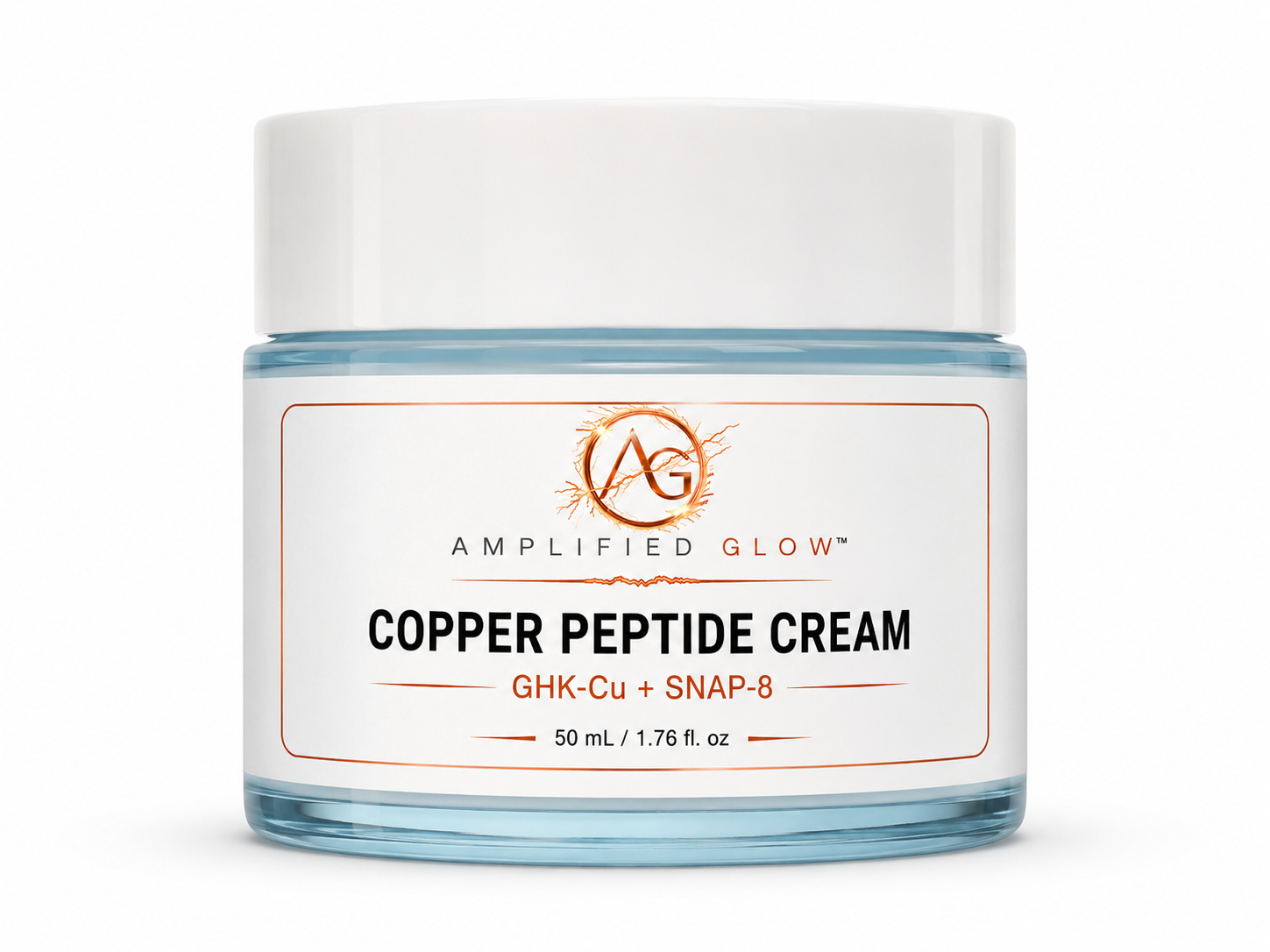
The Copper Peptide Renewal Serum is a fragrance-free 2 fl oz / 60 mL formula listing 0.1% GHK-Cu, dual hyaluronic acid, Palmitoyl Tripeptide-1, and botanical extracts. Its own directions call for applying a small amount to clean face and neck twice daily. For a simple combined routine, this guide positions it as the evening peptide step — not because combining the two is universally forbidden, but because splitting the products by time of day makes a new routine easier to follow and evaluate.
Check both product pages for the latest formula and directions. The cited L-ascorbic-acid studies did not test Amplified Glow's sodium-ascorbyl-phosphate serum.
Common myths and corrections
Myth: One ingredient is always better.
Correction: They serve overlapping but different cosmetic goals — brightening and antioxidant support versus hydration and texture.
Myth: All forms of vitamin C are chemically identical in skincare.
Correction: L-ascorbic acid, sodium ascorbyl phosphate, and other derivatives have different formulas, stability profiles, and bodies of research behind them.
Myth: Vitamin C always destroys copper peptides.
Correction: Compatibility depends on the specific forms and complete formulations involved. Splitting a routine by time of day is a practical, sensible option — not proof that combining them is universally unsafe.
Myth: Either ingredient replaces sunscreen.
Correction: Neither does. Broad-spectrum sunscreen remains a separate, necessary daytime step.
Myth: More products produce faster results.
Correction: A consistent, tolerable routine is usually easier to evaluate than a routine with several new actives introduced at once.
Frequently asked questions
Which is better for dull-looking skin?
A well-formulated vitamin C product is generally the more direct category fit for dullness and uneven-looking tone, since brightening and antioxidant support are its primary cosmetic roles.
Which is better for the appearance of fine lines?
The cited studies do not establish a head-to-head winner for these finished products. Choose by your routine needs and the complete formula rather than expecting a dramatic or guaranteed reduction in lines.
Can copper peptides and vitamin C be used on the same day?
Yes, this is common — for example, vitamin C in the morning and a copper peptide serum in the evening (see Routine A above).
Which product should be used in the morning?
Vitamin C is commonly used in the morning because it pairs naturally with a daytime antioxidant-and-sunscreen routine, but always defer to the specific product's own directions if they differ.
Does sodium ascorbyl phosphate behave like L-ascorbic acid?
No. SAP is a distinct vitamin C derivative. Research on a specific L-ascorbic-acid formula cannot establish how an SAP-based product performs.
How should beginners introduce both products?
Start with one product, monitor your skin for a couple of weeks, then introduce the second on alternating days or at a different time (see Routine C above). Patch-test each new product first.
Can either ingredient replace moisturizer?
A serum may not provide the moisturizing finish your skin needs. Follow the formula's directions and use a moisturizer where needed.
Can either ingredient replace sunscreen?
No. Broad-spectrum sunscreen is a separate, necessary step regardless of which serum or serums you use.
Conclusion
Copper peptides and vitamin C solve different problems: one leans toward hydration and texture, the other toward brightening and antioxidant support. Neither is a universal upgrade over the other, and — especially for vitamin C — the exact form and formula matter more than the ingredient name on the label. Start with the goal that matters most to you, introduce one new product at a time, and let the specific product's directions guide the details.
For the deeper evidence review behind copper peptides, see the complete guide to copper peptides in skincare. You can also browse the Brightening Vitamin C Serum and Copper Peptide Renewal Serum directly, or compare copper peptide and vitamin C serums side by side in the full collection.
References
- Miller TR, Wagner JD, Baack BR, Eisbach KJ. Effects of Topical Copper Tripeptide Complex on CO2 Laser–Resurfaced Skin. Archives of Facial Plastic Surgery. 2006;8(4):252–259. PubMed
- Lin FH, Lin JY, Gupta RD, Tournas JA, Burch JA, Selim MA, Monteiro-Riviere NA, Grichnik JM, Zielinski J, Pinnell SR. Ferulic Acid Stabilizes a Solution of Vitamins C and E and Doubles its Photoprotection of Skin. Journal of Investigative Dermatology. 2005;125(4):826–832. PubMed
- Murray JC, Burch JA, Streilein RD, Iannacchione MA, Hall RP, Pinnell SR. A Topical Antioxidant Solution Containing Vitamins C and E Stabilized by Ferulic Acid Provides Protection for Human Skin Against Damage Caused by Ultraviolet Irradiation. Journal of the American Academy of Dermatology. 2008;59(3):418–425. PubMed